Shanghai Residents Turn To Blockchain To Record Lockdown Memories
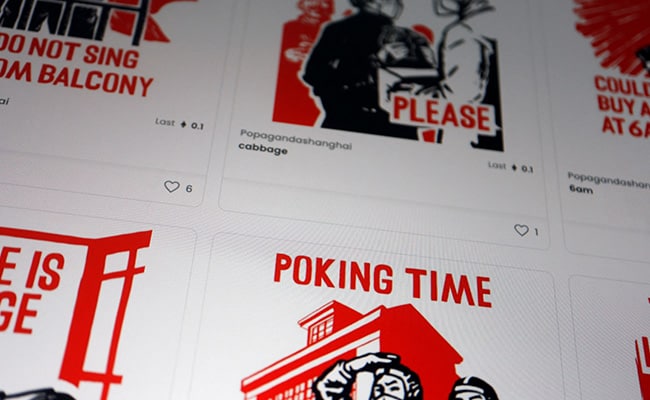
Shanghai residents are turning to the blockchain to preserve memories of the city's month-long COVID-19 lockdown, minting videos, photos and artworks capturing their ordeal as non-fungible tokens to ensure they can be shared and avoid deletion.
Unable to leave their homes for weeks at a time, many of the city's 25 million residents have been unleashing their frustrations online, venting about draconian lockdown curbs and difficulties procuring food, and sharing stories of hardship, such as patients unable to get medical treatment.
That has intensified the cat-and-mouse game with Chinese censors, which have vowed to step up policing of the internet and group chats to prevent what they describe as rumours and efforts to stoke discord over seething public frustration with the lockdown.
While some people have defiantly continued reposting such content, others are turning to NFT marketplaces like the world's largest, OpenSea, where users can mint content and buy or sell it using cryptocurrencies, attracted in part by the fact that data recorded on the blockchain is unerasable.
The height of Shanghai's lockdown minting moment is rooted in April 22, when netizens battled censors overnight to share a six-minute video entitled "The Voice of April", a montage of voices recorded over the course of the Shanghai outbreak.
As of Monday, 786 different items related to the video can be found on OpenSea, alongside hundreds of other NFTs related to the lockdown in Shanghai.
On April 23, a Chinese Twitter user with the handle imFong said in a widely retweeted post, "I have minted the 'Voice of April' video into an NFT and have frozen its metadata. This video will exist forever on the IPFS," referring to the interplanetary file system, a type of distributed network.
Like most major foreign social media and news platforms, Twitter is blocked in China, although residents can access it using VPNs.
A Shanghai-based programmer told Reuters that he was among those in the city who viewed their effort to keep the video alive as part of a "people's rebellion”.
He has himself minted an NFT based on a screenshot of Shanghai's COVID lockdown map, showing how most of the city has been sealed off from the outside world.
"Being stuck at home because of the outbreak leaves me a lot of time," he said, speaking on the condition of anoymity.
Other Shanghai content available on OpenSea as NFTs for sale includes Weibo posts containing complaints about the curbs, images from inside quarantine centres, and works of art inspired by life under lockdown.
Simon Fong, a 49-year-old freelance designer from Malaysia who has been living in Shanghai for nine years, began creating satirical illustrations on life under lockdown in the style of Mao-era propaganda posters.
He started minting them into NFTs, having dabbled in the market since late last year, and has now managed to sell nine of his works for an average price of 0.1 ether ($290)
His pieces include scenes dramatising PCR testing, as well as residents' demands for government rations.
"I chose the Mao-era propaganda style for these pieces because some people are saying that the lockdown situation is taking Shanghai backward," Mr Fong said.
While China has banned cryptocurrency trading, it sees the blockchain as a promising technology and NFTs have been gaining traction in the country, embraced by state media outlets and even tech companies including Ant Group and Tencent Holdings.
The protracted lockdown in Shanghai, China's financial hub, is party of Beijing's controversial zero-COVID strategy, a policy which has growing risks to its economy. The COVID outbreak in Shanghai, which began in March, has been China's worst since the early months of the pandemic in 2020. Hundreds of thousands have been infected in the city.
(Except for the headline, this story has not been edited by NDTV staff and is published from a syndicated feed.)

-
Signature Play: The Classic Cocktail Is Dead. Or Is It?

Classic cocktails are disappearing from India's cocktail menus. But they're still being ordered, taught to bartenders and borrowed from. So, who's really having the last drink?
-
A New Samvat Wishlist: Inclusive Prosperity And Human Development
India has strengthened its economic foundations through infrastructure, digital access and enterprise. Its next growth chapter must deepen productivity, create better livelihoods and widen participation in prosperity.
-
Love, Sex Aur Dhokha: The Audacious Plot To Spy On Jensen Huang
A Taipei dinner, a Singapore chip buyer and a suspected Chinese asset: inside the alleged spy operation that got close to NVIDIA's Jensen Huang.
-
Ten Things I Learnt This Samvat
Patience can be a trap. Cheap stocks can stay cheap. Leverage can wipe you out. What did Samvat 2082 teach us? Niraj Shah writes on 10 lessons from the year gone by.
-
Talking Points This Week: Tech Nerves, FII Buying, And A Faraway Banking Shock
The global markets are not shining this Diwali. The exception in the large markets is, India.
-
Midterm Rally Lasted A Day. The Hard Reality Of A Divided US May Last Two Years | Opinion
Between a contested AI boom, a debt ceiling that arrives in 2027 and a president with every incentive to act alone, the next two years may prove more volatile than the first day's rally suggests.
-
Blue Wave Will Derail the AI Trade but Won't Dismantle the AI Era | Unhedged Position
The Democrats' sweep of the US Congress will see politics collide with economic forces both over the long and short term.
-
It's Time To Take The GST Council's Bet On Trust Global
Payment records can prove India's services exports, and clear, proportionate rules can bring foreign digital sellers into the tax net.
-
Opinion | India at 38: From Innovation Overperformer to Innovation Powerhouse
India now has 453 VC-backed deep science startups, 18 of them late-stage, after 117 percent growth since 2020. Laurus Labs, at USD 9.3 billion, is the most valuable deep science company in any middle-income economy outside China.









