SEBI Asks Exchanges To Act Against 331 Suspected Shell Companies

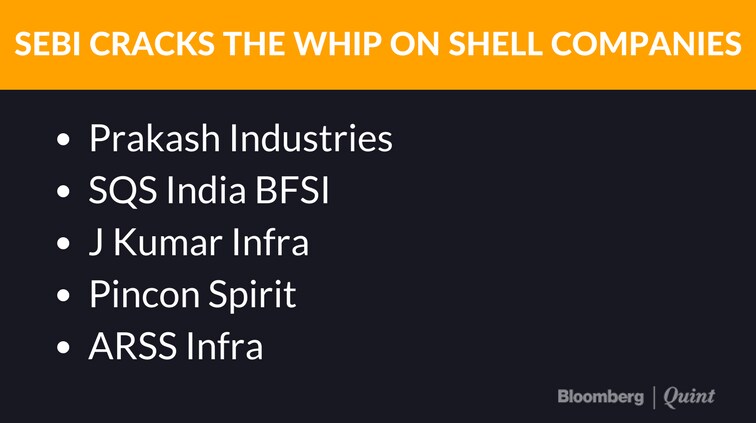
- SEBI on Monday directed exchanges to initiate action against 331 suspected shell companies
- The suspected entities could even face “compulsory delisting”
- These entities will be subject to independent audit; if required, forensic audits could also be initiated
SEBI on Monday directed exchanges to initiate action against 331 suspected shell companies that are listed and these shares will not be available for trading this month, according to a communication.
The regulator's directive came after the corporate affairs ministry shared a list of 331 listed companies that are suspected to be shell entities and could even face “compulsory delisting”.
Stepping up the surveillance measures, these entities would be subject to independent audit and if required, forensic audits could also be initiated to check their credentials.
In a communication sent to the BSE, the NSE and the Metropolitan Stock Exchange, the market regulator has asked them to keep the 331 shares in stage four of the Graded Surveillance Mechanism (GSM) with immediate effect. Securities coming in stage four are permitted to trade only once a month under trade-to-trade category.
Since these shares would be moved to stage four from Tuesday, these securities would not be available for trading this month.
“Trading in these securities shall be permitted once a month (first Monday of the month),” the communication said.
Further, any upward price movement would not be permitted beyond the last traded price while additional surveillance deposit of 200 percent of trade value would be collected from the buyers. This amount would be retained by the exchanges for five months.
Apart from initiating a “process of verifying the credentials/ fundamentals of such companies”, the exchanges have also been asked to appoint an independent auditor to carry out audit of these entities. If necessary, even forensic audit could be ordered to verify their credentials and fundamentals.
On verification, if the bourses do not find appropriate credentials or fundamentals about existence of these companies, they proceeding for “compulsory delisting” would be started.
Besides, these entities would not be permitted to deal in any security on exchange platform and its holding in any depository account would be frozen till such delisting process is completed.
The shares held by the promoters and directors in such listed companies shall be allowed to be transferred by depositories only upon verification by concerned exchanges.SEBI Notification
They would not be allowed to transact in the security except to buy shares in the particular listed company until verification of credential is completed.
Out of the list of shell companies, if securities of any of the listed company are under suspension, the trading in such securities shall be placed under stage four of the GSM directly on revocation of suspension, SEBI has told the exchanges.
As part of efforts to curb the black money menace, the corporate affairs ministry has already cancelled the registration of more than 1.62 lakh companies that have not been carrying out business activities for long.
The ministry is implementing the Companies Act and firms are required to be registered under this law.
While the term ‘shell company' is not defined under the Companies Act, Corporate Affairs Minister Arun Jaitley, last month, told the Lok Sabha that many such entities have been found to be indulging in large scale tax violations.
"However, the Registrars of Companies (RoCs) have removed 1,62,618 companies from the register ofcompanies as on July 12, 2017 after following the due process under Section 248 of the Companies Act, 2013," he had said.

-
Indians Stay With Family, Not In Hotels | The Reason Why

India still lacks enough clean, reliable and affordable hotels for budget-conscious travellers.
-
The Economic Imperative: Analysing The Material Driving Force Behind India-Canada Strategic Reset
This economic complementarity is further reinforced by deep institutional investment ties and talent mobility, which form the bedrock of the bilateral framework.
-
Medicine Pricing: Where Must Profit Stop?
India must confront excessive margins, hidden incentives and regulatory gaps that threaten the integrity of medicine.
-
Why Amazon And Flipkart Are Struggling To Beat Meesho In India's Smaller Cities
With 274 million users and lowest-cost logistics, Meesho is defending its value commerce crown against giants like Amazon and Flipkart.
-
High US Salaries, No Green Card Certainty: The Financial Calculation Facing Indian H-1B Families
The suspension of PERM processing at eight technology employers does not cancel existing H-1B visas. What it does is force a question many Indian families have been avoiding: is the US salary worth tying your career and family plans to one employer?
-
Swiggy vs Eternal: Food Delivery's Two Rivals Are No Longer In The Same Race
Eternal is building a private AI assistant, dark.ai. Swiggy is still working out how to make Instamart pay, with an operating loss of Rs 895 crore in the July-September quarter while Blinkit stayed profitable.
-
Where You Live Shapes How You Get To Work | The Reason Why
Two-wheelers are the most popular way to get to work in India, accounting for nearly 43% of workplace commutes.
-
Unhedged Position: Can India See An Indonesia-Style Time Correction?
The Nifty is trading below levels it first clocked in 2024. Is there, then, as I have suggested in the headline, potential that the current time correction drags on painfully for the next three-five, even ten years?
-
Navigating Friction And Energy Realities: An Analysis Of Marco Rubio's October Visit To India
Occurring at a critical juncture marked by stalled trade negotiations and escalating geopolitical pressures over global energy supplies, the visit offers a profound window into modern US-India relations.
-
India Exports Capital. Why Not Export Trusteeship?
The big question, then, is whether India can build an institution that global borrowers, investors, banks, and lawyers can trust, even without an Indian connection.










