Saving Joshimath And How To Build Climate-Conscious Towns In Himalayan Regions
Between 2016 and 2017, I was involved in a study across the four countries of the Hindu-Kush Himalayan region covering Pakistan, Nepal, India, and Bangladesh. Together with the research team, we studied small towns across four out of eight countries that form the HKH region.
We understood that the topography, climate, hydrology, and hydrogeology of the HKH region are complex. Additionally, these physical characteristics prevent fast urbanisation. Only 3% of the HKH residents reside in big cities, whereas 8% do so in smaller ones as of 2020. However, as people from rural areas migrate to nearby metropolitan centres, in quest of employment and other economic possibilities, urbanisation has risen in the Himalayas in recent years.
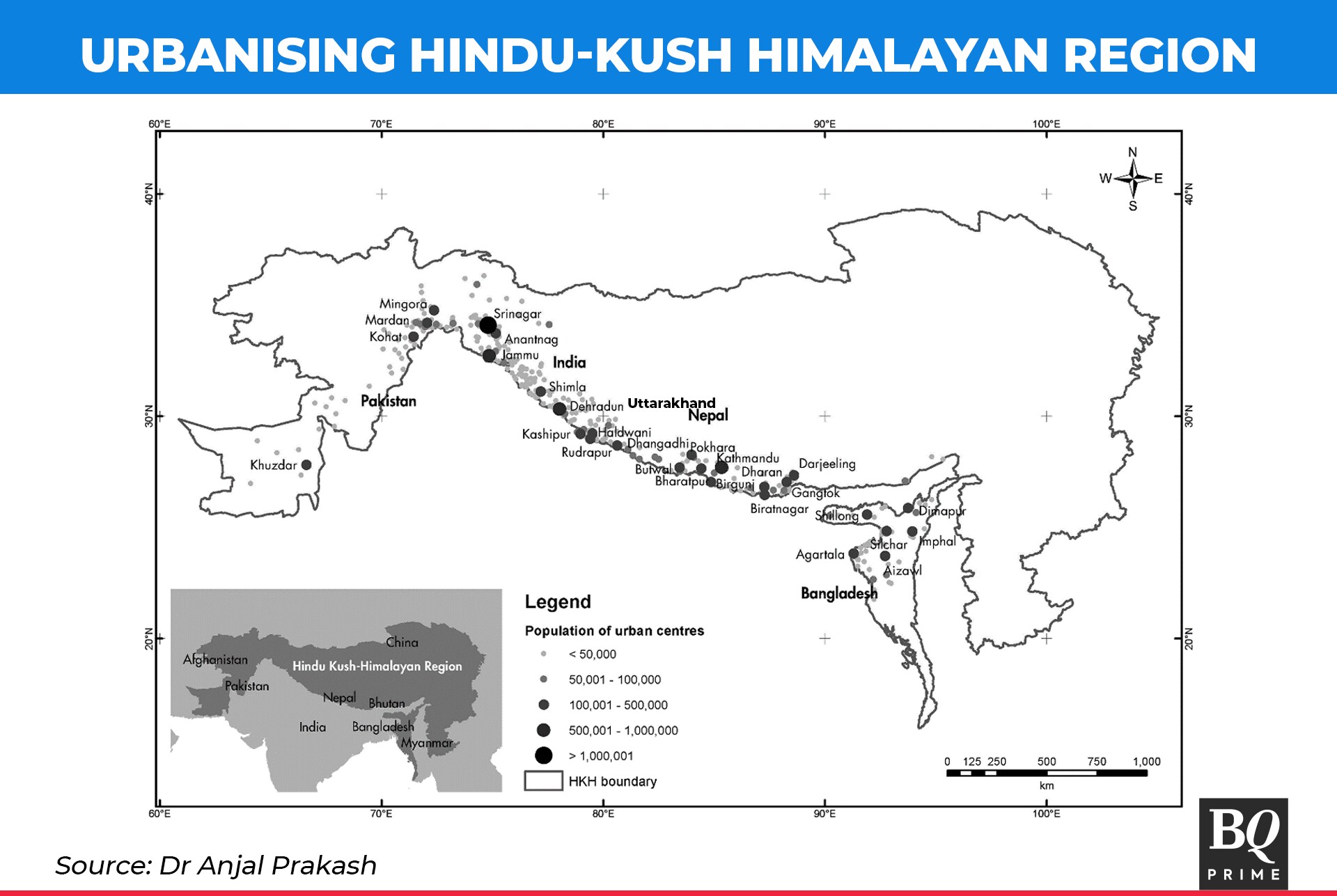
As a result, the region's percentage of the urban population is rising while the rural population is decreasing. According to projections, more than 50% of the population in HKH countries will reside in towns and cities by 2050 (see the map of urbanising HKH region).
We understood three central learning from the study, each of which has implications for Joshimath's situation.
First, the urban Himalayas were running dry. This was a paradox as the region is rich in water resources. We found that there was growing water scarcity in Himalayan towns. Rapid urbanisation has fueled the water demand (both daily and seasonal) and created water insecurity for its people. Poor water administration, urban planning, ineffective peak-season tourism management, and risks and difficulties associated with climate change are all blamed for water insecurity.
Communities are coping by using short-term measures that are proven to be unsustainable, such as groundwater extraction. Urban centres need long-term water sustainability plans; therefore, planners and municipal governments must pay particular attention to this issue.
Second, urban areas are experiencing a shortage of water, which is causing a surge in the privatisation of water supply, primarily through water tankers. These private tankers are meeting demand by obtaining water from surrounding rural areas and selling it to the residents. This industry is mainly unregulated. Since this growth is anticipated to be more assertive in developing countries, small towns will grow and the problems will loom large. Apart from the local residents, these towns are inhabited by a floating population, especially during peak tourist seasons.
The case studies demonstrated that urban water resilience issues are poorly recognised and that water governance in the HKH region continues to be a blind spot. Himalayan towns rely on springs as their main source of water supply. Various nearby aquifers nourish these springs. The base flows in the rivers of the Himalayas are also greatly influenced by the springs. There are more than a million perennial springs in only the Indian Himalayan region, even by rough, conservative estimations.
The urban waste and sewage pollution of the water bodies and catchments poses a serious threat to these springs. Apart from this, rampant infrastructure developments such as hydropower projects are creating havoc on the local environment, destroying the environmental base on which they are situated.
Climate Change And Water Scarcity
The third issue is about climate risks, since landslides and floods are becoming more frequent. Climatic concerns must be considered when developing cities.
In a study of the Indian Himalayan towns of Leh and Dharamshala, it was discovered that there are direct connections between water scarcity and climate change. These communities get their water from glacier melt. The hydrology of water bodies and the local climate characteristics, such as snowfall, rainfall, temperature, and water availability, have changed in the communities. Due to the imbalance created by these changes, the water supply is already under pressure due to climate changes.
The author observes that while the overall need for adaptive measures is present, the reaction to this is mostly supply-driven.
Joshimath—A Reminder Of Dangers Ahead
Looking at these recommendations of the larger study and personal experience of working in the HKH region, I can comfortably say that Joshimath situation is about how the towns can be disturbed if large infrastructure projects such as hydropower projects come up in the vicinity.
Joshimath is a grave reminder that we are messing up with our environment to an irreversible extent. Climate change is becoming a reality.
There are two aspects to the Joshimath problem: first is rampant infrastructure development, which is happening in a very fragile ecosystem like the Himalayas, and this is happening without much of a planning process, in a way where we can protect the environment and at the same time bringing in basic infrastructure for the millions of people who are inhabitation in those areas.
Secondly, climate change is a force multiplier. Many risks in climate change hotspot regions like the Himalayas have been pointed out by several IPCC reports recently. We are at a particular point in history, which should be remembered as what could be done and should be done in the Himalayan region.
I hope we survive this crisis but also learn from this and avoid repeating the same mistakes for the other parts of the Himalayan region.
Dr Anjal Prakash is the Research Director at the Bharti Institute of Public Policy at ISB. He contributes to the IPCC reports and has led research on glaciated rivers in Hindu-Kush Himalayan Region in the past.
The views expressed here are those of the author, and do not necessarily represent the views of BQ Prime or its editorial team.

-
Getting To Work Costs Women More | The Reason Why

It is not just about women paying more than men. It is about women paying much more in cities than in villages.
-
AI Bias In Investing Cannot Be Eliminated, But It Can Be Governed
Framing is a particularly important example as identical financial information presented in terms of gains rather than losses can lead an LLM to reach a different assessment.
-
Joining The Dots | Dark Skies, Steady Diya: Why Hope Holds This Diwali
With war, a weak rupee and foreign outflows weighing on sentiment, policymakers at the NDTV World Summit and market veterans at NDTV Profit Ignite: Diwali Edition offered the same advice: stay invested and filter out the noise.
-
The Curious Case of Equitas Small Finance Bank And A CEO Who Quit For Stock
PN Vasudevan believes persistent investor concerns over a perceived conflict of interest had become a governance overhang on Equitas Small Finance Bank's stock, even as the lender improved profitability and asset quality.
-
Talking Points This Week: AI Cash Burn, A Tiger Comeback And An India That Still Finds Its Own Path
India is not immune to higher oil or tighter global liquidity, yet its earnings base is broader, its domestic policy levers are still available.
-
Foreign Investors Own Half Of HDFC Bank and ICICI Bank. An LTCG Cut Could Matter Most Here
Foreign portfolio investors have US$115 billion parked in HDFC Bank, ICICI Bank. If the government cuts long-term capital gains tax, Jefferies says returning foreign money could land here first.
-
'Never Seen This Level Of Negativity': Sandeep Tandon Says The Next Rally May Be Closer Than You Think
Veteran investor Sandeep Tandon says foreign selling is easing, large-caps are due a comeback and mid-caps are crowded, while he turns positive on gold, power and pharma this Diwali.
-
Indians Stay With Family, Not In Hotels | The Reason Why
India still lacks enough clean, reliable and affordable hotels for budget-conscious travellers.
-
The Economic Imperative: Analysing The Material Driving Force Behind India-Canada Strategic Reset
This economic complementarity is further reinforced by deep institutional investment ties and talent mobility, which form the bedrock of the bilateral framework.
-
Medicine Pricing: Where Must Profit Stop?
India must confront excessive margins, hidden incentives and regulatory gaps that threaten the integrity of medicine.










