Saudi Arabia Says Will 'Do Whatever It Takes' To Balance Oil Market
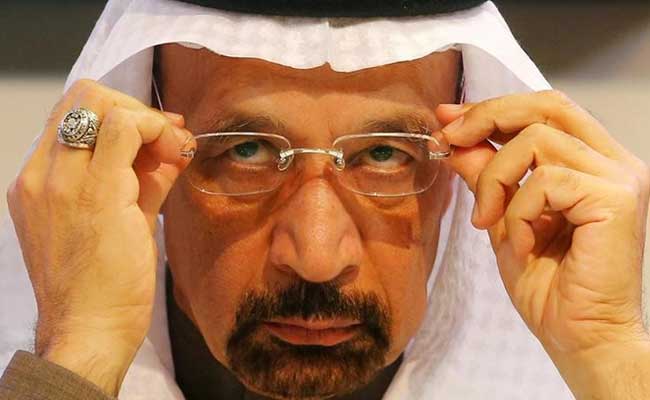
Kuala Lumpur: Saudi Energy Minister Khalid al-Falih said on Monday that oil producers would "do whatever it takes" to rebalance the market and that he expected a global deal on cutting crude output to be extended through all of 2017.
The Organization of the Petroleum Exporting Countries, of which Saudi Arabia is the de-facto leader, and other producers including Russia pledged to cut output by 1.8 million barrels per day (bpd) in the first half of the year to boost the market.
But global inventories remain high, pulling crude oil prices back below $50 per barrel and putting pressure on OPEC to extend the cuts to the rest of the year.
"Based on consultations that I've had with participating members, I am confident the agreement will be extended into the second half of the year and possibly beyond," Falih said at an industry event in Kuala Lumpur.
"The producer coalition is determined to do whatever it takes to achieve our target of bringing stock levels back to the five-year average," he said.
Falih said recent price falls had been caused by seasonal low demand and refinery maintenance, as well as by non-OPEC production growth, especially in the United States.
U.S. oil production has gained more than 10 percent since mid-2016 to 9.3 million bpd, close to the levels of top producers Russia and Saudi Arabia.
Despite this, Falih said markets had improved from last year's lows, when crude prices fell below $30 per barrel.
"I believe the worst is now behind us with multiple leading indicators showing that supply-demand balances are in deficit and the market is moving towards rebalancing," he said.
"We should expect healthier markets going forward."
He said he expected global oil demand to grow at a rate close to last year. In China, oil demand growth should match last year's due to a robust transport sector, while India should record healthy growth, he said.
The chairman of energy consultancy FGE Fereidun Fesharaki said: "They (OPEC) are looking at (extending) for nine to 12 months. Six months is not enough as we'll still be well above five years average of stocks."
ASIA DRIVES LONG-TERM GROWTH
Almost all expected oil demand growth over the next 25 years is likely to originate from Asia as the region's population grows, with countries such as Vietnam and the Philippines rising to become included in the top 20 global economies, Falih said.
Asia will also account for nearly two-thirds of global gas demand by that time, he said.
Global investments in exploration and production have also fallen behind, potentially creating a big supply-demand gap in the next few years, he said.
"Conservative estimates predict that we will need to offset 20 million barrels per day in combined demand growth and natural decline over the next five years," Falih said.
"That is why I fear ... we are heading into a future of supply-demand imbalances."
To help meet this demand, state oil company Saudi Aramco will invest $7 billion in a refinery-petrochemical project with Malaysia's Petronas.
Also, Saudi Aramco's project with Indonesia's Pertamina to expand the Cilacap refinery will enter front-end engineering design in the second half of this year, Falih said.
Falih shrugged off talk that the rise of alternative energy could reduce fossil fuel consumption, saying renewables still face hurdles such as affordability.
(Except for the headline, this story has not been edited by NDTV staff and is published from a syndicated feed.)

-
Indians Are Travelling, But Not Every Journey Is A Holiday | The Week In Whys

Pilgrims, patients and working women are the real travellers, and the system hasn't quite caught up with them.
-
Getting To Work Costs Women More | The Reason Why
It is not just about women paying more than men. It is about women paying much more in cities than in villages.
-
AI Bias In Investing Cannot Be Eliminated, But It Can Be Governed
Framing is a particularly important example as identical financial information presented in terms of gains rather than losses can lead an LLM to reach a different assessment.
-
Joining The Dots | Dark Skies, Steady Diya: Why Hope Holds This Diwali
With war, a weak rupee and foreign outflows weighing on sentiment, policymakers at the NDTV World Summit and market veterans at NDTV Profit Ignite: Diwali Edition offered the same advice: stay invested and filter out the noise.
-
The Curious Case of Equitas Small Finance Bank And A CEO Who Quit For Stock
PN Vasudevan believes persistent investor concerns over a perceived conflict of interest had become a governance overhang on Equitas Small Finance Bank's stock, even as the lender improved profitability and asset quality.
-
Talking Points This Week: AI Cash Burn, A Tiger Comeback And An India That Still Finds Its Own Path
India is not immune to higher oil or tighter global liquidity, yet its earnings base is broader, its domestic policy levers are still available.
-
Foreign Investors Own Half Of HDFC Bank and ICICI Bank. An LTCG Cut Could Matter Most Here
Foreign portfolio investors have US$115 billion parked in HDFC Bank, ICICI Bank. If the government cuts long-term capital gains tax, Jefferies says returning foreign money could land here first.
-
'Never Seen This Level Of Negativity': Sandeep Tandon Says The Next Rally May Be Closer Than You Think
Veteran investor Sandeep Tandon says foreign selling is easing, large-caps are due a comeback and mid-caps are crowded, while he turns positive on gold, power and pharma this Diwali.
-
Indians Stay With Family, Not In Hotels | The Reason Why
India still lacks enough clean, reliable and affordable hotels for budget-conscious travellers.
-
The Economic Imperative: Analysing The Material Driving Force Behind India-Canada Strategic Reset
This economic complementarity is further reinforced by deep institutional investment ties and talent mobility, which form the bedrock of the bilateral framework.










