Samsung To Get Up To $6.4 Billion In US Grants For Chip Plants
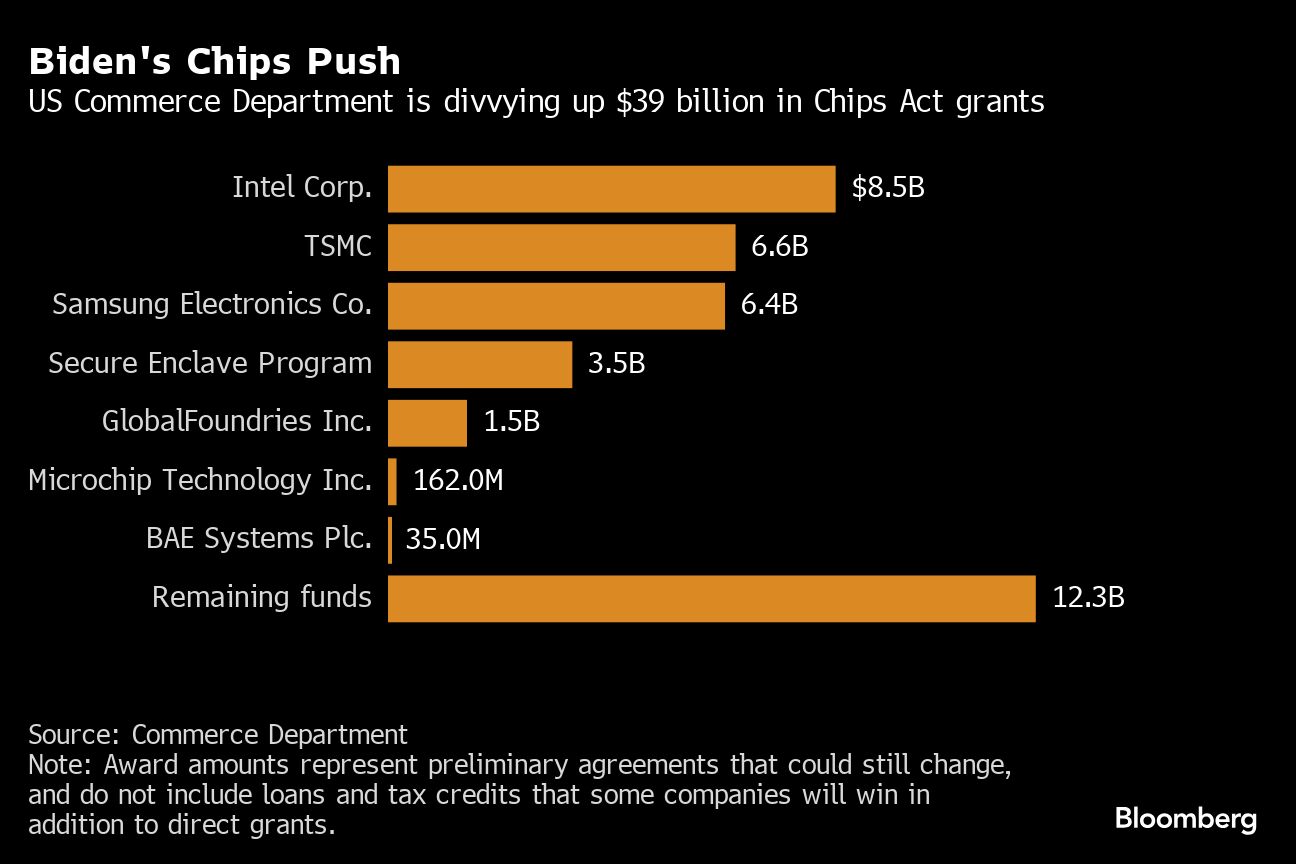
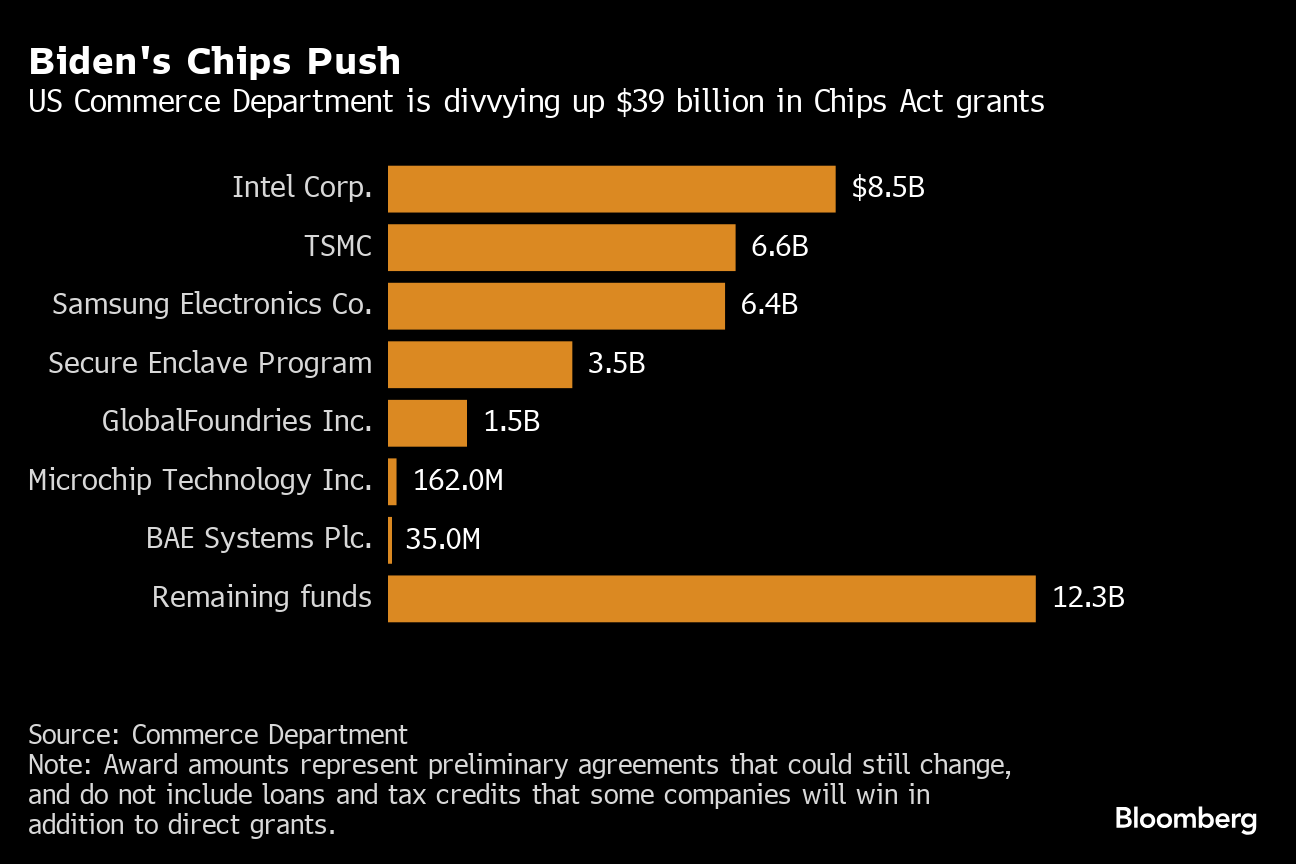
(Bloomberg) -- The Biden administration plans to award Samsung Electronics Co. as much as $6.4 billion in grants to increase chip production in Texas, as part of US efforts to bolster domestic semiconductor manufacturing.
The South Korean company plans to invest more than $40 billion overall, including in two foundry fabrication sites that will produce 4-nanometer and 2nm logic chips — one generation beyond the current state of the art. The massive project will encompass a research and development site, and an advanced chip packaging facility in Taylor, Texas, that will help produce high bandwidth memory chips, which are critical for artificial intelligence applications.
The award will also be used to expand Samsung's existing chipmaking facility in Austin, Texas, which will support US aerospace, defense and automotive industries, the Commerce Department said in a statement. The city of Taylor is just outside Austin.
It's the latest in a series of multibillion-dollar awards by the Biden administration, which is using the 2022 Chips and Science Act to revitalize American chipmaking after decades of production shifting to Asia. Another goal is to counter the technological rise of China, which is building up its own semiconductor industry.
Samsung opted not to tap loans or loan guarantees under the Chips Act, unlike Intel Corp. and Taiwan Semiconductor Manufacturing Co., both of which are also set to receive multibillion dollar grants. Samsung's project is expected to benefit from an investment tax credit, which US officials said is likely to cover as much as 25% of qualified capital expenditures.
The Samsung award is part of President Joe Biden's plans “to bring the manufacture of leading-edge semiconductors back to the United States,” Commerce Secretary Gina Raimondo told reporters.
The Taylor project adds to a robust semiconductor ecosystem in Texas, including tens of billions of dollars of additional investment from Texas Instruments Inc. in its home state and Samsung's existing factory in Austin.
One of the fabs in Taylor is expected to start production in 2026 and the other will begin in 2027, according to a senior administration official. The company originally said the Taylor plant would begin production in the second half of 2024.
The investment is expected to create at least 17,000 construction jobs and more than 4,500 manufacturing jobs, according to Raimondo. It will contribute to local job creation as supply chains move closer to service the new facilities. US officials said $40 million will be dedicated to workforce funding and development.
The Austin expansion will boost output of some of the world's most advanced semiconductor technologies, powering a range of industries including defense, aerospace and autos, Raimondo said. Samsung is the leading producer of memory chips, which store data on smartphones and computers, and it's expanding into the foundry business, or producing chips that are designed by customers.
The facility for packaging — the combining and connecting of semiconductors — will use an advanced technique known as 2.5D packaging, also important for artificial intelligence.
The award will further Samsung's competitive edge with rival chipmakers that have also received US investments. TSMC announced that it will manufacture 2nm technology at an expanded facility in Phoenix. Samsung's hometown rival, SK Hynix Inc., also plans to build an advanced packaging facility in Indiana.
The Chips Act — which set aside $39 billion in grants plus $75 billion in loans and guarantees — has spurred more than $200 billion in private semiconductor investments. Intel snagged almost $20 billion in grants and loans. TSMC, the main chipmaker for Nvidia Corp. and Apple Inc., got $11.6 billion.
The announcement will set off a months-long due diligence period during which Samsung and the Commerce Department will hammer out final terms. The money will then be disbursed as the project hits key construction and production milestones, with the potential for clawbacks if the firm falls short of its promises.
(Updates to detail overall scope of the project)
More stories like this are available on bloomberg.com
©2024 Bloomberg L.P.

-
Gold Is Rs 22,000 Cheaper Than A Month Ago. Should You Buy Amid The Wedding Season?

Gold's potential slide to $3,500 could save around Rs 4,700 per 10 grams, but a soft inflation print could just as easily push prices back up. One way to split the risk is to buy in parts, some now and the rest after the Fed's Dec. 9 decision.
-
AI Agents Are Gaining Power. Who Governs Them?
Artificial intelligence agents promise to transform productivity by moving machines from assisting decisions to executing them. But as organisations delegate greater authority to these AI-agents, they must first establish who controls that authority and who remains accountable when things go wrong.
-
Why Swapping Your Old Gold Can Trigger A Rs 5 Lakh Tax Bill, And How You Can Avoid It Legally
Swapping old gold for new is taxed as a sale and a fresh purchase. Getting your own gold remade can cut most of that bill, though it has its own costs.
-
The AI Trade is Done. The Real Opportunity for Investors Starts in 2027 | Unhedged Position
As pureplay AI stocks plunge and circular, capex-led financing unwinds, 2027 is set to be a year of reckoning for AI companies. Yet the bust clears the way for a better opportunity for investors in 2027 -- shifting the spotlight from AI builders to the companies using AI.
-
Leadership As Mission: Why The Age Of AI Demands More Human Leadership
Debjani Ghosh examines how AI is changing leadership, arguing that its success must be measured by its impact on people and the accountability of those guiding its use.
-
We May Need Another Tukaram Mundhe To Fight Air Pollution | The Reason Why
Developers may install basic measures such as sprinklers and green nets, resume work, and continue violating rules when this equipment stops working.
-
Extracting Value From Battery Scrap Could Be Challenging For India | The Reason Why
A discarded lithium-ion battery still contains valuable materials such as lithium, nickel and cobalt. These can be recovered and reused. When such batteries are crushed and shredded, they produce a dark powder called black mass.
-
One El Nino, India Can Handle. Two Could Break The Granary
India's grain stocks can absorb one bad year, but a second El Nino could drain the buffer in two to three years, economists say.
-
India's Troika Of Good Luck | Joining The Dots
As Jensen Huang's exit drags Nvidia down, a cooling AI trade and resilient earnings have revived investor interest in India. A likely RBI rate hike looms.
-
Talking Points This Week: Leadership Shock At Nvidia, Earnings Strength, And The Fog Over Hormuz
The Anthropic IPO pricing and first trading day, Nvidia's upcoming earnings, and any fresh signals from Iran will set the tone for the following week.









