SAC Capital Ex-Portfolio Manager Martoma Gets 9 Years for Insider Trading
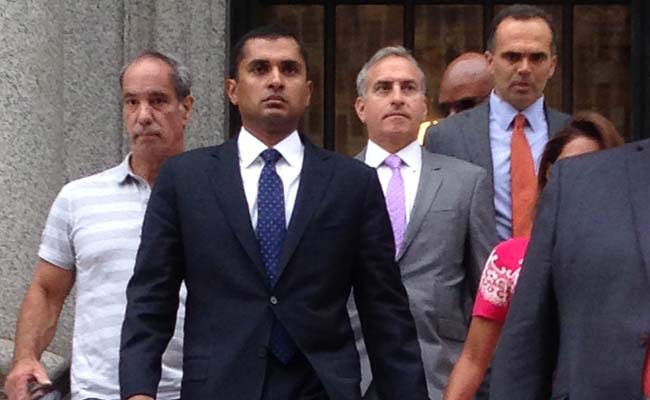
New York: The parents of Mathew Martoma, the former portfolio manager for SAC Capital Advisors, sat quietly through his insider trading trial this year. But moments after a federal judge sentenced Martoma on Monday to nine years in prison for carrying out one of the biggest insider trading schemes on record, his parents could contain themselves no more.
Speaking on the sidewalk outside the old federal courthouse in Lower Manhattan, Martoma's parents said he had been wrongly convicted. The couple asked why Martoma's former boss, Steven A. Cohen, the billionaire investor who founded SAC, was not also charged with insider trading if their son had done something wrong.
"He was framed," Lizzie Thomas said of her son, Mathew, who was convicted in February by a federal jury in Manhattan. His father, Bobbie Martoma, then added that his son had refused to cooperate with the federal authorities against Cohen because he did not want to violate the commandment against "bearing false witness." His parents both criticized the nine-year sentence meted out by Judge Paul G. Gardephe of U.S. District Court in Manhattan as being too severe. The couple suggested that Martoma was given a harsher penalty than most of the other 84 people who were convicted of or pleaded guilty in the insider trading investigation because of his Indian heritage. Martoma's parents are both immigrants from India.
Preet Bharara, the U.S. attorney for Manhattan, whose office indicted Martoma, 40, and prosecuted him, is also of Indian-American ancestry. The nine-year sentence was in line with the recommendation made to Gardephe by prosecutors working for Bharara.
The emotional response by Martoma's parents occurred after Gardephe said the stiff sentence was appropriate given the hundreds of millions of dollars at stake in the 2008 insider trading scheme that involved trades in shares of two drug companies. Gardephe said that while Martoma clearly was a good husband to his wife, Rosemary, a good father to his three children and a charitable person, there was also a darker side to his personality.
"The conduct at SAC was not aberrant conduct," Gardephe said, noting that before getting a job with Cohen's firm, Martoma was expelled from Harvard Law School for doctoring his transcript.
Gardephe, toward the conclusion of the nearly 90-minute proceeding, said, "The sums here are staggering, and the size of the punishment must be sufficient to deter others."
Martoma's lawyers had simply asked Gardephe to show mercy and sentence him to a term of no more than two to three years in prison. Lou Colasuonno, a spokesman for Martoma and his lawyers, issued a statement that said Martoma and his family "are devastated by the outcome" and plan to appeal. Martoma was silent during much of the sentencing hearing, allowing his lawyer Richard M. Strassberg, a partner with Goodwin Procter, to do most of the talking. Rosemary Martoma, seated in the front row, could be seen wiping her eyes at times.
Martoma was also ordered to forfeit a $9.38 million bonus he earned while working at SAC in 2008. The forfeiture includes the luxury home in Boca Raton, Florida, that the couple bought in 2010 for about $2 million.
Hours before the sentencing hearing was scheduled to begin, Gardephe indicated some of his thinking about Martoma's illegal trades in shares of two drug companies, Elan and Wyeth. The judge said in a 25-page decision issued Monday morning that it was appropriate for him to consider all of the $275 million in profits and avoided losses made by Martoma and Cohen, his former boss.
Gardephe noted that while prosecutors did not name Cohen as a co-conspirator, the evidence at trial proved that Martoma "provided inside information to Cohen and this information was the basis for Mr. Cohen and SAC Capital's subsequent trades in Elan and Wyeth securities."
Martoma was convicted of using inside information about a clinical trial for an experimental Alzheimer's drug to help SAC make trades in shares of the two drug companies. The trades in Elan and Wyeth - in which SAC sold large positions before the release of negative information about the clinical trial - took place over a few days in July 2008.
Martoma had said that sentencing him to a long prison term would present an undue hardship on his wife, a nonpracticing physician, and their three children. Martoma and his lawyers had argued that it was unfair for him to receive a long prison sentence for what was essentially a single incident of insider trading.
Prosecutors countered that the number of trades was irrelevant because the improper trading helped SAC generate the $275 million in profits and avoid losses.
The nine-year sentence is two years shy of the 11-year sentence given to Raj Rajaratnam, co-founder of the former Galleon Group hedge fund, which remains the longest sentence anyone in the current insider trading investigation has received.
The sentencing of Martoma closed another chapter in the federal government's investigation of Cohen and his hedge fund, which lasted for more than seven years. SAC was one of the most successful hedge funds before the firm pleaded guilty to insider trading and was forced by the government to stop managing money for outside investors. Federal prosecutors never charged Cohen, 58, with any wrongdoing, but he still faces a civil regulatory action that could permanently bar him from working in the securities industry.
© 2014, The New York Times News Service

-
'Never Seen This Level Of Negativity': Sandeep Tandon Says The Next Rally May Be Closer Than You Think

Veteran investor Sandeep Tandon says foreign selling is easing, large-caps are due a comeback and mid-caps are crowded, while he turns positive on gold, power and pharma this Diwali.
-
Indians Stay With Family, Not In Hotels | The Reason Why
India still lacks enough clean, reliable and affordable hotels for budget-conscious travellers.
-
The Economic Imperative: Analysing The Material Driving Force Behind India-Canada Strategic Reset
This economic complementarity is further reinforced by deep institutional investment ties and talent mobility, which form the bedrock of the bilateral framework.
-
Medicine Pricing: Where Must Profit Stop?
India must confront excessive margins, hidden incentives and regulatory gaps that threaten the integrity of medicine.
-
Why Amazon And Flipkart Are Struggling To Beat Meesho In India's Smaller Cities
With 274 million users and lowest-cost logistics, Meesho is defending its value commerce crown against giants like Amazon and Flipkart.
-
High US Salaries, No Green Card Certainty: The Financial Calculation Facing Indian H-1B Families
The suspension of PERM processing at eight technology employers does not cancel existing H-1B visas. What it does is force a question many Indian families have been avoiding: is the US salary worth tying your career and family plans to one employer?
-
Swiggy vs Eternal: Food Delivery's Two Rivals Are No Longer In The Same Race
Eternal is building a private AI assistant, dark.ai. Swiggy is still working out how to make Instamart pay, with an operating loss of Rs 895 crore in the July-September quarter while Blinkit stayed profitable.
-
Where You Live Shapes How You Get To Work | The Reason Why
Two-wheelers are the most popular way to get to work in India, accounting for nearly 43% of workplace commutes.
-
Unhedged Position: Can India See An Indonesia-Style Time Correction?
The Nifty is trading below levels it first clocked in 2024. Is there, then, as I have suggested in the headline, potential that the current time correction drags on painfully for the next three-five, even ten years?
-
Navigating Friction And Energy Realities: An Analysis Of Marco Rubio's October Visit To India
Occurring at a critical juncture marked by stalled trade negotiations and escalating geopolitical pressures over global energy supplies, the visit offers a profound window into modern US-India relations.










