
(Bloomberg) -- Russia's four-week average seaborne crude exports fell to the lowest in three months, with storms in the Black Sea disrupting shipments for a third week. Loading activities remained sluggish at the port of Novorossiysk even after they restarted on Nov. 30.
About 3.04 million barrels a day of crude were shipped from Russian ports in the four weeks to Dec. 3, tanker-tracking data monitored by Bloomberg show. That was down by 125,000 barrels a day from the revised figure for the period to Nov. 26. The more volatile weekly average also fell.
The OPEC+ group of oil producers, jointly led by Russia and Saudi Arabia, met virtually on Nov. 30 to set output targets for the first part of next year. Several members of the group agreed to make further production cuts during the first quarter after Saudi Arabia said it would prolong its unilateral one-million-barrel-a-day supply reduction.
Also Read | Layoffs Are Rising In Tech, But These Skills Are Helping People Unlock Better Pay
- Click here for an interview with Saudi Energy Minister Prince Abdulaziz bin Salman following the OPEC+ meeting
Russia will deepen its oil export cuts to 500,000 barrels a day below their average May-June levels during the first quarter of next year. The cuts will be shared between crude shipments, which will be reduced by 300,000 barrels a day, and refined products, according to Deputy Prime Minister Alexander Novak. For the rest of 2023, the reduction is set at 300,000 barrels a day, spread across both crude and refined products in undefined proportions. That complicates assessments of whether Russia is meeting its commitment to its OPEC+ partners.
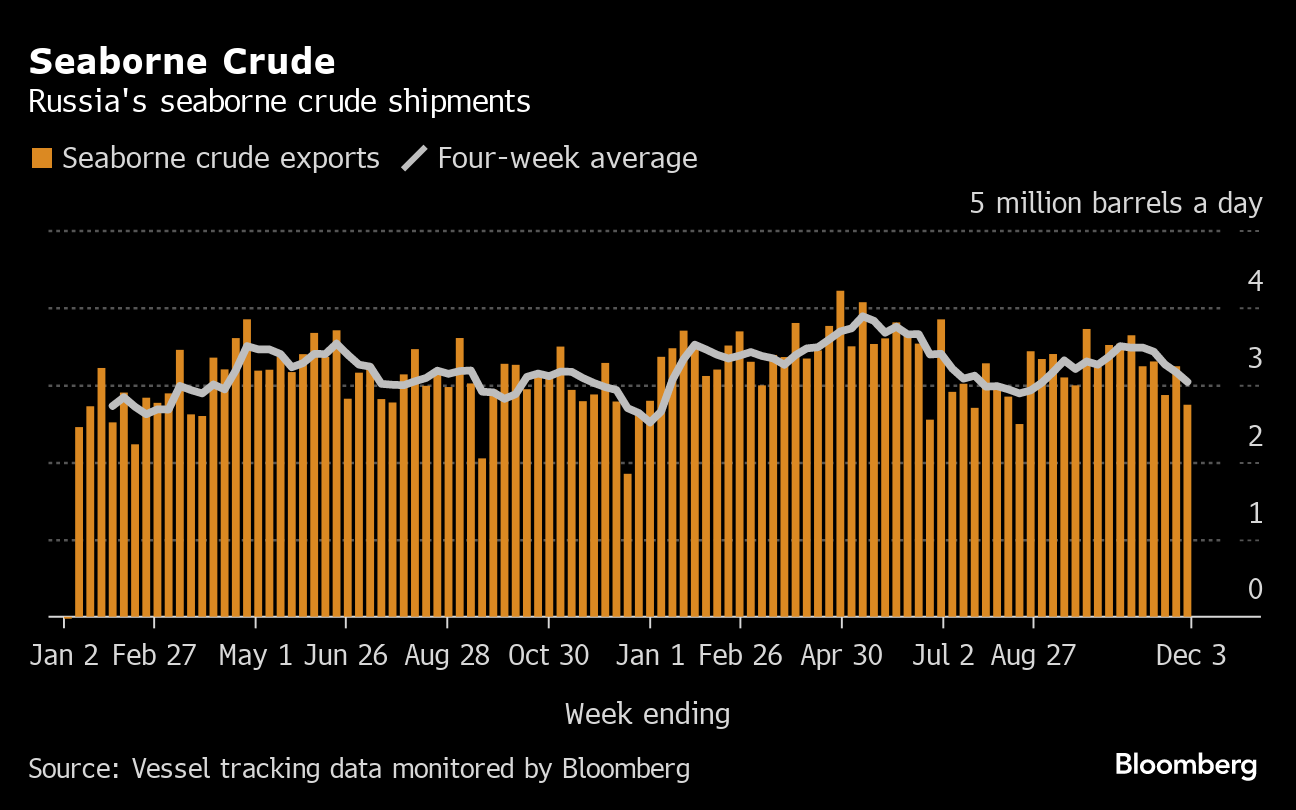
The figure for weekly flows fell sharply. Using this measure, shipments dropped to 2.74 million barrels a day, down by about 500,000 barrels a day from the revised figure for the period to Nov. 26. Weekly shipments were the lowest in 15 weeks.
Russia's oil processing in the last week of November showed the deepest weekly decline since late August amid lower processing at several refineries. One of the hardest hit was Rosneft PJSC's Tuapse refinery on the Black Sea coast. The plant, which sends the bulk of its oil-products abroad, lowered processing rates amid a halt in operations at region's ports last week due to the storms.
The Kremlin's weekly revenues from oil export duties fell, hit by a combination of lower flows and a reduced duty rate for December shipments. From January, Russia's oil producers are set to pay a higher output tax to fund increased downstream subsidies, which were reinstated in October after being halved the previous month. Export duty is set to be abolished at the end of this year as part of Russia's long-running tax reform plans.
Flows by Destination
Russia's seaborne crude flows in the four weeks to Dec. 3 fell to 3.04 million barrels a day. That was down from a revised 3.16 million barrels a day in the period to Nov. 26. Shipments were about 550,000 barrels a day below the average seen during the surge in volumes between April and June.
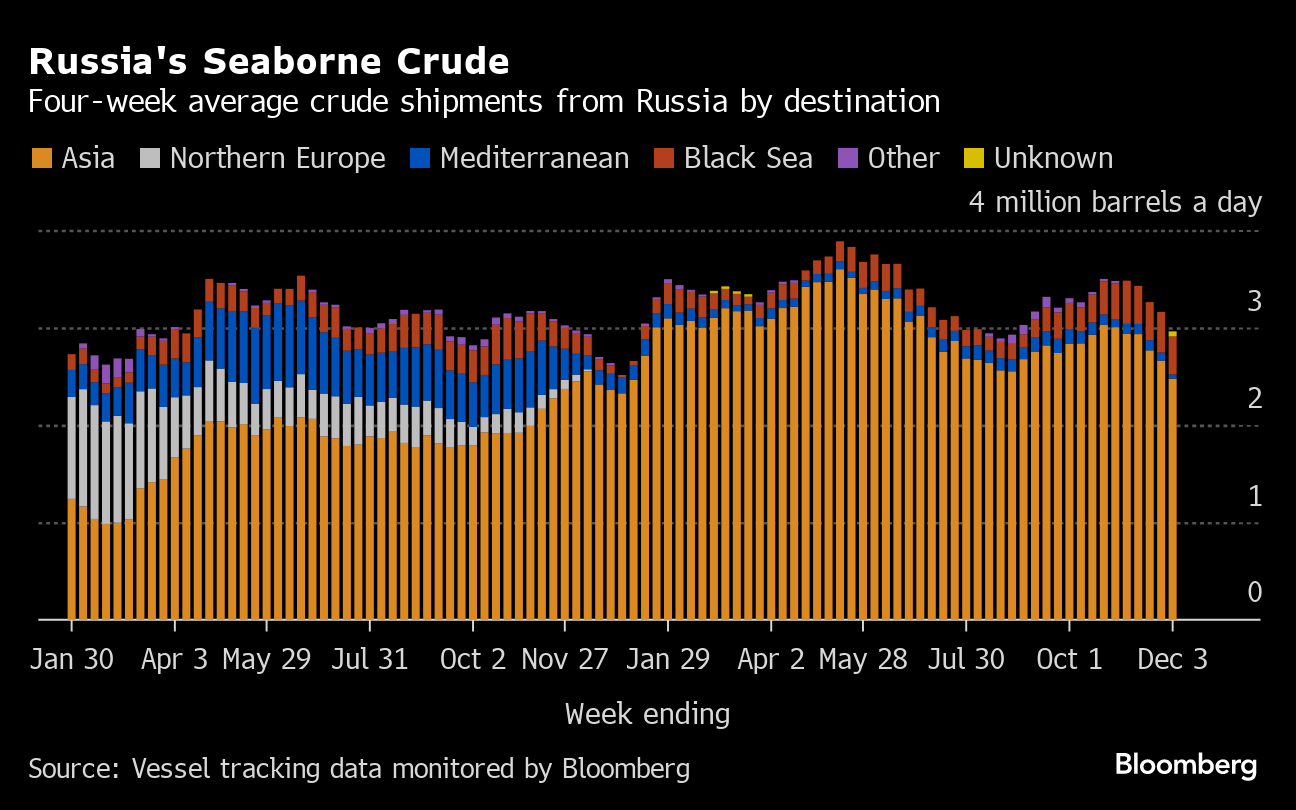
All figures exclude cargoes identified as Kazakhstan's KEBCO grade. Those are shipments made by KazTransoil JSC that transit Russia for export through Novorossiysk and the Baltic port of Ust-Luga and are not subject to European Union sanctions or a price cap.
The Kazakh barrels are blended with crude of Russian origin to create a uniform export grade. Since Russia's invasion of Ukraine, Kazakhstan has rebranded its cargoes to distinguish them from those shipped by Russian companies.
-
Asia
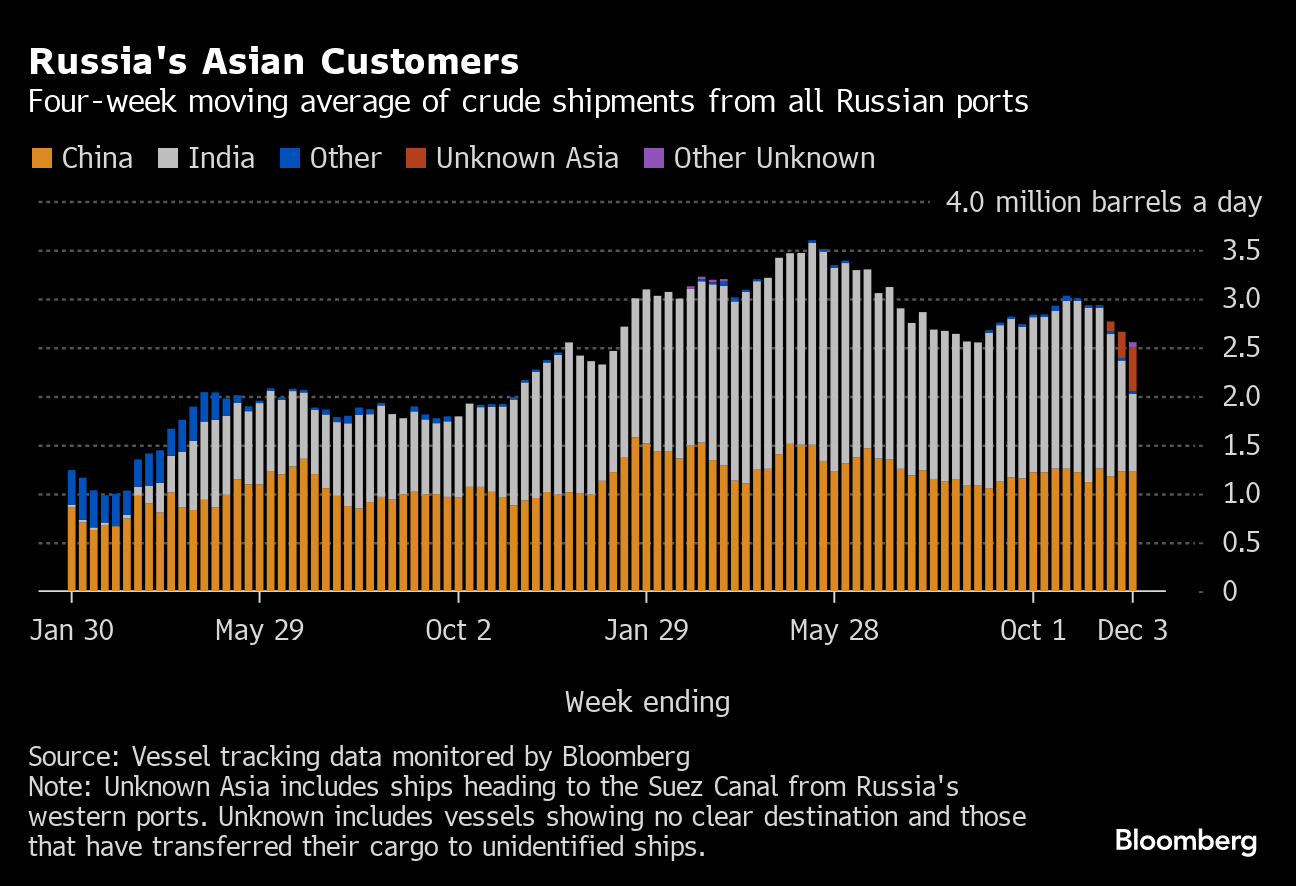
Observed shipments to Russia's Asian customers, including those showing no final destination, fell to 2.58 million barrels a day in the four weeks to Dec. 3, down from a revised 2.66 million barrels a day in the period to Nov. 26. That's the lowest since August.
About 1.23 million barrels a day of crude was loaded onto tankers heading to China in the four weeks to Dec. 3. China's seaborne imports are supplemented by about 800,000 barrels a day of crude delivered directly from Russia by pipeline, either directly, or via Kazakhstan.
Flows on ships signaling destinations in India averaged about 790,000 barrels a day in the four weeks to Dec. 3.
Both the Chinese and Indian figures will rise as the discharge ports become clear for vessels that are not currently showing final destinations.
The equivalent of about 475,000 barrels a day was on vessels signaling Port Said or Suez in Egypt, or are expected to be transferred from one ship to another off the South Korean port of Yeosu. Those voyages typically end at ports in India or China and show up in the chart below as “Unknown Asia” until a final destination becomes apparent.
The “Other Unknown” volumes, running at about 52,000 barrels a day in the four weeks to Dec. 3, are those on tankers showing no clear destination. Most of those cargoes originate from Russia's western ports and go on to transit the Suez Canal, but some could end up in Turkey. Others could be moved from one vessel to another, with most such transfers now taking place in the Mediterranean, off the coast of Greece.
-
Europe and Turkey
Russia's seaborne crude exports to European countries have collapsed since Moscow's troops invaded Ukraine in February 2022. A market that consumed about 1.5 million barrels a day of short-haul seaborne crude, coming from export terminals in the Baltic, Black Sea and Arctic has been lost almost completely, to be replaced by long-haul destinations in Asia that are much more costly and time-consuming to serve.
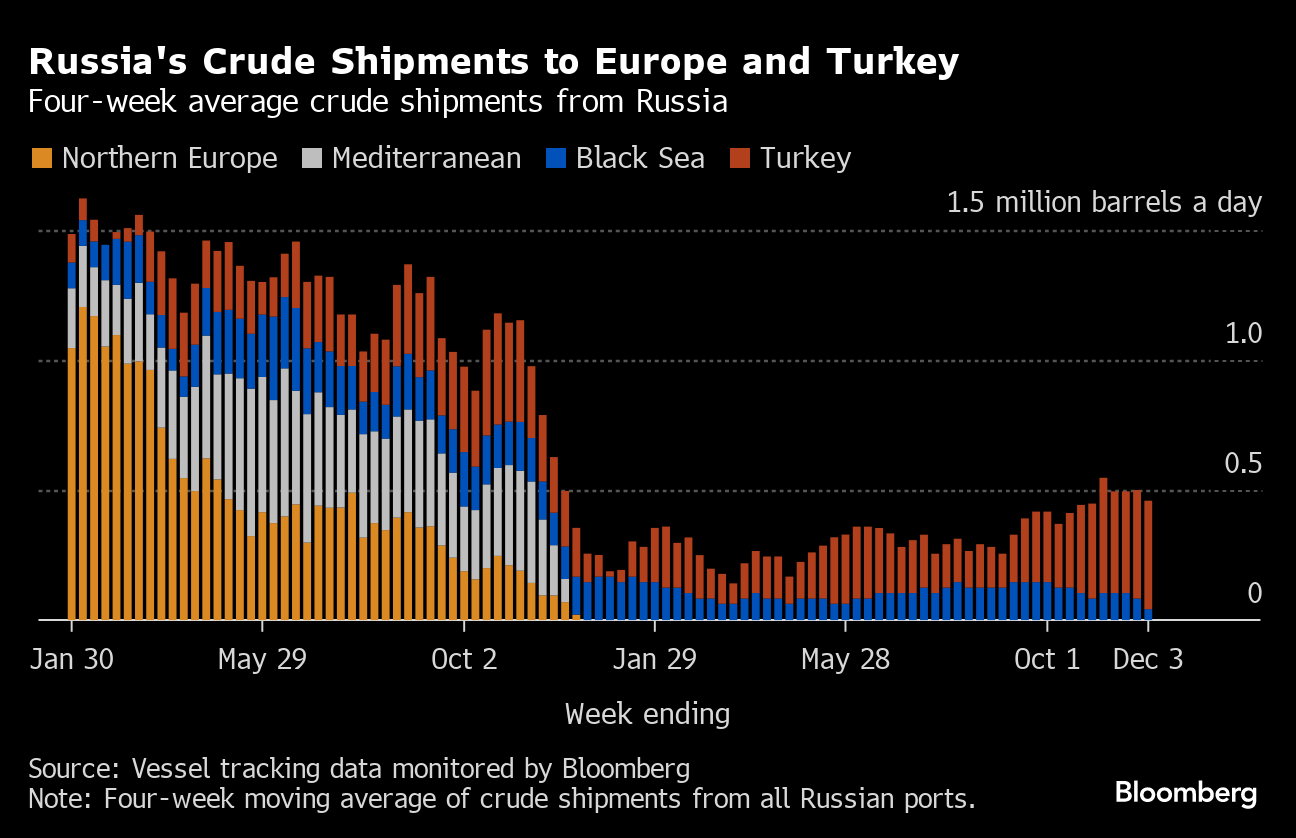
No Russian crude was shipped to northern European countries, or those in the Mediterranean in the four weeks to Dec. 3.
Flows to Bulgaria, now Russia's only European market for crude, fell to about 42,000 barrels a day in the most recent four-week period, it's lowest since April 2022. The disruption to flows from Novorossiysk hit shipments across the Black Sea.
Exports to Turkey were unchanged at about 420,000 barrels a day in the four weeks to Dec. 3. They remain more than twice as high as they were in July and August.
Vessel-tracking data are cross-checked against port agent reports as well as flows and ship movements reported by other information providers including Kpler and Vortexa Ltd.
Export Revenue
Inflows to the Kremlin's war chest from its crude-export duty slumped to $67 million in the seven days to Dec. 3. That's the lowest since September. Meanwhile four-week average income fell by $3 million to $75.5 million.
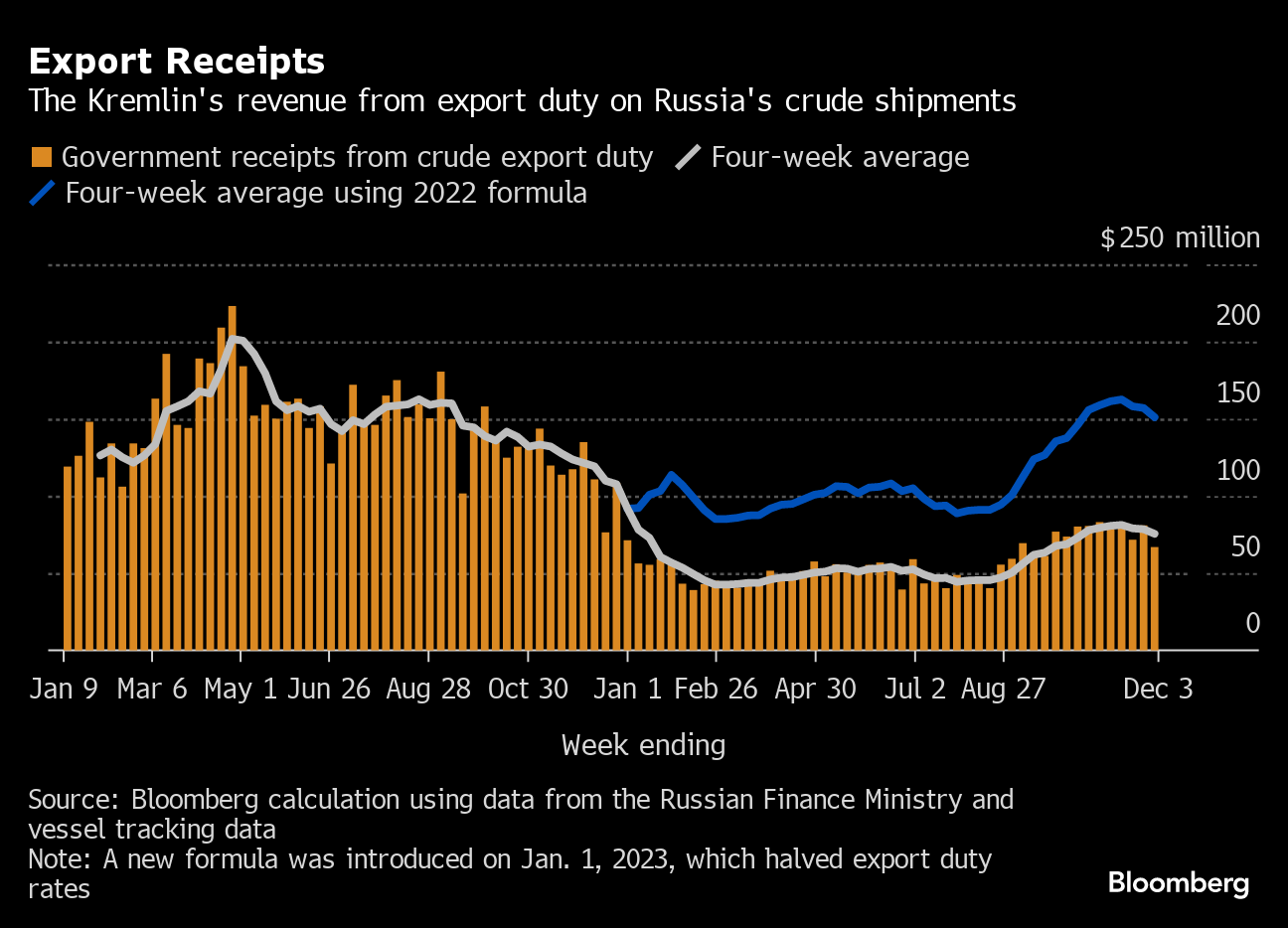
The duty rate for November was set at $3.57 a barrel, based on an average Urals price of $83.35 during the calculation period between Sept. 15 and Oct. 14. That was about $7.70 a barrel below Brent over the same period. November's duty rate set another new high for the year.
The rate for December is $3.37 a barrel, based on an average Urals price of $79.23 during the calculation period between Oct. 15 and Nov. 14. That was about $9.39 a barrel below Brent over the same period.
Origin-to-Location Flows
The following table shows the number of ships leaving each export terminal.
A total of 26 tankers loaded 19.2 million barrels of Russian crude in the week to Dec. 3, vessel-tracking data and port agent reports show. That's down by about 3.5 million barrels from the revised figure for the previous week.
There were no shipments from Novorossiysk, with storms continuing to hamper activity at the port for a third week. Loading activities resumed on Nov. 30, but still appear to be running slowly.
Destinations are based on where vessels signal they are heading at the time of writing, and some will almost certainly change as voyages progress. All figures exclude cargoes identified as Kazakhstan's KEBCO grade.
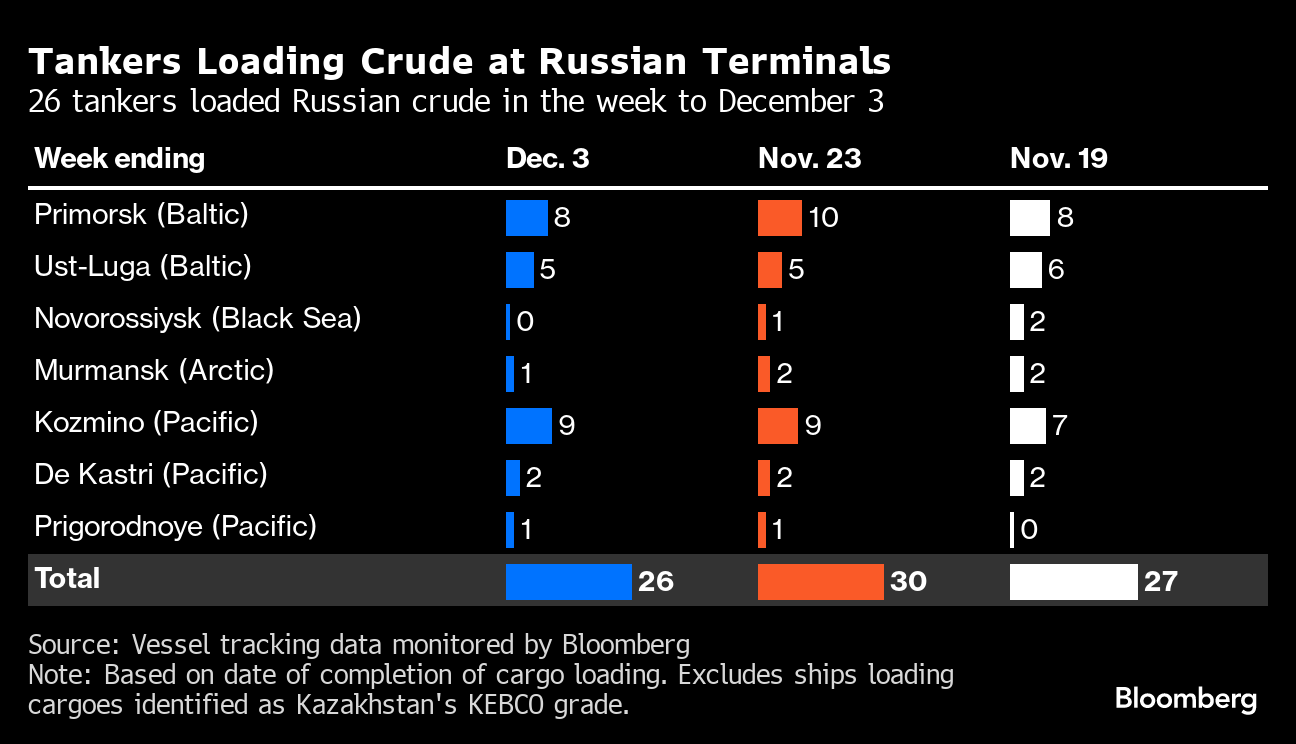
Two cargoes of KEBCO were loaded at Ust-Luga and one at Novorossiysk during the week.
NOTES
Note: This story forms part of a weekly series tracking shipments of crude from Russian export terminals and the export duty revenues earned from them by the Russian government. Weeks run from Monday to Sunday. The next update will be on Tuesday, Dec. 12.
Note: All figures exclude cargoes owned by Kazakhstan's KazTransOil JSC, which transit Russia and are shipped from Novorossiysk and Ust-Luga as KEBCO grade crude.
If you are reading this story on the Bloomberg terminal, click here for a link to a PDF file of four-week average flows from Russia to key destinations.
--With assistance from Sherry Su.
More stories like this are available on bloomberg.com
©2023 Bloomberg L.P.
Essential Business Intelligence, Sharp Market Insights, Practical Personal Finance Advice, Daily Fuel, Gold and Silver Prices and Latest Stories — On NDTV Profit.