Flying Got Safer Last Year Almost Everywhere Except Russia
(Bloomberg) -- Flying further improved its safety record last year, extending a long-term trend that's set to to continue despite quality lapses at Boeing Co. and maintenance setbacks in Russia, where sanctions have put decades of progress at risk.
There were 124 fatalities worldwide aboard passenger jets in 2023, the fewest in any year other than 2017, based on data compiled by Jacdec, a German consulting firm that tracks aviation safety. Hull losses, where aircraft are damaged beyond repair, totaled 45, a 12% improvement from 2022.

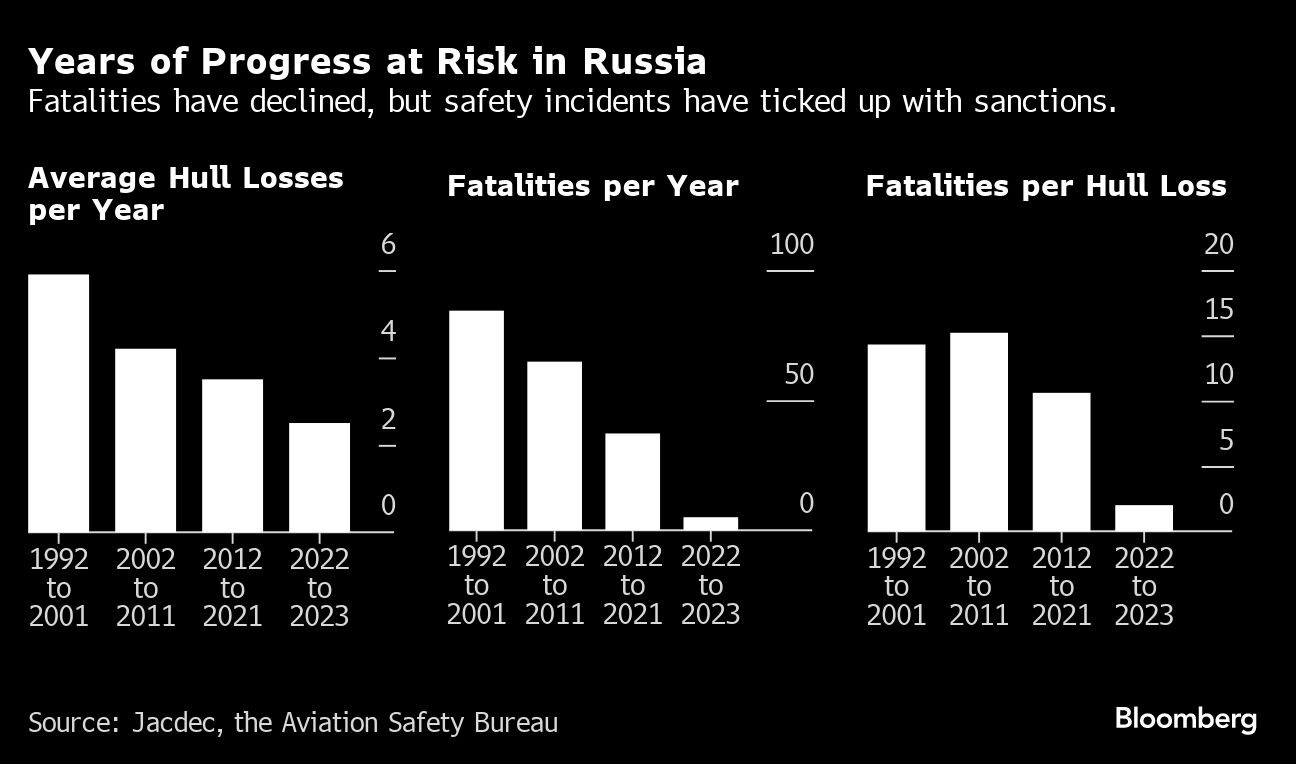
One exception was Russia, where US and European Union sanctions have made it hard for airlines to acquire parts needed to maintain aircraft. The number of air-safety incidents there more than doubled to 81 in 2023 from 2022, according to Jacdec.
In one instance, an Airbus A320 flown by Ural Airlines was left for dismantling in a Siberian field after an issue with hydraulics forced an emergency landing. A separate Air India flight to San Francisco stranded passengers in Russia's Far East for two days after engine issues forced it to divert.
Yet even in Russia, which has endured sanctions following the invasion of Ukraine in early 2022, fatalities have been well below the norms of earlier years. The economic curbs block Russian operators from gaining access to spare parts and technical updates for planes including those made by Boeing and Airbus.
“So far, we don't see any translation into an uptick of fatal accidents in Russian civil aviation,” said Jacdec founder and Chief Executive Officer Jan-Arwed Richter. “A tech embargo does not result in major crashes overnight, but a slow degradation of operational reliability.”

The one deadly Russian crash logged by Jacdec in 2023 likely involved an onboard blast, killing mutinous mercenary Yevgeny Prigozhin in late August alongside nine others traveling in the private jet.
Moscow lodged a complaint over the sanctions to the International Civil Aviation Organization, a UN agency, saying they endanger air safety. In the meantime, Russian aviation officials have turned to “friendly” sources for spare parts in places like Dubai.
Boeing, Haneda
Outside of Russia, air safety remains an urgent concern after incidents in Japan and the US this year.
Regulators stepped up oversight of Boeing factories in response to a near-tragedy on Alaska Air Flight 1282, which suffered a structural blowout after departing from Portland, Oregon. Some airline customers have begun to filter out the 737 Max 9 model involved in the the Jan. 5 mishap when they search for flights.
In Japan, union officials have requested more staff to assist air-traffic controllers in the wake of the Jan. 2 runway collision at Tokyo's Haneda airport.
Over time, higher manufacturing standards and lessons learned from previous mishaps have helped to drive fatalities lower on any given accident.
The deadly crash in Tokyo offers an example of advances such as the greater use of fire-resistant materials on aircraft interiors. Despite fatalities on the smaller aircraft, all 379 people aboard the carbon-hulled Airbus A350 survived.
“Today's jets were built, tested and certified to withstand all imaginable forces to make an accident a survivable one to everyone inside,” Richter said. “Haneda has shown this concept is working, despite the plane being engulfed in flames.”
More stories like this are available on bloomberg.com
©2024 Bloomberg L.P.

-
Getting To Work Costs Women More | The Reason Why

It is not just about women paying more than men. It is about women paying much more in cities than in villages.
-
AI Bias In Investing Cannot Be Eliminated, But It Can Be Governed
Framing is a particularly important example as identical financial information presented in terms of gains rather than losses can lead an LLM to reach a different assessment.
-
Joining The Dots | Dark Skies, Steady Diya: Why Hope Holds This Diwali
With war, a weak rupee and foreign outflows weighing on sentiment, policymakers at the NDTV World Summit and market veterans at NDTV Profit Ignite: Diwali Edition offered the same advice: stay invested and filter out the noise.
-
The Curious Case of Equitas Small Finance Bank And A CEO Who Quit For Stock
PN Vasudevan believes persistent investor concerns over a perceived conflict of interest had become a governance overhang on Equitas Small Finance Bank's stock, even as the lender improved profitability and asset quality.
-
Talking Points This Week: AI Cash Burn, A Tiger Comeback And An India That Still Finds Its Own Path
India is not immune to higher oil or tighter global liquidity, yet its earnings base is broader, its domestic policy levers are still available.
-
Foreign Investors Own Half Of HDFC Bank and ICICI Bank. An LTCG Cut Could Matter Most Here
Foreign portfolio investors have US$115 billion parked in HDFC Bank, ICICI Bank. If the government cuts long-term capital gains tax, Jefferies says returning foreign money could land here first.
-
'Never Seen This Level Of Negativity': Sandeep Tandon Says The Next Rally May Be Closer Than You Think
Veteran investor Sandeep Tandon says foreign selling is easing, large-caps are due a comeback and mid-caps are crowded, while he turns positive on gold, power and pharma this Diwali.
-
Indians Stay With Family, Not In Hotels | The Reason Why
India still lacks enough clean, reliable and affordable hotels for budget-conscious travellers.
-
The Economic Imperative: Analysing The Material Driving Force Behind India-Canada Strategic Reset
This economic complementarity is further reinforced by deep institutional investment ties and talent mobility, which form the bedrock of the bilateral framework.
-
Medicine Pricing: Where Must Profit Stop?
India must confront excessive margins, hidden incentives and regulatory gaps that threaten the integrity of medicine.










