Rupee To Hover At 70 Levels Against Dollar In A Year: Poll
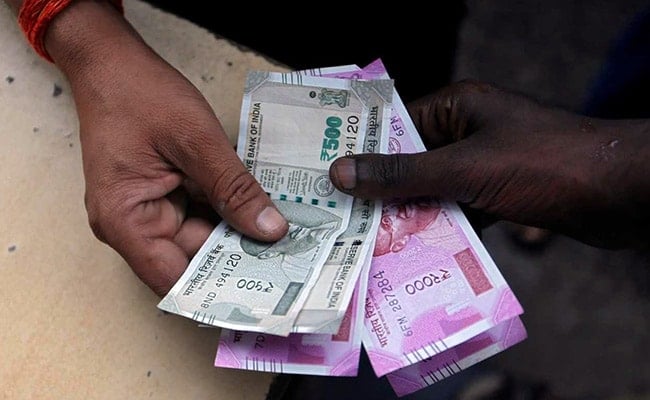
Bengaluru: India's battered rupee, which has lost more than 12 per cent this year, will hover near record lows on a worsening trade balance and at best only pare some of those losses in the coming 12 months, a Reuters poll found. Extending its losses, the rupee on Thursday breached the level of 72 per dollar for the first time, rattled by trade tension that has hurt most emerging market currencies. Taken before the currency hit a new record low, the latest Reuters poll of 40 foreign exchange analysts showed the rupee was still expected to remain vulnerable at 70.42 per dollar in a year's time, weaker than 68.22 predicted in August's poll.
While the 12-month consensus was for it to gain 2 per cent, no analyst polled expected it to be where it was in January, with the most optimistic call at 66.10 per dollar in a year.
"The recent financial market turmoil has pushed the INR too low," said Hugo Erken, a senior economist at Rabobank.
"Admittedly, India is still coping with current account deficits and a relatively large public debt level, but the entire Indian debt is in denominated in INR.
"The Indian economy is in much better shape than five years ago. And we still expect one more (interest rate) hike in October. Given all these developments, we expect some strengthening."
But a separate Reuters poll of economists showed the Reserve Bank of India was not expected to raise rates until 2019, having done so at a second straight meeting in August.
An increasing number of foreign exchange analysts polled remained bearish about the rupee's outlook, with risks from rising oil prices, uncertainty ahead of next year's general elections and an escalating trade war.
"The pair is already trading at 72 level...I see no strong reasons why this trend should reverse soon, unless for a sharp weakening of the dollar which is not our house view for the near-term," said Prakash Sakpal, an economist at ING.
"I am skeptical that more (interest) rate hikes will help the INR, given its exposure to a continually widening current account deficit, due to a surging oil import bill and also rising political uncertainty ahead of elections in early 2019."
India's trade deficit widened to a more than five-year high of $18.02 billion in July, driven by higher global prices of crude oil and steady capital outflows, which dragged the rupee lower.
India remains the fastest growing major economy with annual economic growth of 8.2 per cent last quarter, but the rupee - already shaken by higher oil prices, high inflation and trade conflicts - will take another hit if the US Federal Reserve hikes rates this month.
With oil prices elevated, Indian inflation was above the RBI's medium-term target of 4 per cent for a ninth consecutive month in July, putting more pressure on the rupee.
But it is not alone.
Most emerging currencies covered by the Reuters poll are at best expected to either stay near current levels or appreciate only slightly. China's yuan was predicted to gain slightly over the coming year.
"We are pursuing our strategy of selling emerging market currencies of countries that diverge sharply from the Fed's monetary policy, and are doing so against a backdrop of trade tensions," said analysts at Natixis.

-
Indians Are Travelling, But Not Every Journey Is A Holiday | The Week In Whys

Pilgrims, patients and working women are the real travellers, and the system hasn't quite caught up with them.
-
Getting To Work Costs Women More | The Reason Why
It is not just about women paying more than men. It is about women paying much more in cities than in villages.
-
AI Bias In Investing Cannot Be Eliminated, But It Can Be Governed
Framing is a particularly important example as identical financial information presented in terms of gains rather than losses can lead an LLM to reach a different assessment.
-
Joining The Dots | Dark Skies, Steady Diya: Why Hope Holds This Diwali
With war, a weak rupee and foreign outflows weighing on sentiment, policymakers at the NDTV World Summit and market veterans at NDTV Profit Ignite: Diwali Edition offered the same advice: stay invested and filter out the noise.
-
The Curious Case of Equitas Small Finance Bank And A CEO Who Quit For Stock
PN Vasudevan believes persistent investor concerns over a perceived conflict of interest had become a governance overhang on Equitas Small Finance Bank's stock, even as the lender improved profitability and asset quality.
-
Talking Points This Week: AI Cash Burn, A Tiger Comeback And An India That Still Finds Its Own Path
India is not immune to higher oil or tighter global liquidity, yet its earnings base is broader, its domestic policy levers are still available.
-
Foreign Investors Own Half Of HDFC Bank and ICICI Bank. An LTCG Cut Could Matter Most Here
Foreign portfolio investors have US$115 billion parked in HDFC Bank, ICICI Bank. If the government cuts long-term capital gains tax, Jefferies says returning foreign money could land here first.
-
'Never Seen This Level Of Negativity': Sandeep Tandon Says The Next Rally May Be Closer Than You Think
Veteran investor Sandeep Tandon says foreign selling is easing, large-caps are due a comeback and mid-caps are crowded, while he turns positive on gold, power and pharma this Diwali.
-
Indians Stay With Family, Not In Hotels | The Reason Why
India still lacks enough clean, reliable and affordable hotels for budget-conscious travellers.
-
The Economic Imperative: Analysing The Material Driving Force Behind India-Canada Strategic Reset
This economic complementarity is further reinforced by deep institutional investment ties and talent mobility, which form the bedrock of the bilateral framework.










