Rupee Rises To 82.64 A Dollar, But Chinese Yuan's Crash To Record Low Limits Gains
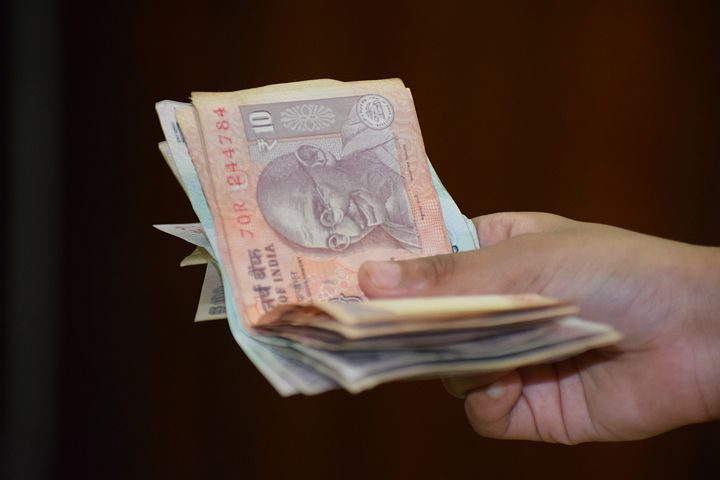
The rupee gained slightly on Tuesday, driven by an easing dollar on less hawkish US central bank bets, but the domestic currency's rise was limited in a holiday-shortened trading week after the Chinese yuan crashed to a record low.
Bloomberg showed the rupee was last changing hands at 82.6425 per dollar, after opening at 82.65, compared to its previous close of 82.6850 on Friday.
PTI reported that the domestic currency rose 25 paise to 82.63 against the US dollar in early trade.
Last week, the rupee hit a new record low against the dollar, falling to 83.29 per dollar on worries about the US Federal Reserve's aggressive monetary tightening path. But the Reserve Bank of India intervened to stop the bleeding and bring the rupee back below the 83-mark.
Indian financial markets were closed on Monday and will be shut on Wednesday for Diwali celebrations and, as such, could limit capital inflows in thin trade.
"The rupee is expected to remain in a range of 82.50 to 82.90 as holidays in many parts of the country will curtail the trading volumes. It is a shortened week with another holiday tomorrow and only two working days after today," said Anil Kumar Bhansali, Head of Treasury at Finrex Treasury Advisors.
"Yesterday, the Hang Seng index fell 6 per cent after China did not change its policies on Covid and environmental issues. Also, the yuan falling to 7.33 levels gives very little chance for the rupee to gain," he added.
The offshore yuan fell to a record low of 7.3650 to the dollar after the People's Bank of China's daily fix sparked expectations that the central bank could permit a market-determined exchange rate.
In contrast to a Reuters estimate of 7.1348, the PBOC placed the mid-point at 7.1668 as investors sold Chinese assets after President Xi Jinping's new leadership team stoked concerns that development will be sacrificed for ideology-driven policies.
"We're certainly staying away from the Chinese market right now because the political scene is not favourable," Laila Pence, President of Pence Wealth Management, said in an interview on Bloomberg TV. "There's a lot less risk in the US and just as much upside."
But, Tuesday also saw a weakening of the safe-haven US dollar against peers on indications that the world's largest economy is already being held back by Federal Reserve rate increases, while risk sentiment increased with Rishi Sunak's impending appointment as the Prime Minister of Britain.
That is likely to limit any sharp declines in the rupee.
If it were not for the yuan, the rupee would have had "had a decent opening" considering the "slightly less" hawkish Fed outlook, a trader at a Mumbai-based bank told Reuters.
Another fall in India's foreign exchange "is probably another problem" for the rupee, the trader said.
India's forex reserve dropped $4.5 billion to $528.4 billion in the week ending October 14, marking over a $100 billion decline in the country's import cover since Russia invaded Ukraine in late February.
On the other hand, UK bonds surged as investors pinned their hopes on Rishi Sunak to restore credibility to economic policymaking and help calm the nation's rattled markets.
Sterling inched closer to this month's highs, and the euro threatened to reach $0.99 for the first time since October 6 ahead of Thursday's European Central Bank (ECB) policy meeting.
Following two days of Bank of Japan (BOJ) intervention straddling the weekend, the yen remained stable on the higher side of 149 per dollar.
The greenback fell, driven by the latest indication of a weakening US economy in the face of high inflation and rising interest rates. The S&P flash PMI data released overnight indicated that business activity shrank for the fourth consecutive month in October.
"Structurally, there's still a lot to like about the US dollar, but we're in a mean-reversion, sideways, a choppy market at the moment," Chris Weston, Head of Research at Pepperstone in Melbourne, told Reuters.
Mr Weston expects the dollar index to dip as low as 110 before potentially resuming its uptrend to test 115. "I still think the dollar is the most beautiful currency to own in G-10," he added.

-
One El Nino, India Can Handle. Two Could Break The Granary

India's grain stocks can absorb one bad year, but a second El Nino could drain the buffer in two to three years, economists say.
-
India's Troika Of Good Luck | Joining The Dots
As Jensen Huang's exit drags Nvidia down, a cooling AI trade and resilient earnings have revived investor interest in India. A likely RBI rate hike looms.
-
Talking Points This Week: Leadership Shock At Nvidia, Earnings Strength, And The Fog Over Hormuz
The Anthropic IPO pricing and first trading day, Nvidia's upcoming earnings, and any fresh signals from Iran will set the tone for the following week.
-
Signature Play: The Classic Cocktail Is Dead. Or Is It?
Classic cocktails are disappearing from India's cocktail menus. But they're still being ordered, taught to bartenders and borrowed from. So, who's really having the last drink?
-
A New Samvat Wishlist: Inclusive Prosperity And Human Development
India has strengthened its economic foundations through infrastructure, digital access and enterprise. Its next growth chapter must deepen productivity, create better livelihoods and widen participation in prosperity.
-
Love, Sex Aur Dhokha: The Audacious Plot To Spy On Jensen Huang
A Taipei dinner, a Singapore chip buyer and a suspected Chinese asset: inside the alleged spy operation that got close to NVIDIA's Jensen Huang.
-
Ten Things I Learnt This Samvat
Patience can be a trap. Cheap stocks can stay cheap. Leverage can wipe you out. What did Samvat 2082 teach us? Niraj Shah writes on 10 lessons from the year gone by.
-
Talking Points This Week: Tech Nerves, FII Buying, And A Faraway Banking Shock
The global markets are not shining this Diwali. The exception in the large markets is, India.
-
Midterm Rally Lasted A Day. The Hard Reality Of A Divided US May Last Two Years | Opinion
Between a contested AI boom, a debt ceiling that arrives in 2027 and a president with every incentive to act alone, the next two years may prove more volatile than the first day's rally suggests.
-
Blue Wave Will Derail the AI Trade but Won't Dismantle the AI Era | Unhedged Position
The Democrats' sweep of the US Congress will see politics collide with economic forces both over the long and short term.









