Rupee Recovers Sharply To 82.75 A Dollar After Hitting A Record Low Of 83.29
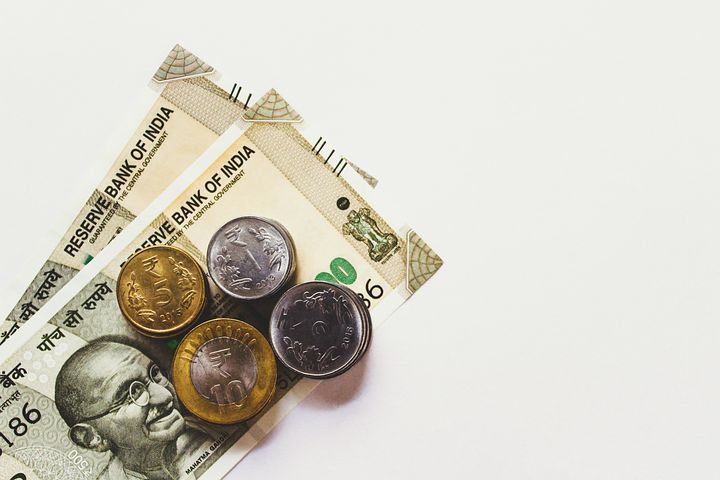
The rupee recovered to below 83 against a resurgent dollar, helped by the Reserve Bank of India's intervention after the domestic currency collapsed sharply to an all-time low of 83.29, driven broadly by a global sell-off in risk assets in a see-saw session on Thursday.
Bloomberg showed the rupee was last changing hands at 82.7538 per dollar after opening at 82.9825 and crashing to a new record low of 83.2925.
PTI reported that the domestic currency recouped 25 paise to close provisionally at 82.75 against the US dollar, with fag-end buying in domestic equities also bolstering sentiment.
"After hitting a lifetime low of 83.2325, the rupee reversed to dip below 83/$. Currently trading at 82.85 as the RBI sold dollars in the open market to smoothen out the process of the currency's sharp depreciation," said Anil Kumar Bhansali, Head of Treasury at Finrex Treasury Advisors.
Reuters reported that the rupee to the dollar exchange rate was last at 82.86, down from 83.0200 the previous day. Early in the session, the local unit fell to a record low of 83.2625.
According to traders who spoke to Reuters, the RBI was selling dollars and engaging in buy/sell swaps as the rupee fell to a new record low.
Recently, the RBI has intervened through advance dollar sales rather than spot transactions as the central bank was likely keeping the spot reserves in order to avoid having its involvement affect the rupee's liquidity, according to analysts.
A Reuters survey showed the rupee could fall further to 84.50 by December.
In the previous session, the domestic currency had reversed sharp gains from earlier on Wednesday to close at its weakest level of 83.02 per dollar, driven by the RBI likely buying dollars at about 82 in currency futures to buffer up its capacity to intervene.
The rupee's slide was amplified by broad dollar strength and stop losses at 72.40, a level the RBI probably wanted to protect.
"Yesterday, the rupee's weakness was caused by probable dollar buying at 82.02 by the RBI in currency futures and outflows of large size of about $500 million from Gas Authority of India Limited (GAIL) and Mangalore Refinery and Petrochemicals Limited (MRPL)," said Mr Bhansali.
"The RBI did not protect 82.40, and short covering of the pair took it to 83.00, with stop losses triggered between 82.40 to 83.50," he added.
Separately, the dollar's appeal rose, driven by additional signs that strong inflation will keep major central banks in rate-hike mode after British inflation reached 40-year highs.
A spike in US Treasury yields hampered the recent surge in global risk assets on expectations that the Federal Reserve would continue to raise interest rates rapidly.
The shocking inflation data from Canada, Britain, and New Zealand released this week also demonstrated that central banks worldwide are still battling to control decades-high inflation, even at the expense of slowing economic growth, escalating recession fears, and increasing demand for safe-haven assets.
For the first time since 1990, the dollar reached the symbolic threshold of 150 yen on Thursday, helped along by Treasury rates that were trading at multi-year highs and kept markets on high alert for intervention from Japanese authorities.
Moves in the other major currencies were more restrained, with the euro at $0.9786 and the pound continuing its falls. The euro was still trying to make up the ground it lost during the previous day's dollar rise.
As of Wednesday's closing, the fragile Japanese yen had lost ground for 11 successive sessions and has already renewed 32-year lows six times.
"As long as the terminal point of the US interest rate remains unclear, dollar strength will not subside. 150 was just a pass point, and the focus now is on if it tops 160," Takumi Tsunoda, Senior Economist at Shinkin Central Bank Research Institute in Tokyo, told Reuters.

-
We May Need Another Tukaram Mundhe To Fight Air Pollution | The Reason Why

Developers may install basic measures such as sprinklers and green nets, resume work, and continue violating rules when this equipment stops working.
-
Extracting Value From Battery Scrap Could Be Challenging For India | The Reason Why
A discarded lithium-ion battery still contains valuable materials such as lithium, nickel and cobalt. These can be recovered and reused. When such batteries are crushed and shredded, they produce a dark powder called black mass.
-
One El Nino, India Can Handle. Two Could Break The Granary
India's grain stocks can absorb one bad year, but a second El Nino could drain the buffer in two to three years, economists say.
-
India's Troika Of Good Luck | Joining The Dots
As Jensen Huang's exit drags Nvidia down, a cooling AI trade and resilient earnings have revived investor interest in India. A likely RBI rate hike looms.
-
Talking Points This Week: Leadership Shock At Nvidia, Earnings Strength, And The Fog Over Hormuz
The Anthropic IPO pricing and first trading day, Nvidia's upcoming earnings, and any fresh signals from Iran will set the tone for the following week.
-
Signature Play: The Classic Cocktail Is Dead. Or Is It?
Classic cocktails are disappearing from India's cocktail menus. But they're still being ordered, taught to bartenders and borrowed from. So, who's really having the last drink?
-
A New Samvat Wishlist: Inclusive Prosperity And Human Development
India has strengthened its economic foundations through infrastructure, digital access and enterprise. Its next growth chapter must deepen productivity, create better livelihoods and widen participation in prosperity.
-
Love, Sex Aur Dhokha: The Audacious Plot To Spy On Jensen Huang
A Taipei dinner, a Singapore chip buyer and a suspected Chinese asset: inside the alleged spy operation that got close to NVIDIA's Jensen Huang.
-
Ten Things I Learnt This Samvat
Patience can be a trap. Cheap stocks can stay cheap. Leverage can wipe you out. What did Samvat 2082 teach us? Niraj Shah writes on 10 lessons from the year gone by.
-
Talking Points This Week: Tech Nerves, FII Buying, And A Faraway Banking Shock
The global markets are not shining this Diwali. The exception in the large markets is, India.









