Rupee Gains And Holds Below 80 Per Dollar As RBI Vows To Do What It Takes
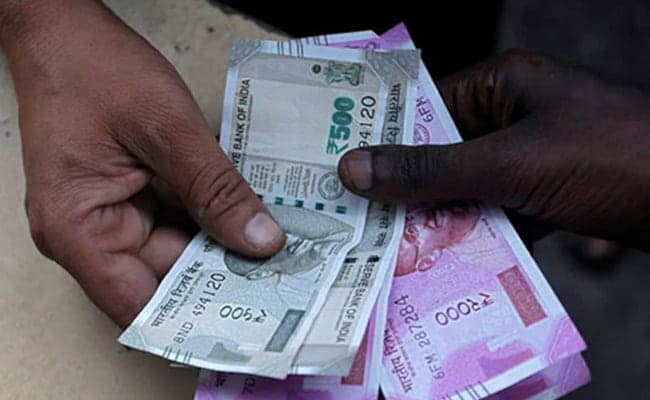
The rupee inched higher on Monday, tracking a modest rise in its Asian peers as the Reserve Bank of India has vowed to do what it takes to defend the rupee from "jerky movements."
But the gains in the currency were limited by losses in domestic stock markets ahead of the Federal Reserve meeting this week and on global economic activity risks.
Bloomberg quoted the rupee at 79.7363 against the dollar compared to its close of 79.8537 on Friday. The news agency showed the rupee traded in the 79.7000 to 79.8737 range on Monday.
PTI reported that the Indian currency gained 16 paise to close provisionally at 79.74 against the US dollar.
Reuters quoted the Indian currency at the highest in more than a week. The news agency said the partially convertible rupee ended trading at 79.73 per dollar compared to its close of 79.8550 on Friday. The unit rose to a high of 79.6950 during trade, its strongest since July 13.
"The dollar is weakening against most majors in European trade, which has helped the rupee. But with Fed expected to raise rates this week, we could see pressure building up on the rupee again," the head of trading at a private bank told Reuters.
A separate report showed the rupee risks a further decline to 82 per dollar in the near term due to the widening of the trade deficit and expected aggressive rate hike by the US Fed later this week to tame record high inflation, according to economists.
The RBI, though, has made it clear that they would defend the Indian currency from extreme volatility and limit any sharp movements.
While the central bank says the rupee has held up well, they were ready to spend $100 billion in reserves if needed to support the currency in these unprecedented times, when almost every currency listed on the other side of the exchange rate against the dollar has taken a hit.
A member of the Economic Advisory Council said that the RBI was justified in using the country's foreign exchange reserves to smooth out volatility in the rupee's moves against the dollar.
"I think that the RBI is correct to use the FX reserves to smooth movement in the INR/USD... There is no point targeting an INR/USD level when USD is appreciating against all other majors," Sanjeev Sanyal told the Reuters Global Markets Forum (GMF) in an interview.
"Longer term, we need to maintain overall macro-stability and allow the cycle to play itself out," said Mr Sanyal, who was previously India's chief economic adviser.
India's forex reserves fell by $7.5 billion as the Reserve Bank of India is using its war chest to limit the sharp decline and 'jerky movements' in the rupee, as indicated by Governor Shaktikanta Das, who said, "you buy an umbrella to use it when it rains!"
That latest data is a near $70 billion wiped from the record high reserves in October last year and about a $30 billion loss since Russia invaded Ukraine.
The rupee has repeatedly hit new lows and breached 80 per dollar for the first time ever this week and has collapsed about 7.4 per cent from about 74 at the beginning of the year.
The dollar, though, was on a firm footing as traders brace for a sharp US interest rate hike this week and look for safety as recent data points to a weakening global economy.
The US Federal Reserve concludes a two-day meeting on Wednesday, and markets are priced for a 75-basis-point (bp) rate hike, with about a 9 per cent chance of a 100 bp hike.
"Market reaction will turn on how hawkish Chair (Jerome) Powell sounds with his determination to reduce inflation in the face of slowing growth," National Australia Bank currency strategist Rodrigo Catril told Reuters.
Asian stocks lost ground, retreating from over three-week highs as worries about a global economic downturn sapped investors' risk appetite.
Tracking those cues, Indian equity benchmarks ended lower on Monday, snapping their six-day winning run.

-
One El Nino, India Can Handle. Two Could Break The Granary

India's grain stocks can absorb one bad year, but a second El Nino could drain the buffer in two to three years, economists say.
-
India's Troika Of Good Luck | Joining The Dots
As Jensen Huang's exit drags Nvidia down, a cooling AI trade and resilient earnings have revived investor interest in India. A likely RBI rate hike looms.
-
Talking Points This Week: Leadership Shock At Nvidia, Earnings Strength, And The Fog Over Hormuz
The Anthropic IPO pricing and first trading day, Nvidia's upcoming earnings, and any fresh signals from Iran will set the tone for the following week.
-
Signature Play: The Classic Cocktail Is Dead. Or Is It?
Classic cocktails are disappearing from India's cocktail menus. But they're still being ordered, taught to bartenders and borrowed from. So, who's really having the last drink?
-
A New Samvat Wishlist: Inclusive Prosperity And Human Development
India has strengthened its economic foundations through infrastructure, digital access and enterprise. Its next growth chapter must deepen productivity, create better livelihoods and widen participation in prosperity.
-
Love, Sex Aur Dhokha: The Audacious Plot To Spy On Jensen Huang
A Taipei dinner, a Singapore chip buyer and a suspected Chinese asset: inside the alleged spy operation that got close to NVIDIA's Jensen Huang.
-
Ten Things I Learnt This Samvat
Patience can be a trap. Cheap stocks can stay cheap. Leverage can wipe you out. What did Samvat 2082 teach us? Niraj Shah writes on 10 lessons from the year gone by.
-
Talking Points This Week: Tech Nerves, FII Buying, And A Faraway Banking Shock
The global markets are not shining this Diwali. The exception in the large markets is, India.
-
Midterm Rally Lasted A Day. The Hard Reality Of A Divided US May Last Two Years | Opinion
Between a contested AI boom, a debt ceiling that arrives in 2027 and a president with every incentive to act alone, the next two years may prove more volatile than the first day's rally suggests.
-
Blue Wave Will Derail the AI Trade but Won't Dismantle the AI Era | Unhedged Position
The Democrats' sweep of the US Congress will see politics collide with economic forces both over the long and short term.









