Difficult Conversations A Wealth Manager Must Have With Clients

It is quite unclear if one can make a living out of telling clients what they ‘need to' hear and not what they ‘want to' hear.
I am also not sure if everyone understands that advisors need to have seriously difficult conversations with clients almost every day. For those of us who have a coaching approach, life isn't easy at all. Human beings register information in short bursts and streaks, so imbibing a long-term outlook isn't the easiest thing to do.
However, we try and I want to narrate the story of a client who treated me with much suspicion, in the beginning, challenged me, debated with me and almost slipped away. Read on.
Our first meeting:
It was a cold day, or maybe I was feeling cold under the hard stare of Mr Singh.
He was my prospective client at that time, a CXO of a large firm, very tall and imposing; almost formidable if you didn't know him well. He spoke little and I have to admit it took a fair bit of courage to contradict him. I don't think he knew that I was under the impression that he needed ‘coaching' – I had to break it to him.
Me: Mr Singh, your profiler says that you overestimate your risk appetite.
Mr Singh: Silence (and that stare)
Me: Allow me to explain that to you?
Mr Singh: Please.
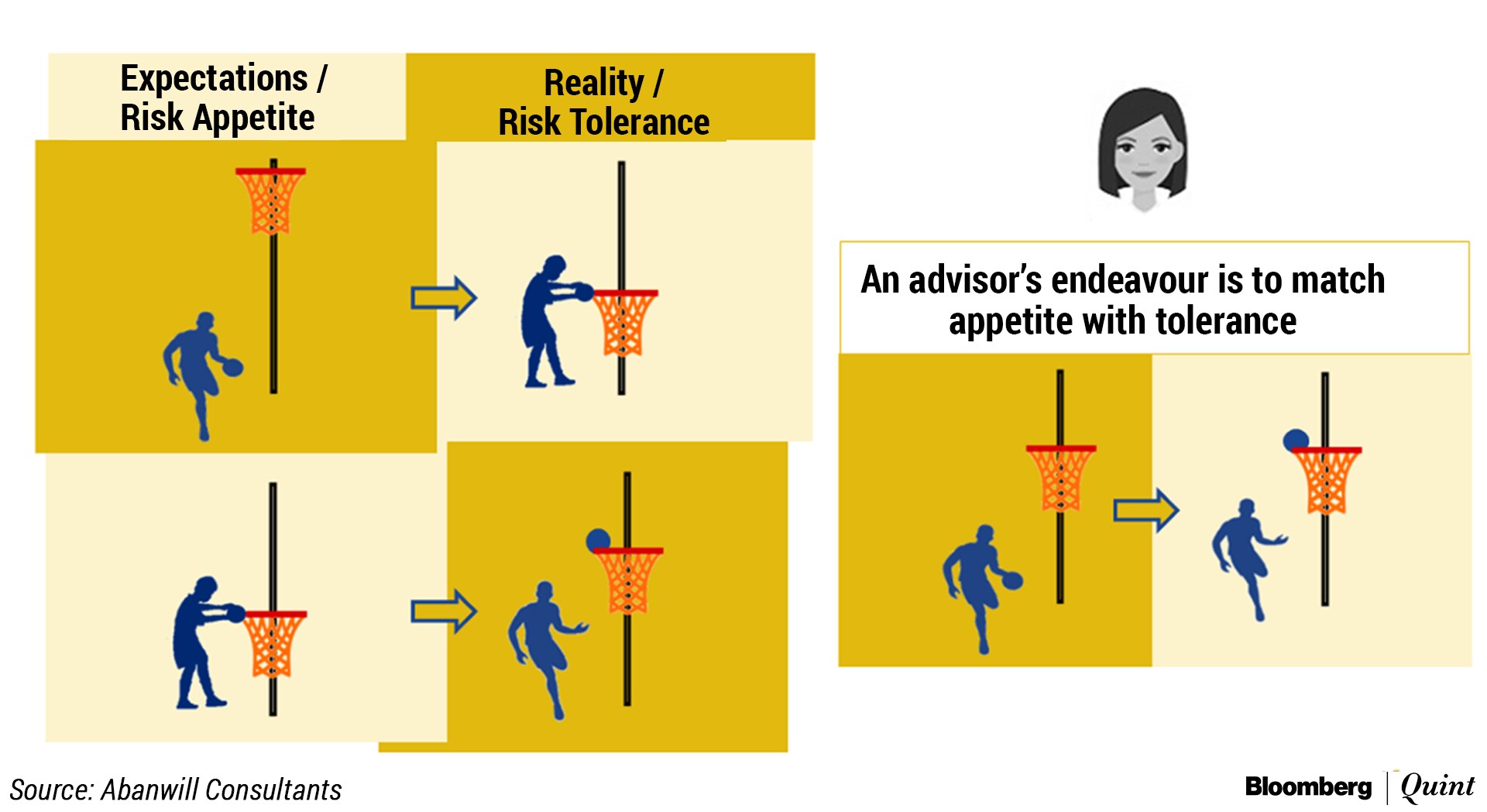
Me: Risk appetite is a reflection of how much volatility you are willing to take in anticipation of returns but when you see sustained and/or steep losses, you may not be able to withstand that volatility. If one is unable to assess one's appetite correctly, one may start behaving irrationally.
For example, a prolonged downturn in the market may make you want to book losses.
There was a long pause. After which,
Mr Singh: Isn't it your duty then, to stop me from doing that.
Me: Ahem, I am flattered Sir, that you should think I will be ‘able' to ‘stop' you from taking action but my experience is that clients are inconsolable during such situations and I will have little to do if you act without consulting me or against my advice.
Mr Singh: So, what are you saying?
I am recommending that we make the portfolio in a manner that the probability of such an occurrence is reduced to the minimum. If you do not take undue risk, to begin with, then we will never get to that undesirable place.
Mr Singh agreed and I embarked on making a model portfolio for him.
Soon after,
I had assigned index funds as part of the core portfolio. I have great faith in them and shared the last couple of SPIVA reports with him.
Mr Singh: So, you recommend that the largest part of my portfolio should be in the indices.
Me: Yes Sir, the indices are most often, difficult to beat. Besides, what better way to participate in the broad markets and get the market return at least for a large part of the portfolio. We will try and take a risk with smaller pockets to diversify and drive our required rate of return.
Mr Singh: I am convinced that index funds are good but why should I pay you for recommending the same? I don't need an investment advisor to recommend index funds to me.
Me: Yes Sir, I am afraid you do. Here are my reasons:
- In spite of knowing that investing in the indices makes sense, it is not a part of your portfolio yet.
- If we don't execute this plan right away, many years from now, we may still be discussing this and/or a very small portion of your wealth may actually be invested in the indices
- Investing is a negative art. By acting on this advice, we will be eliminating the chances of buying multiple new funds that come our way – the next big ideas, that often fail.
Mr Singh: Oh yes, I wanted to discuss an idea that has come to me.
Someone had pitched an NCD with fixed coupon payments. The underlying was a real estate project. I knew the group. It had the backing of a well-known financial institution but it had all the characteristics of what I have come to identify as constructs that were “built to fail”. It had a moratorium, and then quarterly payments. The project had many unsold flats, the company had defaulted on some payments already, it was public information. However, the promised coupon was high.
I narrated to Mr Singh, a discussion that I had with another client on the ‘psychology of fraud'. She had told me that if she wanted to defraud a lender, she would always make the interest payments on time - that would buy her sufficient time before her inability to pay the principal was noticed.
His cold stare continued. He thought I was being hyper-cautious. He would go ahead with that investment.
He listened to me only in that he put a very small sum of his money in this instrument. He signed up with me anyway, maybe just to hear my contrarian views and anecdotes. This relationship may need continuous maintenance, but which one doesn't.
The NCD has defaulted on its coupon payments for a few quarters already, paid some penal interest and Mr Singh is doing just fine.
In the meanwhile, I continue to wonder how long I can make a living by telling clients what they ‘need to hear' and not what they ‘want to'.
Abaneeta Chakraborty has close to two decades of experience in managing money for ultra-HNI families. She founded the firm Abanwill Consultants LLP in 2017 to provide independent views on investing.
The views expressed here are those of the author and do not necessarily represent the views of BloombergQuint or its editorial team.

-
The Curious Case of Equitas Small Finance Bank And A CEO Who Quit For Stock

PN Vasudevan believes persistent investor concerns over a perceived conflict of interest had become a governance overhang on Equitas Small Finance Bank's stock, even as the lender improved profitability and asset quality.
-
Talking Points This Week: AI Cash Burn, A Tiger Comeback And An India That Still Finds Its Own Path
India is not immune to higher oil or tighter global liquidity, yet its earnings base is broader, its domestic policy levers are still available.
-
Foreign Investors Own Half Of HDFC Bank and ICICI Bank. An LTCG Cut Could Matter Most Here
Foreign portfolio investors have US$115 billion parked in HDFC Bank, ICICI Bank. If the government cuts long-term capital gains tax, Jefferies says returning foreign money could land here first.
-
'Never Seen This Level Of Negativity': Sandeep Tandon Says The Next Rally May Be Closer Than You Think
Veteran investor Sandeep Tandon says foreign selling is easing, large-caps are due a comeback and mid-caps are crowded, while he turns positive on gold, power and pharma this Diwali.
-
Indians Stay With Family, Not In Hotels | The Reason Why
India still lacks enough clean, reliable and affordable hotels for budget-conscious travellers.
-
The Economic Imperative: Analysing The Material Driving Force Behind India-Canada Strategic Reset
This economic complementarity is further reinforced by deep institutional investment ties and talent mobility, which form the bedrock of the bilateral framework.
-
Medicine Pricing: Where Must Profit Stop?
India must confront excessive margins, hidden incentives and regulatory gaps that threaten the integrity of medicine.
-
Why Amazon And Flipkart Are Struggling To Beat Meesho In India's Smaller Cities
With 274 million users and lowest-cost logistics, Meesho is defending its value commerce crown against giants like Amazon and Flipkart.
-
High US Salaries, No Green Card Certainty: The Financial Calculation Facing Indian H-1B Families
The suspension of PERM processing at eight technology employers does not cancel existing H-1B visas. What it does is force a question many Indian families have been avoiding: is the US salary worth tying your career and family plans to one employer?
-
Swiggy vs Eternal: Food Delivery's Two Rivals Are No Longer In The Same Race
Eternal is building a private AI assistant, dark.ai. Swiggy is still working out how to make Instamart pay, with an operating loss of Rs 895 crore in the July-September quarter while Blinkit stayed profitable.










