Rising Wheat Flour Prices: A Roadblock For Rural FMCG Growth
The persistent rise in wheat flour or atta prices — a staple for crores of rural Indians — has led to reduced consumption, hurting growth of the fast-moving consumer goods sector, according to a Kantar report. Prices for wheat flour are currently at a 15-year high.
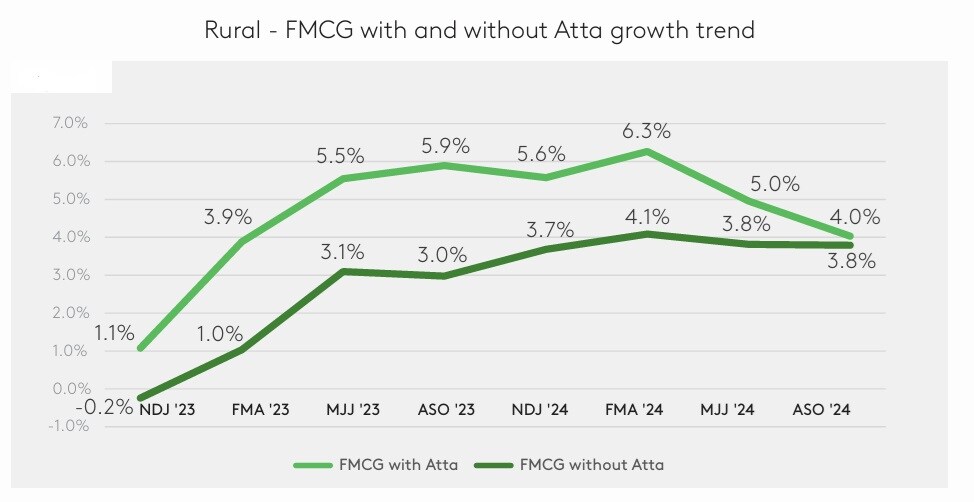
"At 4%, not only has the October quarter growth [in rural] been slower than the quarter ended July, but it is also slower than urban's quarterly growth which was at 4.5%," the report noted. "You could call this a slowdown too, but it is all led by the mega category, wheat flour (atta)."
Prices of atta have remained elevated for the past several months despite the efforts by the government to tame food inflation. The all-India monthly average retail price of atta was Rs 40 per kg in December — the highest since January 2009, the earliest month for which data are available, according to data reported by State Civil Supplies Departments to the Union Ministry of Consumer Affairs, Food and Public Distribution. For families in rural India, atta constitutes a chunk of their monthly expenditure.
The non-atta rural FMCG growth, however, is stable and growing seasonally. Kantar, which tracks household consumption of categories including food, personal care and home care, states that "confidence" in rural markets appears to be growing because of a good growth in the personal care segment, which is often considered an indicator of positive growth. Personal care categories in rural areas grew by 5.4% in the quarter ended October as compared with 2.8% a year ago, the data showed.
Source: Kantar
There are some concerns over rainfall for the rabi season, but still a major stress is not expected, the report stated. "The agriculture industry is expected to grow, and the government's continued focus on rural development will help the rural shopper. Therefore, we do see a sustained rural performance despite inflation continuing at least in the first half of 2025."
Several companies including Britannia Industries Ltd. and Parle Products Pvt. have flagged the commodity cost pressure, indicating price hikes to the tune of 4-5%.
"It's a fundamental issue as far as wheat is concerned because the crop has been lower, the government is holding less stocks," Varun Berry, managing director, Britannia Industries, said in a post-results call. "...we are hoping that acreage will improve, yields will improve on wheat next year and things will get better."
Urban: Remains Under Stress
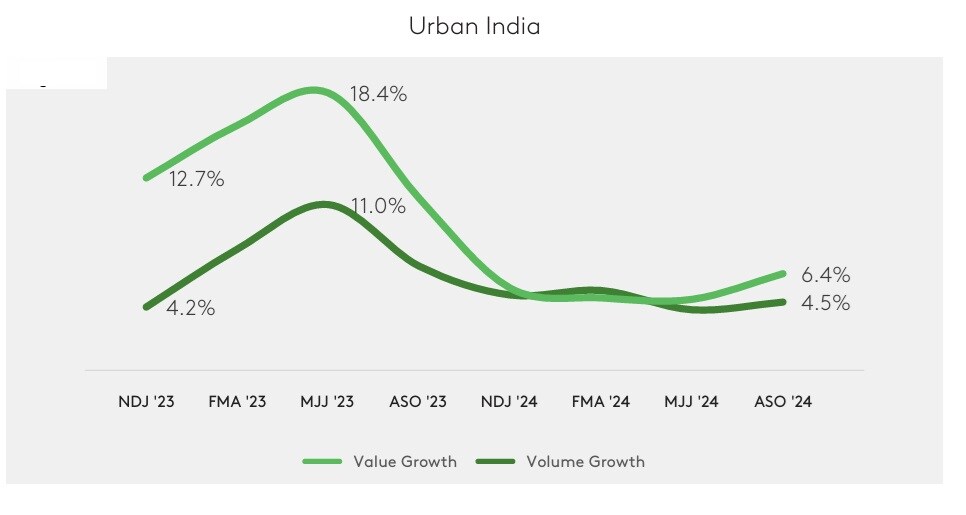
The Kantar report also noted that urban FMCG consumption slowed down by 4.5% in three months to October as compared with a growth rate of 6.9% in the same period last year. However, a 4.5% growth following a near 7% growth in the previous term is extremely rare, according to Kantar.
Source: Kantar
"In fact, over the last five years, this has only happened in the quarters of 2024," the report said, adding that "while technically urban is in a slowdown, it is far from a slump".
The average quarterly expenditure per household stood at Rs 6,761 during the quarter ended October. "Per-household average quarterly spend had crossed Rs. 6,000 for the first time in the quarter ended October of 2022. Two years since then, spends have seen a 13% jump."
Moreover, after three consecutive quarters of slowdown, value rebounded this quarter for the first time, creating a 1.9 percentage point gap between value and volume growth, the report noted.
In the quarter ending July 2024, the average price paid by shoppers for FMCG was Rs 133 per kg. Just one quarter later, this figure rose to Rs 137 per kg, reflecting an increase of Rs 4 per kg. Such a surge in prices within a single quarter has not been seen since the early stages of inflation in 2022.
Kantar attributes this to the 11.1% consumer food price index recorded for October for urban India, which is the highest growth in 15 months.
With no immediate relief from food inflation in sight, Kantar predicts that the value growth may continue to outpace volume growth for some more time on the back of planned price hikes. "As a result, it is hard to see urban growing rapidly than the current levels. We are expecting similar levels of growth to continue into the first half of the next year."

-
Navigating Friction And Energy Realities: An Analysis Of Marco Rubio's October Visit To India

Occurring at a critical juncture marked by stalled trade negotiations and escalating geopolitical pressures over global energy supplies, the visit offers a profound window into modern US-India relations.
-
India Exports Capital. Why Not Export Trusteeship?
The big question, then, is whether India can build an institution that global borrowers, investors, banks, and lawyers can trust, even without an Indian connection.
-
France's Economy & Politics Are In Crisis | The Reason Why
Let's look at how the French economy and politics evolved under Nicolas Sarkozy, Franois Hollande and Emmanuel Macron.
-
You May Inherit The Business. You Must Earn Its Credibility.
Succession tests the founder's ability to share authority as much as it tests the next generation's readiness to assume it.
-
Signing Deals Is One Thing; Making Them Work Is Another | The Week In Whys
Sometimes, things don't turn out as planned. Indian companies have lost some bids to rivals, some projects won't produce until 2030.
-
FOMC Wall, PERM Suspension, Hospital Stocks | Talking Points This Week
A PERM suspension would directly affect green-card sponsorship rather than H-1B visas, so the near-term earnings impact could remain relatively limited. The key question is whether this marks a new phase in US scrutiny of Indian IT.
-
Everything, Everywhere, All At Once: Dalal Street's Week To Forget | Joining The Dots
Visa curbs, a Starlink spat and cancer drug caps: what connects this week's shocks for Indian markets
-
India Is Going Abroad For Critical Minerals. But It May Take Years To Pay Off | The Reason Why
Although India's steps are in the right direction, they remain modest compared with India's growing dependence.
-
When Everyone Has AI, What Gives You An Edge?
India's young workforce is entering an uncertain world of work where powerful AI tools are becoming widely accessible. The advantage will belong to those who combine deep expertise with digital fluency, and the distinctly human capabilities that technology cannot manufacture.
-
Wrong Labels, High Pesticide Residues Holding Back Agri Exports | The Reason Why
India needs stronger domestic food-safety and labelling standards, with best practices becoming part of everyday business for farmers, traders and food companies.