Rising Commodity Costs Put Unilever's Margins In Spotlight, Valuation Lags Peers
Unilever's first-half results should give a sign of how the consumer goods giant is coping with soaring commodity and transport costs - whether it has managed to lift prices without hitting sales volumes, or whether margins are being squeezed.
But Thursday's results will also be vying for an attention with an ongoing row over the decision of the group's American ice-cream brand Ben & Jerry's to stop marketing its products in the occupied Palestinian territories - a move that has sparked a backlash in Israel.
Analysts expect the Dove soap and Hellmann's mayonnaise maker to report a 1.2 percentage point drop in underlying operating margins from a year ago, according to a company supplied consensus.
Pantry stocking and a surge in eating-at-home during pandemic lockdowns last year allowed Unilever to cut back on marketing and store promotions, boosting margins. But soaring commodity costs for everything from plastics to tea and nuts in the first half of 2021 have put a question mark over its full-year goal to lift margins "slightly" from last year. The company reported underlying operating margins of 18.5 per cent in 2020.
Jefferies analyst Martin Deboo expects Unilever's commodity costs to have surged 9.8 per cent in the first half, up from his initial forecast of 7.4 per cent, due mainly to higher prices of plastics, ethylene oxide and palm oils used in manufacturing and packaging its beauty and personal care products. Raw material and packaging costs account for 40 per cent of Unilever's overall sales.
"We continue to view 2021 as the year of most significant cost challenge to the industry since 2011," Deboo said. While Unilever raised prices by one per cent in the first quarter, in areas such as teas and high-inflation Latin American countries, analysts say the impact is expected to be felt only later this year, leaving it with a hefty first-half commodities bill.
Unilever is expected to raise prices further, but its initial hikes are already weakening sales volumes in countries such as Brazil, Morgan Stanley analysts noted in a research report earlier this month. Emerging markets, including Brazil, India and China, make up 60 per cent of group sales.
"Whilst these higher input costs are known, the exact actual impact on margins will have been hard to estimate so poses an additional risk to coming results, not just for the impact of this quarter but also what it means for the second-half," said Tineke Frikkee, head of UK Equity research at Unilever shareholder Waverton Investment Management.
Despite the pressures, Unilever said in April it was confident of delivering full-year underlying sales growth within its mid-term target range of three-five per cent, with the first half around the top of the range.
Some analysts are less bullish, however, citing suppressed consumption of ice-cream outside the home due to a cold April and wet May in northern Europe. Before the pandemic, out-of-home ice-cream sales accounted for eight per cent of the group total, with the second quarter a big chunk of that.
Unilever valuation lags most peers
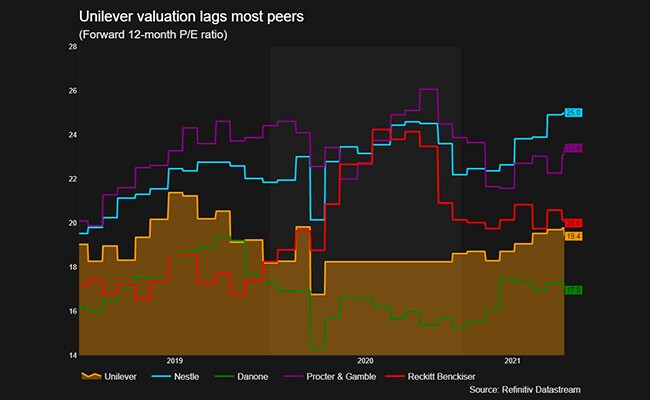
Unilever valuation lags most peers
Photo Credit: Reuters
Fundamentals
* Analysts forecast Unilever's Q2 turnover will increase 0.6 per cent to 13.38 billion euros ($15.77 billion), with underlying sales growth at 4.8 per cent, according to company supplied estimates.
* H1 underlying earnings per share are estimated at 1.24 euros, down 8.8 per cent year on year.
* H1 underlying operating margins are seen at 18.6 per cent, down 1.2 percentage points.
* Unilever shares have lost 1.6 per cent year-to-date, while the UK's benchmark FTSE 100 index has gained 6.5 per cent.
* The stock, which rose one per cent in 2020, is the weakest performer among consumer packaged goods stocks, including Nestle and Procter & Gamble, this year.
* 12 out of 21 analysts rate the stock "buy" or similar, while three have it as a "hold" and six a "sell" or similar.
* The median price target is 48 pounds versus Tuesday's close of 43.2 pounds.

-
The Curious Case of Equitas Small Finance Bank And A CEO Who Quit For Stock

PN Vasudevan believes persistent investor concerns over a perceived conflict of interest had become a governance overhang on Equitas Small Finance Bank's stock, even as the lender improved profitability and asset quality.
-
Talking Points This Week: AI Cash Burn, A Tiger Comeback And An India That Still Finds Its Own Path
India is not immune to higher oil or tighter global liquidity, yet its earnings base is broader, its domestic policy levers are still available.
-
Foreign Investors Own Half Of HDFC Bank and ICICI Bank. An LTCG Cut Could Matter Most Here
Foreign portfolio investors have US$115 billion parked in HDFC Bank, ICICI Bank. If the government cuts long-term capital gains tax, Jefferies says returning foreign money could land here first.
-
'Never Seen This Level Of Negativity': Sandeep Tandon Says The Next Rally May Be Closer Than You Think
Veteran investor Sandeep Tandon says foreign selling is easing, large-caps are due a comeback and mid-caps are crowded, while he turns positive on gold, power and pharma this Diwali.
-
Indians Stay With Family, Not In Hotels | The Reason Why
India still lacks enough clean, reliable and affordable hotels for budget-conscious travellers.
-
The Economic Imperative: Analysing The Material Driving Force Behind India-Canada Strategic Reset
This economic complementarity is further reinforced by deep institutional investment ties and talent mobility, which form the bedrock of the bilateral framework.
-
Medicine Pricing: Where Must Profit Stop?
India must confront excessive margins, hidden incentives and regulatory gaps that threaten the integrity of medicine.
-
Why Amazon And Flipkart Are Struggling To Beat Meesho In India's Smaller Cities
With 274 million users and lowest-cost logistics, Meesho is defending its value commerce crown against giants like Amazon and Flipkart.
-
High US Salaries, No Green Card Certainty: The Financial Calculation Facing Indian H-1B Families
The suspension of PERM processing at eight technology employers does not cancel existing H-1B visas. What it does is force a question many Indian families have been avoiding: is the US salary worth tying your career and family plans to one employer?
-
Swiggy vs Eternal: Food Delivery's Two Rivals Are No Longer In The Same Race
Eternal is building a private AI assistant, dark.ai. Swiggy is still working out how to make Instamart pay, with an operating loss of Rs 895 crore in the July-September quarter while Blinkit stayed profitable.










