Decade-Old RIL-ONGC Gas Migration Dispute To Reach 'Logical End' After $2.81-Billion Compensation Demand
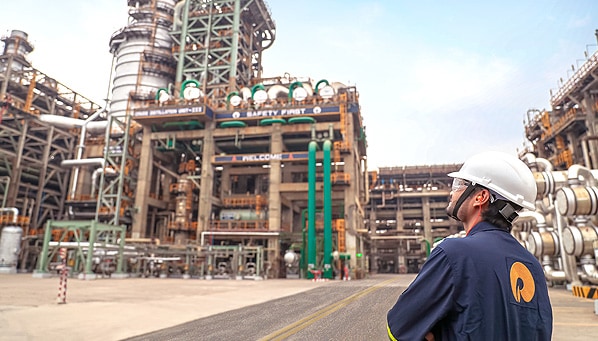
A decade-long dispute between Reliance Industries Ltd. and the Union government over gas migration to the company's KG-D6 block from those of Oil & Natural Gas Corp. is finally reaching its "logical end".
The government has demanded a whopping $2.81 billion from RIL and its consortium partners, increasing the stakes in this high-profile case, with the company now planning to challenge the decision in the Supreme Court, according to an exchange filing on Tuesday.
In 2013, ONGC brought up the issue of natural gas from its blocks allegedly seeping into RIL's KG-D6 block. A former ONGC official aware of the matter claimed that RIL was aware of the gas migration and was liable to pay for the gas it consumed.
It is a matter of liability. RIL has the constitutional right to explore legal options, but they cannot deny the fact that they consumed gas that did not belong to them, the official said on the condition of anonymity.
"RIL is likely to take the matter to the Supreme Court following a similar template they used during international arbitration," Deven Choksey, managing director of DR Choksey Finservm said.
Controlling the flow of natural gas in offshore conditions is extremely difficult and a decade-long matter will reach its "logical end", according to Choksey.
"This is a complex issue and it's not unusual for disputes like this to arise in fields with interconnected geological formations," Anish De, global head of energy at KPMG, said. "In such cases, oil and gas naturally flow between designated field boundaries."
A typical example is of Qatar and Iran, which share such connected reservoirs between North Field of Qatar and South Pars of Iran. "It becomes challenging and difficult to limit flows or conclusively establish any wrongful extraction in such instances," De added.
However, there is a possibility of the two companies arriving at a mutually agreed settlement over the matter. The arbitral award earlier was against a demand of $1.55 billion that has now increased to $2.81 billion, which may get reduced under a settlement. Taking the issue to the Supreme Court will further delay the matter, according to a consultant with an international consultancy firm who also spoke on the condition of anonymity.
RIL's stock has been under pressure over the last couple of months and has declined over 23% in the last one year. The stock has already priced in the negative news from February, but the possibility of a settlement remains, according to an analyst who did not want to be quoted.
As the matter heads to the Supreme Court, all eyes are on the outcome of this decade-long dispute.
History
The dispute dates back to 2013 when ONGC suspected that RIL's KG-D6 block was draining gas from its adjacent blocks.
ONGC was asked to sidestep as it had no ownership rights on the property as it belonged to the government.
In 2016, the government sought $1.55 billion from RIL and its partners for the quantum of gas that had migrated to its block KG-D6.
RIL contested the claims before an arbitral tribunal, which upheld in July 2018 that it was not obliged to pay any compensation.
The government filed an appeal and a single judge of the Delhi High Court upheld the arbitration award in May 2023, dismissing the appeal.
In February, a division bench of the high court set aside the single judge order, ruling against RIL and its partners.
The government demanded $2.81 billion in compensation from RIL
Reliance plans to challenge the judgment in the Supreme Court, stating that the demand is "unsustainable" and that they don't expect any liability on this account.
Watch

-
Foreign Investors Own Half Of HDFC Bank and ICICI Bank. An LTCG Cut Could Matter Most Here

Foreign portfolio investors have US$115 billion parked in HDFC Bank, ICICI Bank. If the government cuts long-term capital gains tax, Jefferies says returning foreign money could land here first.
-
'Never Seen This Level Of Negativity': Sandeep Tandon Says The Next Rally May Be Closer Than You Think
Veteran investor Sandeep Tandon says foreign selling is easing, large-caps are due a comeback and mid-caps are crowded, while he turns positive on gold, power and pharma this Diwali.
-
Indians Stay With Family, Not In Hotels | The Reason Why
India still lacks enough clean, reliable and affordable hotels for budget-conscious travellers.
-
The Economic Imperative: Analysing The Material Driving Force Behind India-Canada Strategic Reset
This economic complementarity is further reinforced by deep institutional investment ties and talent mobility, which form the bedrock of the bilateral framework.
-
Medicine Pricing: Where Must Profit Stop?
India must confront excessive margins, hidden incentives and regulatory gaps that threaten the integrity of medicine.
-
Why Amazon And Flipkart Are Struggling To Beat Meesho In India's Smaller Cities
With 274 million users and lowest-cost logistics, Meesho is defending its value commerce crown against giants like Amazon and Flipkart.
-
High US Salaries, No Green Card Certainty: The Financial Calculation Facing Indian H-1B Families
The suspension of PERM processing at eight technology employers does not cancel existing H-1B visas. What it does is force a question many Indian families have been avoiding: is the US salary worth tying your career and family plans to one employer?
-
Swiggy vs Eternal: Food Delivery's Two Rivals Are No Longer In The Same Race
Eternal is building a private AI assistant, dark.ai. Swiggy is still working out how to make Instamart pay, with an operating loss of Rs 895 crore in the July-September quarter while Blinkit stayed profitable.
-
Where You Live Shapes How You Get To Work | The Reason Why
Two-wheelers are the most popular way to get to work in India, accounting for nearly 43% of workplace commutes.
-
Unhedged Position: Can India See An Indonesia-Style Time Correction?
The Nifty is trading below levels it first clocked in 2024. Is there, then, as I have suggested in the headline, potential that the current time correction drags on painfully for the next three-five, even ten years?










