Return To Office Highest In Telecom, Consulting Sectors; IT Lags: Report
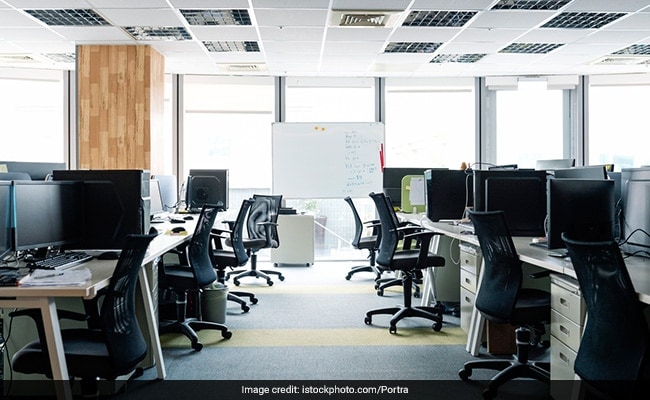
Majority of employees in telecom and consulting sectors have returned to office with significant fall in COVID-19 cases but the IT sector is lagging, according to a survey by Colliers and Awfis.
Property consultant Colliers India and co-working operator Awfis' joint report explores the status of return to work across different sectors.
"As the third wave of COVID-19 started waning in February, the return-to-office gained momentum. As a result, by June 2022 about 34 per cent of the companies saw about 75-100 per cent of the employees back in office (includes hybrid work)," the report said.
About 41 per cent of occupiers stated that only up to 25 per cent of their employees have returned to office.
The survey showed that telecom and consulting sectors saw the highest (75-100 per cent) rate of return to office while IT and new technology companies saw the lowest (0-25 per cent) rate of return to office.
"The survey has made it clear that a distributed workspace strategy is the way to go for occupiers in this new era of experiential workplaces, as occupiers emerge from the after-effects of the pandemic. Flex spaces, in particular, are leading this growth, as occupiers from varied sectors are housing teams in flex centres across cities," Colliers India CEO Ramesh Nair said.
Flexible workspace operators leased about 3.5 million square feet of office space in January-June this year across the top six cities, almost three-fourths of the flexible space leasing in entire 2021, he added.
The survey was conducted during May-June among occupiers to understand their strategies regarding distributed workplace. The respondents were from different sectors such as IT/ITeS, BFSI, engineering and manufacturing and others.
Total 150 responses were received from C-Suite executives spanning Founders, CEOs, COOs and CHROs of various companies. The company size of the respondents varied, starting from a range of 1-500 employees to companies having over 10,000 employees.
As per the survey, about 74 per cent of the occupiers are likely to adopt distributed workspace while 53 per cent of occupiers prefer working from home plus office as their preferred workplace portfolio strategy.
About 49 per cent of the occupiers are likely to adopt flex centres to enable distributed workspace, followed by setting up their own offices in metro and non-metro cities.
The consultant sees opportunities for flex spaces not only in metro cities but also in non-metro cities. "In fact, in non-metro cities, total flex spaces are likely to grow more than two-fold to 5.5 million square feet by the end of 2022," Mr Nair said.
Amit Ramani, Founder and CEO, Awfis said the findings of the survey are a testament to the success of the distributed work model and subsequently of flex spaces in catering to the ever-evolved workspace needs of India Inc.
"Going forward, 77 per cent occupiers will include flex spaces as part of their workplace strategy. We expect exceptional demand in the future, driven largely by large corporates for de-densification of existing traditional offices," he added.
According to the Colliers India data, the gross leasing of office rose to 32.9 million square feet in 2021 from 30.1 million square feet in the previous year. During 2019, the numbers stood at 44.8 million square feet across six cities -- Delhi-NCR, Mumbai, Bengaluru, Chennai, Hyderabad and Pune.
In the first six months of this year, the office leasing has risen to 27.5 million square feet from 10.3 million square feet in the year-ago period. The share of leasing by flexible workspace operators stood at 13 per cent.
(This story has not been edited by NDTV staff and is auto-generated from a syndicated feed.)

-
Your iPhone Costs 12 Grams Of Gold, A Car About 100. What Does Your Life Weigh?

Measured in rupees, almost everything looks more expensive than it did a generation ago. Measured in grams of gold, a lot of it has become cheaper.
-
Gold Is Rs 22,000 Cheaper Than A Month Ago. Should You Buy Amid The Wedding Season?
Gold's potential slide to $3,500 could save around Rs 4,700 per 10 grams, but a soft inflation print could just as easily push prices back up. One way to split the risk is to buy in parts, some now and the rest after the Fed's Dec. 9 decision.
-
AI Agents Are Gaining Power. Who Governs Them?
Artificial intelligence agents promise to transform productivity by moving machines from assisting decisions to executing them. But as organisations delegate greater authority to these AI-agents, they must first establish who controls that authority and who remains accountable when things go wrong.
-
Why Swapping Your Old Gold Can Trigger A Rs 5 Lakh Tax Bill, And How You Can Avoid It Legally
Swapping old gold for new is taxed as a sale and a fresh purchase. Getting your own gold remade can cut most of that bill, though it has its own costs.
-
The AI Trade is Done. The Real Opportunity for Investors Starts in 2027 | Unhedged Position
As pureplay AI stocks plunge and circular, capex-led financing unwinds, 2027 is set to be a year of reckoning for AI companies. Yet the bust clears the way for a better opportunity for investors in 2027 -- shifting the spotlight from AI builders to the companies using AI.
-
Leadership As Mission: Why The Age Of AI Demands More Human Leadership
Debjani Ghosh examines how AI is changing leadership, arguing that its success must be measured by its impact on people and the accountability of those guiding its use.
-
We May Need Another Tukaram Mundhe To Fight Air Pollution | The Reason Why
Developers may install basic measures such as sprinklers and green nets, resume work, and continue violating rules when this equipment stops working.
-
Extracting Value From Battery Scrap Could Be Challenging For India | The Reason Why
A discarded lithium-ion battery still contains valuable materials such as lithium, nickel and cobalt. These can be recovered and reused. When such batteries are crushed and shredded, they produce a dark powder called black mass.
-
One El Nino, India Can Handle. Two Could Break The Granary
India's grain stocks can absorb one bad year, but a second El Nino could drain the buffer in two to three years, economists say.
-
India's Troika Of Good Luck | Joining The Dots
As Jensen Huang's exit drags Nvidia down, a cooling AI trade and resilient earnings have revived investor interest in India. A likely RBI rate hike looms.









