Reliance Industries Shares Surge On Mukesh Ambani's Plan To Slash Debt
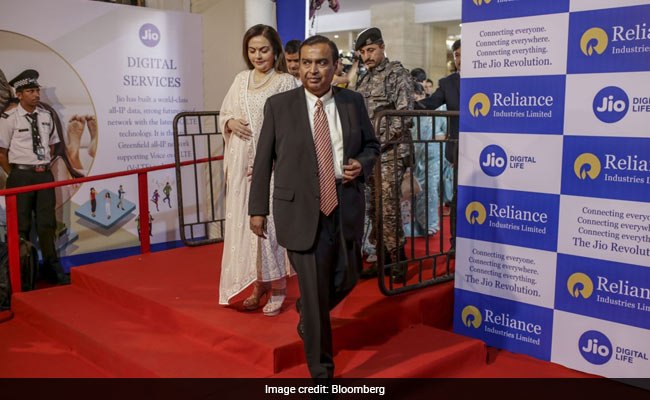
Reliance Industries Ltd. soared the most in more than two years after billionaire Mukesh Ambani revealed a plan to sell a stake to Aramco as part of efforts to pare debt.
The conglomerate aims to be a zero-net-debt company in 18 months, Asia's richest man told shareholders Monday. Aiding that would be a proposed sale of 20 per cent of Reliance's oil-to-chemicals business to Saudi Arabian Oil Co. at an enterprise value of $75 billion. The company will also start preparing to list its retail and telecommunications units within five years, Mr Ambani said.
Shares of Reliance jumped as much as 9.3 per cent in Mumbai on Tuesday, their biggest intraday gain since February 22, 2017. Morgan Stanley, Macquarie Group and BOB Capital Markets were among brokerages that upgraded the stock.
The tycoon is cleaning up the group's finances following years of spending on his wireless carrier, whose entry in 2016 with free calls and cheap data upended the industry and spurred a consolidation. The $50 billion plowed into the phone venture, mostly in debt, has raised concerns among analysts including at Credit Suisse Group AG that Reliance's ballooning borrowings could weigh on growth. Mr Ambani sought to allay those fears.
"With these initiatives, I have no doubt that your company will have one of the strongest balance sheets in the world," he said. "We will also evaluate value unlocking options for our real estate and financial investments." The group spent $76 billion in the last five years, he said.
The Aramco deal should be completed by March and is subject to due diligence, definitive agreements and regulatory and other approvals, Mr Ambani said. He didn't say how the deal would be structured.
Saudi Aramco and Reliance Industries have agreed to a non-binding Letter of Intent regarding a proposed investment in the Indian company's oil-to-chemicals division comprising the refining, petrochemicals and fuels marketing businesses, according to a statement from Reliance on Monday.
Signaling an end to the spending cycle at Reliance Jio Infocomm Ltd., Mr Ambani is setting a new growth path for his group, whose bread-and-butter business has been oil refining and petrochemicals. The company is building an e-commerce platform by leveraging its phone network and Reliance Retail Ltd. to eventually take on Amazon.com Inc. and Walmart Inc.
"This is a unique business model we are building in partnership with millions of small merchants" and mom-and-pop stores, he said. As part of the plan, Reliance has been forming partnerships and acquiring technology assets. This month, Reliance announced plans for a joint venture with Tiffany & Co. to open stores for the jeweler in India, and in May paid $82 million for the British toy-store chain Hamleys.
The new businesses are likely to contribute 50 per cent of Reliance's earnings in a few years, from about 32 per cent, Mr Ambani said.
What Bloomberg Intelligence Says
"Reliance Industries could dominate the Indian telecom and organized-retail segments through aggressive expansion, capitalizing on its energy business. More than $7 billion in annual cash flow from the energy business provides a war chest to win market share in the retail and telecom industries"
--Kunal Agrawal, energy analyst
While the spending on Jio has helped Reliance lure almost 350 million users in the world's second-biggest mobile market, the growth has come at a price.
Not Since 2013
Reliance had a net debt of Rs 1.54 lakh crore ($22 billion) at the end of March 31, according to Mr Ambani. His plan to carry zero debt would mean the borrowings would fall below the company's cash reserves to a level not seen since 2013.
Last week, Credit Suisse cut its recommendation for Reliance's stock and the price target citing reasons including rising liabilities and finance costs. Shares of the company pared their losses Tuesday after having earlier slumped about 18 per cent from a record reached on May 3. The benchmark S&P BSE Sensex declined 4 per cent in the same period.
Reliance's debt is backed by "extremely valuable assets," Mr Ambani said, signaling his group isn't prone to the kind of troubles that have been plaguing many other corporate borrowers in India. The conglomerate controlled by Mr Ambani's younger brother, Anil, has been struggling to pay creditors while his mobile carrier has slipped into bankruptcy.
Apart from the Aramco deal, Reliance also announced a joint venture with BP Plc this month, under which the European oil major would buy 49 per cent of the Indian firm's petroleum retailing business. Reliance would receive about Rs 7,000 crore under this deal.
The "commitments" from the Aramco and BP deals alone are about Rs 1.1 lakh crore, Mr Ambani said, adding that Reliance will induct "leading global partners" in telecom and retail units in the next few quarters.
- Some of the planned offerings revealed by Mr Ambani:
- A new broadband service called Jiofiber will start commercial services from September 5 and will be available at tariff packs starting as low as Rs 700 a month with a minimum speed of 100 Mbps
- Jio will install across India one of the world's largest blockchain networks in the next one year
- After mobile broadband, Jio to start generating revenues from Internet of Things and broadband for home, businesses and smaller enterprises by March 2020
- Reliance is getting ready to roll out the new commerce platform at a larger scale to capture what Ambani sees as a $700 billion business opportunity
- Reliance Retail aims to be among the world's top 20 retailers in the next five years

-
We May Need Another Tukaram Mundhe To Fight Air Pollution | The Reason Why

Developers may install basic measures such as sprinklers and green nets, resume work, and continue violating rules when this equipment stops working.
-
Extracting Value From Battery Scrap Could Be Challenging For India | The Reason Why
A discarded lithium-ion battery still contains valuable materials such as lithium, nickel and cobalt. These can be recovered and reused. When such batteries are crushed and shredded, they produce a dark powder called black mass.
-
One El Nino, India Can Handle. Two Could Break The Granary
India's grain stocks can absorb one bad year, but a second El Nino could drain the buffer in two to three years, economists say.
-
India's Troika Of Good Luck | Joining The Dots
As Jensen Huang's exit drags Nvidia down, a cooling AI trade and resilient earnings have revived investor interest in India. A likely RBI rate hike looms.
-
Talking Points This Week: Leadership Shock At Nvidia, Earnings Strength, And The Fog Over Hormuz
The Anthropic IPO pricing and first trading day, Nvidia's upcoming earnings, and any fresh signals from Iran will set the tone for the following week.
-
Signature Play: The Classic Cocktail Is Dead. Or Is It?
Classic cocktails are disappearing from India's cocktail menus. But they're still being ordered, taught to bartenders and borrowed from. So, who's really having the last drink?
-
A New Samvat Wishlist: Inclusive Prosperity And Human Development
India has strengthened its economic foundations through infrastructure, digital access and enterprise. Its next growth chapter must deepen productivity, create better livelihoods and widen participation in prosperity.
-
Love, Sex Aur Dhokha: The Audacious Plot To Spy On Jensen Huang
A Taipei dinner, a Singapore chip buyer and a suspected Chinese asset: inside the alleged spy operation that got close to NVIDIA's Jensen Huang.
-
Ten Things I Learnt This Samvat
Patience can be a trap. Cheap stocks can stay cheap. Leverage can wipe you out. What did Samvat 2082 teach us? Niraj Shah writes on 10 lessons from the year gone by.
-
Talking Points This Week: Tech Nerves, FII Buying, And A Faraway Banking Shock
The global markets are not shining this Diwali. The exception in the large markets is, India.









