Reform Will Be Key Pillar In Boosting India's Growth: Tata Sons Chairman N Chandrasekaran
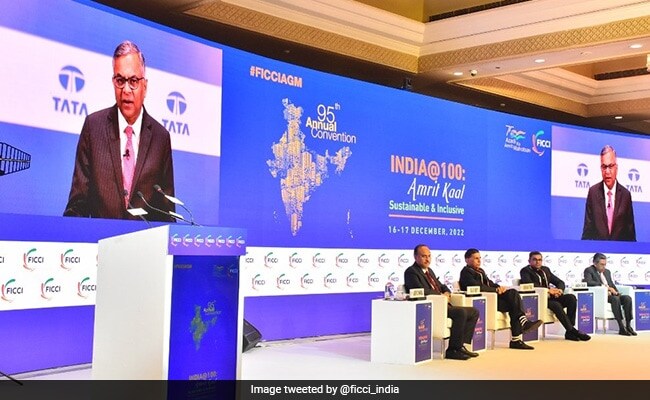
Reforms will be a key pillar that will propel fundamentals of India's performance in the coming decades, which have a major growth opportunity for the country, Tata Sons Chairman N Chandrasekaran said today.
While the country can look forward to becoming a $25-30 trillion economy in its 100th year of Independence, it is also crucial to spread the gains of the future to everyone, including informal workers, agricultural labourers and women, he said while addressing the annual convention of industry body FICCI.
N Chandrasekaran noted that the government has taken several reforms before and after the pandemic which has set a strong foundation for a renewed vision for India in 2047.
"Looking for the next few decades, India presents a major growth opportunity. At the same time, it is important to remember the scope of reforms India has undertaken in the last few years," he said.
Pre-pandemic, the government introduced GST, Insolvency and Bankruptcy Code (IBC), inflation targeting framework, a reduction in the corporate tax rate and addressing the banking sector balance sheets, Chandrasekaran added.
He further said since the pandemic, the pace of structural reforms has picked up further, highlighting measures like labour reforms, PM Gati Shakti, and national asset monetization plan, production link incentive scheme to boost domestic manufacturing, higher investment limits for small businesses, power sector reforms and aggressive disinvestment targets.
"The scope and scale of economic reform has been really fast-paced, and this will drive productivity improvements and the continued growth and capital accumulation. Reform is going to be a key pillar that will propel the fundamentals of India's growth performance in the coming decades," he asserted.
Crucially, in past few years, N Chandrasekaran said India has also made significant progress in achieving results in the social sector, particularly in extending the reach and access of basic services citing examples of electrification, bank accounts, healthcare insurance, sanitation, and connectivity.
"Hundreds of millions of people have been lifted out of poverty, while health outcomes have also improved significantly," he said, adding the country also implemented one of the most successful COVID-19 vaccination programmes in the world.
This strong foundation, he said, sets the stage for a renewed vision for India, at 2047.
"As we celebrate our 100th year of Independence, we will need to be deliberate in ensuring that fruits of our long-term growth potential reach every citizen," he added.
The big question is, he said,"How do we spread the gains of the future to everyone, informal workers, agricultural labourers, and women who want to participate in our workforce?" N Chandrasekaran further asserted,"It is our responsibility to set the best path that will ensure a future India that in 100 years of Independence can be $25 to 30 trillion in size but more importantly, in what manner our nurses, farmers, teachers and truck drivers, all have the opportunity of having a good job and the stability that other people enjoy."
He said India is now "clearly the fastest growing major economy, a real bright spot" in an otherwise gloomy global economy and it "will likely remain the world's fastest major economy for the third consecutive year in 2023, and hopefully for seven years to come." The Tata Sons Chairman stressed on the need to focus on improving healthcare, focus on tourism, embracing the opportunities in digitalisation, propelling renewable energy and cut pollution while pushing for clean technologies like solar energy and electric vehicles for the country to be a global leader in the future.

-
Signature Play: The Classic Cocktail Is Dead. Or Is It?

Classic cocktails are disappearing from India's cocktail menus. But they're still being ordered, taught to bartenders and borrowed from. So, who's really having the last drink?
-
A New Samvat Wishlist: Inclusive Prosperity And Human Development
India has strengthened its economic foundations through infrastructure, digital access and enterprise. Its next growth chapter must deepen productivity, create better livelihoods and widen participation in prosperity.
-
Love, Sex Aur Dhokha: The Audacious Plot To Spy On Jensen Huang
A Taipei dinner, a Singapore chip buyer and a suspected Chinese asset: inside the alleged spy operation that got close to NVIDIA's Jensen Huang.
-
Ten Things I Learnt This Samvat
Patience can be a trap. Cheap stocks can stay cheap. Leverage can wipe you out. What did Samvat 2082 teach us? Niraj Shah writes on 10 lessons from the year gone by.
-
Talking Points This Week: Tech Nerves, FII Buying, And A Faraway Banking Shock
The global markets are not shining this Diwali. The exception in the large markets is, India.
-
Midterm Rally Lasted A Day. The Hard Reality Of A Divided US May Last Two Years | Opinion
Between a contested AI boom, a debt ceiling that arrives in 2027 and a president with every incentive to act alone, the next two years may prove more volatile than the first day's rally suggests.
-
Blue Wave Will Derail the AI Trade but Won't Dismantle the AI Era | Unhedged Position
The Democrats' sweep of the US Congress will see politics collide with economic forces both over the long and short term.
-
It's Time To Take The GST Council's Bet On Trust Global
Payment records can prove India's services exports, and clear, proportionate rules can bring foreign digital sellers into the tax net.
-
Opinion | India at 38: From Innovation Overperformer to Innovation Powerhouse
India now has 453 VC-backed deep science startups, 18 of them late-stage, after 117 percent growth since 2020. Laurus Labs, at USD 9.3 billion, is the most valuable deep science company in any middle-income economy outside China.









