Recovery has created far more low-wage jobs than better-paid ones
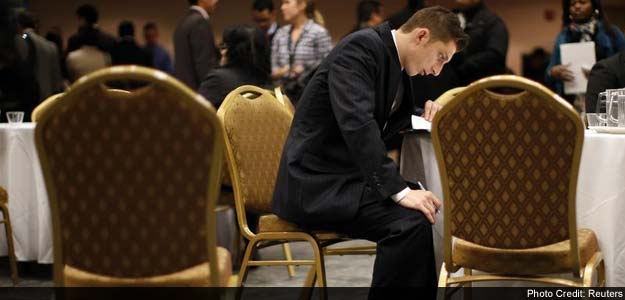
The deep recession wiped out primarily high-wage and middle-wage jobs. Yet the strongest employment growth during the sluggish recovery has been in low-wage work, at places like strip malls and fast-food restaurants.
In essence, the poor economy has replaced good jobs with bad ones. That is the conclusion of a new report from the National Employment Law Project, a research and advocacy group, analyzing employment trends four years into the recovery.
"Fast food is driving the bulk of the job growth at the low end - the job gains there are absolutely phenomenal," said Michael Evangelist, the report's author. "If this is the reality - if these jobs are here to stay and are going to be making up a considerable part of the economy - the question is, how do we make them better?"
The report shows that total employment has finally surpassed its pre-recession level. "The good news is we're back to zero," Evangelist said.
But job losses and gains have been skewed. Higher-wage industries - like accounting and legal work - shed 3.6 million positions during the recession and have added only 2.6 million positions during the recovery. But lower-wage industries lost 2 million jobs, then added 3.8 million.
With 10.5 million Americans still looking for work - the unemployment rate is 6.7 percent - employers feel no pressure to raise wages for those who are working. As a result, the average household's take-home pay has declined through the recession and the recovery to $51,017 in 2012 from $55,627 in 2007, after adjusting for inflation.
With joblessness high and job gains concentrated in low-wage industries, hundreds of thousands of Americans have accepted positions that pay less than they used to make, in some cases, sliding out of the middle class and into the ranks of the working poor.
That includes Connie Ogletree, a former administrative and executive assistant who now earns $7.25 an hour at a McDonald's in Atlanta. "It was 40 years ago that I had my first fast-food job, at a Dairy Queen," said Ogletree, 55. "This is my second."
Ogletree is in school working toward a bachelor's degree, in the hope of returning to a white-collar position. But in the meantime, she and her older sister have scrimped and saved to make ends meet on her meager earnings.
She said that she appreciated her job - many do not have one - but that she found the work tough.
"When you go into a fast-food restaurant, you want to be sure the people in the back are doing the best job they can," she said. "You want them not to be worried about missing a day if they're sick, to be able to go to a child's play at school or a PTA meeting. I'd like a vacation once a year, but my employer doesn't offer that, or sick days."
The National Employment Law Project study found that there were about 1 million fewer jobs in middle-wage industries - including parts of the health care system, loan servicing and real estate - than there were when the recession hit.
Economists worry that even a stronger recovery might not bring back jobs in traditionally middle-class occupations eroded by mechanization and offshoring. The U.S. work force might become yet more "polarized," with positions easier to find at the high and low ends than in the middle.
The swelling of the low-wage work force has led to a push for policies to raise the living standards of the poor, including through job training, expansion of health care coverage and a higher minimum wage.
President Barack Obama has supported a Democratic proposal to lift the federal minimum wage to $10.10 an hour from its current level of $7.25.
"Nobody who works full-time should ever have to live in poverty," Obama said on Saturday in his weekly address. "That's why nearly 3 in 4 Americans support raising the minimum wage."
Raising it to $10.10 would "lift wages for nearly 28 million Americans across the country," he said. "We're not just talking about young people on their first job. The average minimum-wage worker is 35 years old. They work hard, often in physically demanding jobs."
But with congressional inaction stalling that proposal, many state and local governments have forged ahead on their own. States including Connecticut, New York, New Jersey, California and Rhode Island have raised their local minimum wages. And a total of 34 states are considering lifting their wage floors, while activists in other states are pushing for ballot referendums to do so.
"They're actually getting the job done, so that workers get a raise," said Thea Lee, the deputy chief of staff of the AFL-CIO. "The hope is that it creates momentum nationally and builds an activist base."
But many Republicans oppose raising the wage floor while the economy remains weak. And many businesses staunchly oppose higher minimum wages because of the threat to their bottom lines.
The National Employment Law Project study found especially strong growth in restaurants and food services, administrative and waste services and retail trades. Those industries - which often pay wages at the federal minimum - accounted for about 40 percent of the increase in private sector employment during the past four years.
There has also been strong jobs growth in some high-paying industries, like professional, scientific and technical services - a category that includes accountants, lawyers, software developers and engineers. That sector accounted for about 9 percent of the private-sector job gains in the recovery.
© 2014, The New York Times News Service

-
Getting To Work Costs Women More | The Reason Why

It is not just about women paying more than men. It is about women paying much more in cities than in villages.
-
AI Bias In Investing Cannot Be Eliminated, But It Can Be Governed
Framing is a particularly important example as identical financial information presented in terms of gains rather than losses can lead an LLM to reach a different assessment.
-
Joining The Dots | Dark Skies, Steady Diya: Why Hope Holds This Diwali
With war, a weak rupee and foreign outflows weighing on sentiment, policymakers at the NDTV World Summit and market veterans at NDTV Profit Ignite: Diwali Edition offered the same advice: stay invested and filter out the noise.
-
The Curious Case of Equitas Small Finance Bank And A CEO Who Quit For Stock
PN Vasudevan believes persistent investor concerns over a perceived conflict of interest had become a governance overhang on Equitas Small Finance Bank's stock, even as the lender improved profitability and asset quality.
-
Talking Points This Week: AI Cash Burn, A Tiger Comeback And An India That Still Finds Its Own Path
India is not immune to higher oil or tighter global liquidity, yet its earnings base is broader, its domestic policy levers are still available.
-
Foreign Investors Own Half Of HDFC Bank and ICICI Bank. An LTCG Cut Could Matter Most Here
Foreign portfolio investors have US$115 billion parked in HDFC Bank, ICICI Bank. If the government cuts long-term capital gains tax, Jefferies says returning foreign money could land here first.
-
'Never Seen This Level Of Negativity': Sandeep Tandon Says The Next Rally May Be Closer Than You Think
Veteran investor Sandeep Tandon says foreign selling is easing, large-caps are due a comeback and mid-caps are crowded, while he turns positive on gold, power and pharma this Diwali.
-
Indians Stay With Family, Not In Hotels | The Reason Why
India still lacks enough clean, reliable and affordable hotels for budget-conscious travellers.
-
The Economic Imperative: Analysing The Material Driving Force Behind India-Canada Strategic Reset
This economic complementarity is further reinforced by deep institutional investment ties and talent mobility, which form the bedrock of the bilateral framework.
-
Medicine Pricing: Where Must Profit Stop?
India must confront excessive margins, hidden incentives and regulatory gaps that threaten the integrity of medicine.










