RBI’s Monetary Policy Shift: Connecting The Past, Present, And Future
The Reserve Bank of India and its Monetary Policy Committee surprised on multiple fronts – an off-cycle repo rate hike, a larger-than-expected 40 basis point quantum of increase, and a double-barrelled shift as the hike was accompanied by an increase in the cash reserve ratio by 50 bps to 4.5% of net demand and time liabilities. The shift in the policy narrative has been dramatic since January 2022, when growth was still high on the list of priorities, overshadowing the policy mandate i.e., inflation.
Three questions arise, then – what has changed since a dovish January-February 2022 (past), why the urgency (present), and what lies ahead (future)?
What's Changed, Why The Urgency, What Lies Ahead?
Addressing the first, the central bank was dovish in its guidance in its post-union budget rate review. Inflation was seen as a risk but expected to return to the midpoint of the policy target by end-FY23. The absence of a broad-based recovery, as well as the short-term impact of the Omicron variant of Covid-19, were posing downside risks to growth. This was notwithstanding near-term momentum, and the centre's strong capex push at the budget, which backed the official FY23 real GDP forecast at 7.8%. The rupee's resilience and ample reserves buffer provided policymakers with the confidence that India's policy path could decouple from the U.S. Federal Reserve's tightening bias and move on its own beat.
The ground shifted at the April rate review, bringing inflation back to the centre of the policy dashboard, backed by the 120 bps upward revision in price forecasts. Even as the Omicron wave eased, commodity prices have been driven sharply higher – ominously (predominantly) by geopolitical tensions, narrowing output gaps, and idiosyncratic factors (weather, and in a few instances, resource nationalism). India being a price taker when it comes to commodities, has witnessed a passthrough of higher crude oil, edible oils, base metals, and food, amongst others. Bigger firms are in a much better position to pass the rise in input prices, as the pandemic accelerated the formalisation process.
The timing of the May 4 move was likely intended to front-run the upcoming sharp rise in April inflation (which could be higher than 7.5% YoY based on our estimate) after the above-target rage inflation in January-March 2022. Add to this, the likelihood of a 50 bps hike from the U.S. Federal Open Market Committee and hawkish commentary this week might have also prompted the RBI's hand. While we are still of the view that the U.S. policy moves play a smaller role in the RBI's policy matrix, it would be hard to overlook the fallout of a sharp widening in rates or yield spreads, given its concomitant risk to foreign interests, even if the quantum of interest-sensitive flows is much smaller now than three-four years back.
A sustained rally in the dollar index coupled with a weakening bias in the yuan might also test the rupee's relative resilience.
What lies ahead? Inflation risks are becoming more generalised as the pass-through of higher input costs to consumers occurs with a lag, apart from transportation and logistics. This coupled with the likelihood that as reopening from the pandemic is complete, the nature of inflation will shift from being purely goods driven to services-led, thereby making price increases more enduring. These will underpin core readings and raise the risk of un-anchoring inflationary expectations.
Add to this, the May surprise move has lowered the bar for aggressive policy tightening moves. A likely addition of 50-100 bps hikes, on top of our forecast of a 75 bps increase in 2022, is not trivial. Given the clear guidance of a return to a pre-pandemic level of 5.15%, this could happen quickly, possibly within July-September 2022.
Markets might be quick to draw parallels with the aggressive hiking cycle, such as in 2010, with one-year implied rates at 150 basis points above the 4.4% repo rate level.
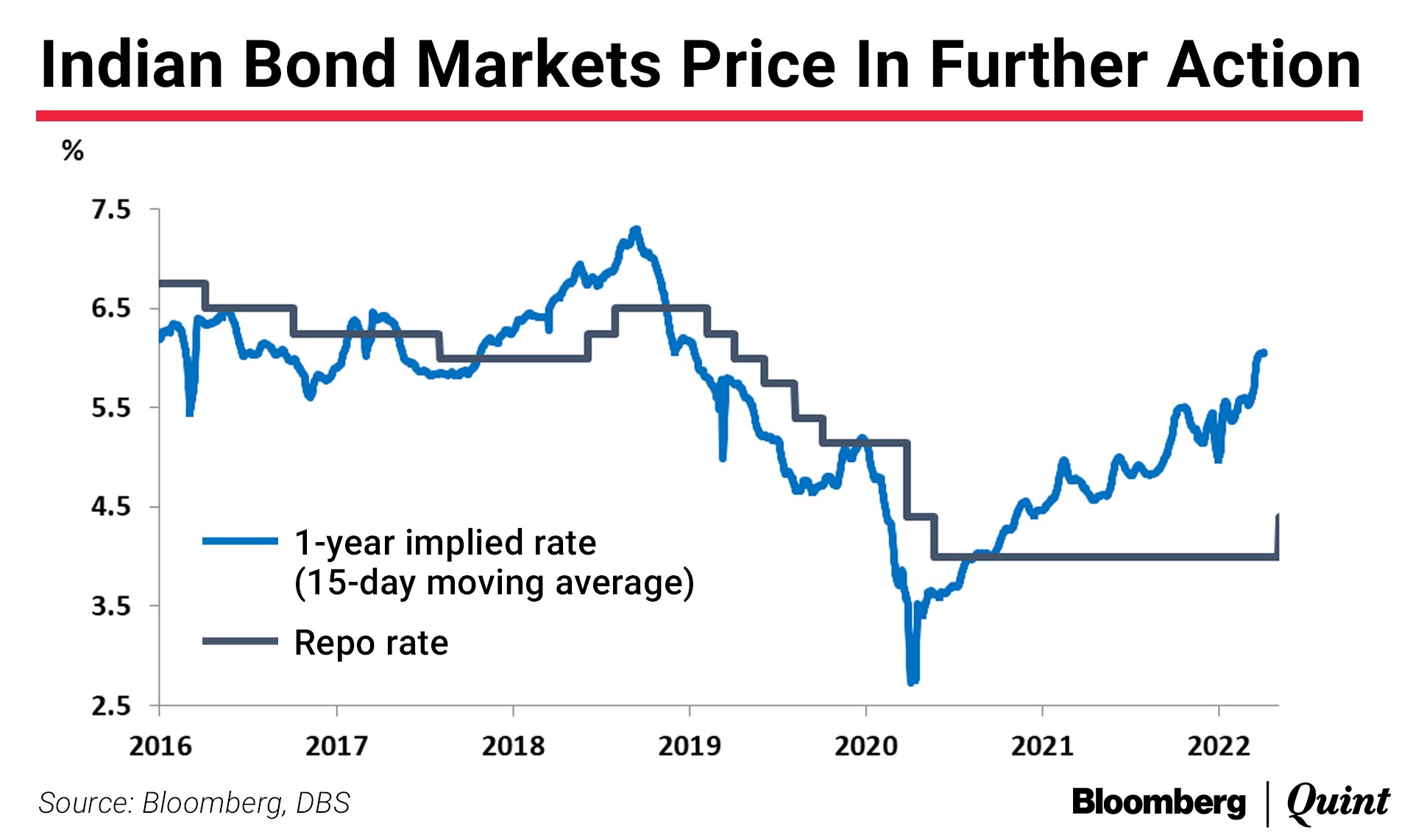
Markets are understandably under weather. Bond yields rose sharply in reaction to the unexpected rate hike, with a flattening bias to build in as price stability becomes a priority, buttressed further by a negative impulse on growth due to a tighter monetary policy. The cost of capital is bound to go up as loans linked to external benchmarks get adjusted and markets-based borrowing costs also get dearer, just as global rates are also on the climb.
Radhika Rao is Senior Economist and Executive Director at DBS Bank, Singapore.
The views expressed here are those of the author, and do not necessarily represent the views of BloombergQuint or its editorial team.

-
Signature Play: The Classic Cocktail Is Dead. Or Is It?

Classic cocktails are disappearing from India's cocktail menus. But they're still being ordered, taught to bartenders and borrowed from. So, who's really having the last drink?
-
A New Samvat Wishlist: Inclusive Prosperity And Human Development
India has strengthened its economic foundations through infrastructure, digital access and enterprise. Its next growth chapter must deepen productivity, create better livelihoods and widen participation in prosperity.
-
Love, Sex Aur Dhokha: The Audacious Plot To Spy On Jensen Huang
A Taipei dinner, a Singapore chip buyer and a suspected Chinese asset: inside the alleged spy operation that got close to NVIDIA's Jensen Huang.
-
Ten Things I Learnt This Samvat
Patience can be a trap. Cheap stocks can stay cheap. Leverage can wipe you out. What did Samvat 2082 teach us? Niraj Shah writes on 10 lessons from the year gone by.
-
Talking Points This Week: Tech Nerves, FII Buying, And A Faraway Banking Shock
The global markets are not shining this Diwali. The exception in the large markets is, India.
-
Midterm Rally Lasted A Day. The Hard Reality Of A Divided US May Last Two Years | Opinion
Between a contested AI boom, a debt ceiling that arrives in 2027 and a president with every incentive to act alone, the next two years may prove more volatile than the first day's rally suggests.
-
Blue Wave Will Derail the AI Trade but Won't Dismantle the AI Era | Unhedged Position
The Democrats' sweep of the US Congress will see politics collide with economic forces both over the long and short term.
-
It's Time To Take The GST Council's Bet On Trust Global
Payment records can prove India's services exports, and clear, proportionate rules can bring foreign digital sellers into the tax net.
-
Opinion | India at 38: From Innovation Overperformer to Innovation Powerhouse
India now has 453 VC-backed deep science startups, 18 of them late-stage, after 117 percent growth since 2020. Laurus Labs, at USD 9.3 billion, is the most valuable deep science company in any middle-income economy outside China.









