RBI Financial Stability Report: NBFC Crisis Has Imposed Greater Market Discipline

Recent pressure faced by non-banking financial companies has brought in greater market discipline amongst non-bank lenders, the Reserve Bank of India said in its Financial Stability Report, suggesting that the central bank remains averse to idea of providing any special support to these firms.
The turn in market conditions has meant that better performing companies continue to raise funds, while lenders with asset-liability mismatches or asset quality issues, are subjected to higher borrowing costs, the RBI said in the report released on Thursday.
Despite the dip in confidence, better performing NBFCs with strong fundamentals were able to manage their liquidity even though their funding costs moved with market sentiments and risk perceptions.RBI Financial Stability Report June2019
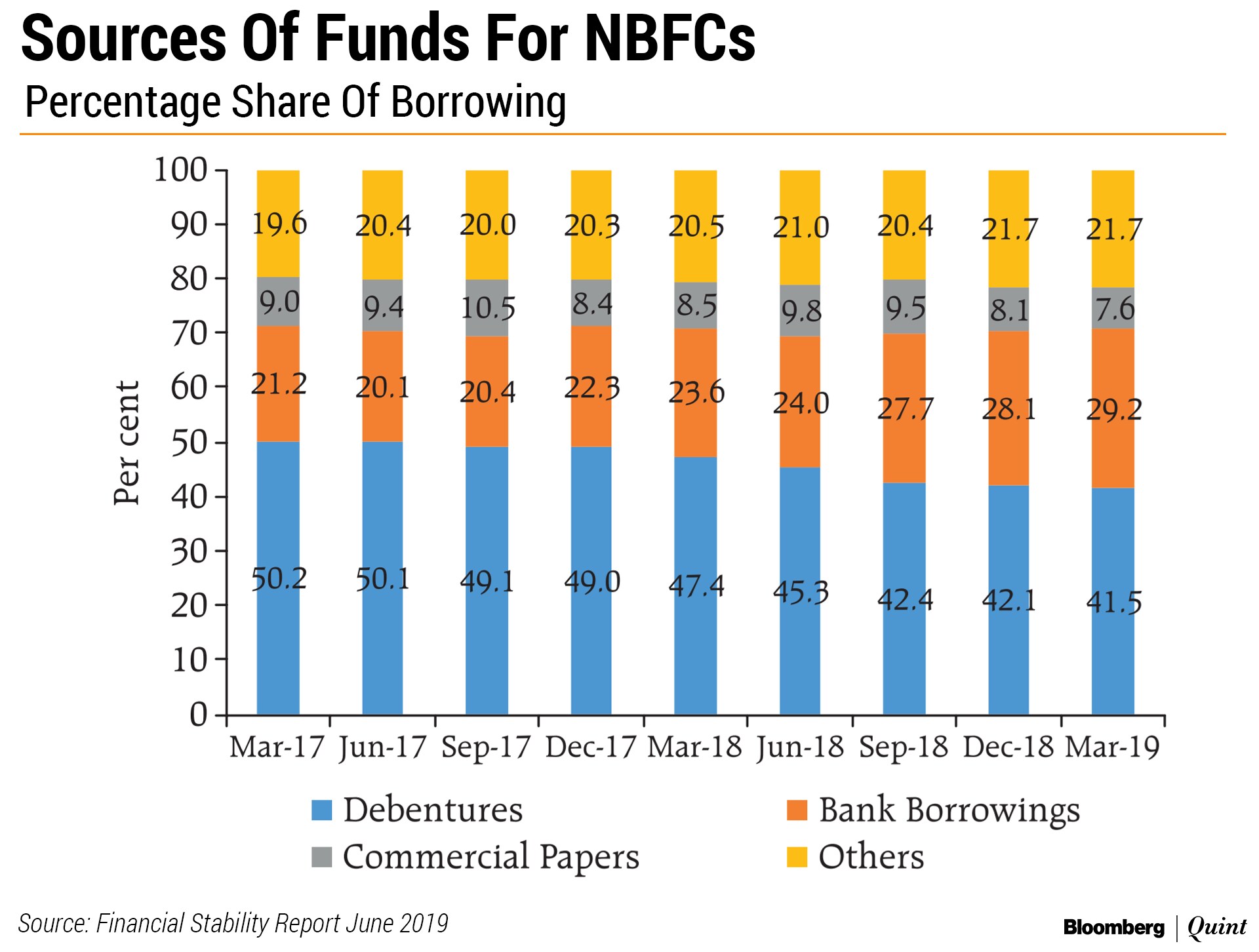
The reduced availability of funds from market sources has meant that NBFCs are more dependent on bank funds now than a year ago.
Share of bank borrowing in total liabilities of NBFCs increased from 21.2 percent in March 2017 to 23.6 percent in March 2018 and further to 29.2 percent in March 2019, the RBI said in its report. Debentures formed the largest share of NBFC liabilities at 41.5 percent in March 2019, down from 47.4 percent a year ago. The share of commercial paper borrowings fell to 7.6 percent in March 2019 from 8.5 percent in March 2018.
The report added that the top ten NBFCs accounted for more than 50 percent of total bank exposure to the sector, while the top 30 NBFCs (including government owned NBFCs) accounted for more than 80 percent of the total exposure.
This suggests that access to bank funding for a large number of smaller NBFCs may be difficult. There were 9,659 NBFCs registered with the Reserve Bank as on March 31, 2019, of which 88 were deposit accepting and 263 systemically important non-deposit accepting NBFCs.
The tough funding conditions meant that loan growth for NBFCs declined to 18.6 percent in 2018-19, compared to 21.1 percent in the financial year-ended March 2018.
Net profit growth also fell to 15.3 percent in FY19 from over 27 percent in FY18. Total income growth, however, was stronger in FY19 at 17.8 percent versus 11.4 percent in FY18.
Jump In Non-Mortgage Loans For HFCs
While analysing the portfolios of HFCs, the RBI highlighted a few issues. Among them was a rise in non-mortgage loans, including loans against property and developer loans.
The move away from pure mortgage loans may be due to the fact that spreads on high quality individual loans are below 2 percent, while those on other riskier loans may be higher.
However, funding of such loans via short-term commercial paper and other shorter maturity debt has liquidity risk implications during times of uncertainty, the RBI said.
On the liability side of HFCs, the RBI said that the share of non convertible debentures fell to just over 44 percent as of March 2019 compared to 46.2 percent a year ago. The share of bank funding rose to nearly 29 percent.
The regulator, however, said that bank lines are not a sustainable funding proposition for HFCs in the housing finance market for competitive reasons. “Significant reliance on these lines may have implications for adverse selection in the mortgage portfolios which banks too compete for,” the RBI said.
Stress Tests & Risk Of Contagion
In order to assess the resilience of the NBFC sector, the RBI conducted stress tests under three scenarios:
- Scenario 1: Increase in gross NPA by 0.5 standard deviation
- Scenario 2: Increase in gross NPA by 1 standard deviation
- Scenario 3: Increase in gross NPA by 3 standard deviation
“The results indicate that in the first scenario, the sector's capital adequacy ratio declined from 19.5 percent to 17.9 percent. In the second scenario, it declined to 15.3 percent and in the third scenario it declined to 11.7 percent.”
The RBI added that stress tests' results for individual NBFCs indicate that under the first two scenarios, around 8 percent of the companies will not be able to comply with the minimum regulatory capital requirements of 15 per cent. Around 13 percent of the companies will not be able to comply with the minimum regulatory capital adequacy norms under the third scenario.
Given fears of defaults by certain Housing Finance Companies and NBFCs, the RBI assessed contagion risk as well. Its study found that the top five non-bank lenders that can lead to a significant risk to the banking system are all HFCs. The RBI did not name these institutions but noted that greater surveillance may be justified given the risk these entities pose to the system.
Solvency contagion losses to the banking system due to idiosyncratic HFC/NBFC failure show that the failure of largest of these can cause losses comparable to those caused by the big banks,underscoring the need for greater surveillance overlarge HFCs/NBFCs .RBI Financial Stability Report June2019
Related Coverage:

-
Getting To Work Costs Women More | The Reason Why

It is not just about women paying more than men. It is about women paying much more in cities than in villages.
-
AI Bias In Investing Cannot Be Eliminated, But It Can Be Governed
Framing is a particularly important example as identical financial information presented in terms of gains rather than losses can lead an LLM to reach a different assessment.
-
Joining The Dots | Dark Skies, Steady Diya: Why Hope Holds This Diwali
With war, a weak rupee and foreign outflows weighing on sentiment, policymakers at the NDTV World Summit and market veterans at NDTV Profit Ignite: Diwali Edition offered the same advice: stay invested and filter out the noise.
-
The Curious Case of Equitas Small Finance Bank And A CEO Who Quit For Stock
PN Vasudevan believes persistent investor concerns over a perceived conflict of interest had become a governance overhang on Equitas Small Finance Bank's stock, even as the lender improved profitability and asset quality.
-
Talking Points This Week: AI Cash Burn, A Tiger Comeback And An India That Still Finds Its Own Path
India is not immune to higher oil or tighter global liquidity, yet its earnings base is broader, its domestic policy levers are still available.
-
Foreign Investors Own Half Of HDFC Bank and ICICI Bank. An LTCG Cut Could Matter Most Here
Foreign portfolio investors have US$115 billion parked in HDFC Bank, ICICI Bank. If the government cuts long-term capital gains tax, Jefferies says returning foreign money could land here first.
-
'Never Seen This Level Of Negativity': Sandeep Tandon Says The Next Rally May Be Closer Than You Think
Veteran investor Sandeep Tandon says foreign selling is easing, large-caps are due a comeback and mid-caps are crowded, while he turns positive on gold, power and pharma this Diwali.
-
Indians Stay With Family, Not In Hotels | The Reason Why
India still lacks enough clean, reliable and affordable hotels for budget-conscious travellers.
-
The Economic Imperative: Analysing The Material Driving Force Behind India-Canada Strategic Reset
This economic complementarity is further reinforced by deep institutional investment ties and talent mobility, which form the bedrock of the bilateral framework.
-
Medicine Pricing: Where Must Profit Stop?
India must confront excessive margins, hidden incentives and regulatory gaps that threaten the integrity of medicine.










