Ratan Tata Personally Asked Cyrus Mistry To Resign Before Ouster
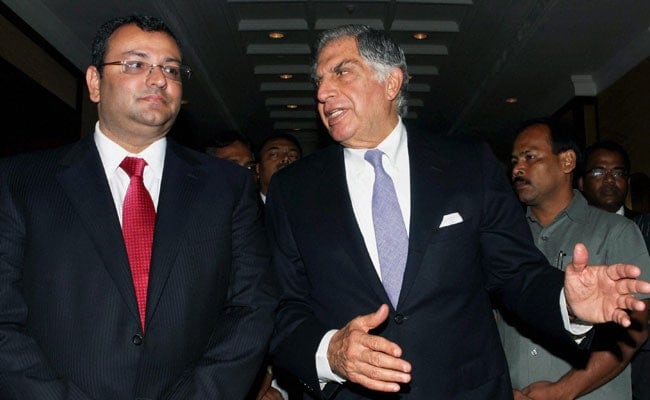
Mumbai: Tata Group patriarch Ratan Tata had personally asked Cyrus P Mistry to resign as chairman of Tata Sons as the board had lost faith in him, but his refusal led to the removal via majority vote.
In a para-by-para response to the petition filed by investment firms associated with Mr Mistry's family against his removal, Tata Sons - the holding company of the $103 billion salt-to-software conglomerate - told the National Company Law Tribunal (NCLT) that Mr Mistry was removed as Chairman on October 24 last year after "little or no signs of improvement" in his leadership.
Seven out of the nine directors of Tata Sons voted for his replacement after Farida Khambata abstained and Mr Mistry was declared ineligible to vote as he was an interest director.
"Before the commencement of the board meeting of Tata Sons on October 24, 2016, Ratan N Tata and (director) Nitin Nohria personally spoke to Cyrus Mistry and offered Cyrus Mistry an opportunity to resign voluntarily as Executive Chairman. However, Cyrus Mistry refused to do so," Tata Sons said in 204-page affidavit.
Stating that the decision was not taken suddenly or in haste, it said the removal "was the result of a chain of events that led to a growing trust and confidence deficit that had to be addressed without delay".
During his four years at the helm, "several disturbing facts" emerged about his leadership including insufficient details and discipline on capital allocation decisions, slow execution on problems, strategic Plan and Business Plan lacking specificity and follow-through, no meaningful steps to enter new growth businesses and weak top management team.
The affidavit said Mr Mistry was reluctant to accept and fully embrace the terms in the Articles of Association that spelled out the governance structure of Tata Sons and certain rights of the Tata Trusts and the Trust Nominee Directors -- terms which he himself had participated in finalising through extensive meetings and discussions with representatives of the Tata Trusts and external advisers.
Mr Mistry in a "systemic and planned manner" reduced the representation of Tata Sons' directors on the boards of other major Tata Companies.
As several directors of Tata Sons on the board of Tata companies retired, he did not appoint any directors of Tata Sons on the boards of other Tata Companies, as was the practice in the past.
The affidavit said: "This systematic dilution weakened the bind through which Tata values, ethos, governance principles, group strategies were to be implemented across the Tata Group companies.
"In most of the cases, Mr Mistry ensured that he was the only director who was common to Tata Sons and Tata Group companies. Effectively making himself the only 'channel' between Tata Sons and Tata group companies. Mistry's actions were deliberately weakening the Tata Group structure which was inimical to Tata Sons' interest and therefore, the mismanagement, if any has been perpetrated by Mr Mistry."
"During Mr Mistry's tenure as Executive Chairman, several board members, including Mr Nohria, repeatedly expressed their concerns to (him) about the criteria and discipline employed to make capital allocation decisions," said the affidavit.
While there was little discipline on expected returns on capital commitments, there was limited detail on the financial or strategic milestones that companies were expected to achieve to justify these capital requests, it said.
The affidavit said Mr Mistry focused only on the problems from the past and blamed them on "legacy issues" but identifying these hot-spots, the execution and follow-through was slow and lacked a sense of urgency.
Although a strategic plan was presented in June 2014, it lacked the specificity. Also, no new business initiative was launched that gained meaningful traction.
"Ensuring a positive relationship with investors and shareholders specially the principal shareholders is one of the primary duties of any leader, which Mr Mistry was unable to fulfil. This led to a growing and untenable trust deficit between Tata Sons and the Tata Trusts," it said.
The absence of proper interface for communication between the Trusts, the Board of Tata Sons and the operating companies led to a breakdown of communication between the three constituents, and the same was proving to be detrimental to the interest of the Tata Group as a whole.
Also, being a significant shareholder in his family enterprise (Shapoorji Pallonji Group of Companies), Mr Mistry was aware that it was being awarded significant contracts by the Tata Group even after his appointment as Deputy Chairman in November 2011 and his appointment as Chairman in December 2012.
For 4 years, the directors of Tata Sons supported Mr Mistry and exercised caution, restraint and patience, according to the affidavit.
"It was Mr Mistry himself who invited Ratan Tata to be the Chairman Emeritus of Tata Sons and in that capacity, Ratan Tata had the right to participate in the meetings of the Board of Directors of Tata Sons," it said.
Prior to October 24, 2016, in his capacity as Chairman Emeritus, Tata never attended any board meeting of Tata Sons and used to render advice only if warranted, as a person interested in the welfare of the Tata Group and in most cases, if not all, only when Mr Mistry reached out to him.
"Ratan Tata personally advised and counselled Mr Mistry on several matters, when time and again Mr Mistry reached out to Ratan Tata for guidance on business related matters," it said.
It said although the Nominations and Remunerations Committee of Tata Sons, in its meeting held on June 28, 2016, made positive comments on Mr Mistry's performance, it also stressed upon "the need for greater clarity on the functioning of the Board of Tata Sons Ltd in relation to the Tata Trusts, as well as its role vis-a-vis Group Companies".
Further, the Committee "did not sufficiently factor his ability to lead the Tata Group in the future".
"It was felt that Mr Mistry's leadership was lacking on numerous fronts and did not match up to his promises made at the time of his selection. Mr Mistry's leadership was not aligned to the long term goals and targets of Tata Sons as a company and the Tata Group as a whole," it added.

-
Gold Is Rs 22,000 Cheaper Than A Month Ago. Should You Buy Amid The Wedding Season?

Gold's potential slide to $3,500 could save around Rs 4,700 per 10 grams, but a soft inflation print could just as easily push prices back up. One way to split the risk is to buy in parts, some now and the rest after the Fed's Dec. 9 decision.
-
AI Agents Are Gaining Power. Who Governs Them?
Artificial intelligence agents promise to transform productivity by moving machines from assisting decisions to executing them. But as organisations delegate greater authority to these AI-agents, they must first establish who controls that authority and who remains accountable when things go wrong.
-
Why Swapping Your Old Gold Can Trigger A Rs 5 Lakh Tax Bill, And How You Can Avoid It Legally
Swapping old gold for new is taxed as a sale and a fresh purchase. Getting your own gold remade can cut most of that bill, though it has its own costs.
-
The AI Trade is Done. The Real Opportunity for Investors Starts in 2027 | Unhedged Position
As pureplay AI stocks plunge and circular, capex-led financing unwinds, 2027 is set to be a year of reckoning for AI companies. Yet the bust clears the way for a better opportunity for investors in 2027 -- shifting the spotlight from AI builders to the companies using AI.
-
Leadership As Mission: Why The Age Of AI Demands More Human Leadership
Debjani Ghosh examines how AI is changing leadership, arguing that its success must be measured by its impact on people and the accountability of those guiding its use.
-
We May Need Another Tukaram Mundhe To Fight Air Pollution | The Reason Why
Developers may install basic measures such as sprinklers and green nets, resume work, and continue violating rules when this equipment stops working.
-
Extracting Value From Battery Scrap Could Be Challenging For India | The Reason Why
A discarded lithium-ion battery still contains valuable materials such as lithium, nickel and cobalt. These can be recovered and reused. When such batteries are crushed and shredded, they produce a dark powder called black mass.
-
One El Nino, India Can Handle. Two Could Break The Granary
India's grain stocks can absorb one bad year, but a second El Nino could drain the buffer in two to three years, economists say.
-
India's Troika Of Good Luck | Joining The Dots
As Jensen Huang's exit drags Nvidia down, a cooling AI trade and resilient earnings have revived investor interest in India. A likely RBI rate hike looms.
-
Talking Points This Week: Leadership Shock At Nvidia, Earnings Strength, And The Fog Over Hormuz
The Anthropic IPO pricing and first trading day, Nvidia's upcoming earnings, and any fresh signals from Iran will set the tone for the following week.









