Raghuram Rajan's Formidable Reputation Helped Stabilise Rupee: Subbarao
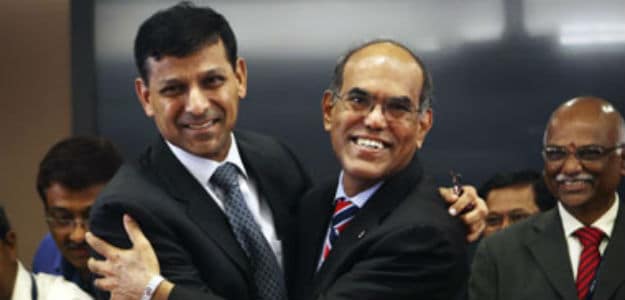
Mumbai: Former Reserve Bank Governor Duvvuri Subbarao has credited his successor Raghuram Rajan's "formidable reputation" for bringing sanity to the forex market when the rupee had lost nearly 25 per cent amid 'taper tantrums' in the summer of 2013.
He has also blamed then then Finance Minister P Chidambaram's reluctance to accept that the rupee was bleeding more because of domestic issues and less due to external factors like the taper tantrums - a reference to the US Fed's gradual withdrawal of stimulus measures for the American economy following the global financial crisis of 2008.
"I had several conversations with Chidambaram on this, but found him reluctant to face up to this inconvenient truth. He is too intelligent not to have seen the point; I suspect he found it politically convenient to point to an external scapegoat rather than call attention to domestic structural factors," Mr Subbarao, the bureaucrat-turned central banker, has written in a book.
He has also blamed Mr Chidambaram who "wholeheartedly supported his appointment" to the Mint Road for undermining the autonomy of RBI and putting pressure on him to cut interest rates.
On the impact of the appointment of Raghuram Rajan as the new Governor on stabilising the rupee, Mr Subbarao says "the scheduled leadership change at the Reserve Bank and the formidable reputation of my successor, Raghuram Rajan, helped restore confidence in the Indian markets".
The book 'Who Moved My Interest Rates- Leading the Reserve Bank of India through Five Turbulent Years', is a tell-tale 352 page memoir by Mr Subbarao. It hit the stands today and will be formally launched next month. It is published by Penguin Random House.
"In fact, as chief economic adviser to the government, Raghu was on board all through the exchange rate turmoil and was more actively involved in all the decisions after he was named in early August as my successor," he notes in the book, which he began penning in the middle of last year.
On the radical measures that Dr Rajan announced on assuming charge, Subbarao says soon after Rajan came to RBI as an OSD, they both had agreed on those steps like raising forex through NRI deposits.
"Raghu was kind enough to offer that I announce these measures before signing off. But I thought that the measures would be more effective if he announced them as the incoming governor. At least on this issue, my judgement worked!" he says in a chapter titled 'Rupee Tantrums 137'.
Blaming the plight of the rupee primarily on structural imbalances like high current account deficit (CAD) driven by non-productive imports like gold, Subbarao says Chidambaram was not ready to accept this.
"My concern was that we would go astray in both the diagnosis and remedy if we did not acknowledge that at the heart of our external economy problem were domestic vulnerabilities," he says in his book.
Mr Chidambaram's reluctance to put the house in order happened, writes Mr Subbarao, "even as we were engaged in a fierce exchange rate defence, one issue that troubled me all through was the narrative that was taking shape about the origin of the problem."
"The government, in particular, was attempting to paint the rupee problem as caused entirely by external factors...But global factors were just the proximate cause for our exchange rate turmoil; the root cause lay in our domestic economy where, for years, we had been heaping pressure on the rupee, an issue that the Reserve Bank consistently raised in its monetary policy statements.
"An implosion was inevitable; it was incidental that the trigger came by way of the taper tantrums," he says.
On whether the RBI Governor is free or not, Mr Subbarao, who in the book admits that both his bosses in the North Block put pressure on him to cut rates, and is also a fan of the great existential philosopher JP Sartre, says every "Reserve Bank governor is a creature of the circumstances in which he is called upon to perform. He has to make choices and decisions based on his own learning and experiences. The governor is condemned to be free!"
(This story has not been edited by NDTV staff and is auto-generated from a syndicated feed.)

-
Getting To Work Costs Women More | The Reason Why

It is not just about women paying more than men. It is about women paying much more in cities than in villages.
-
AI Bias In Investing Cannot Be Eliminated, But It Can Be Governed
Framing is a particularly important example as identical financial information presented in terms of gains rather than losses can lead an LLM to reach a different assessment.
-
Joining The Dots | Dark Skies, Steady Diya: Why Hope Holds This Diwali
With war, a weak rupee and foreign outflows weighing on sentiment, policymakers at the NDTV World Summit and market veterans at NDTV Profit Ignite: Diwali Edition offered the same advice: stay invested and filter out the noise.
-
The Curious Case of Equitas Small Finance Bank And A CEO Who Quit For Stock
PN Vasudevan believes persistent investor concerns over a perceived conflict of interest had become a governance overhang on Equitas Small Finance Bank's stock, even as the lender improved profitability and asset quality.
-
Talking Points This Week: AI Cash Burn, A Tiger Comeback And An India That Still Finds Its Own Path
India is not immune to higher oil or tighter global liquidity, yet its earnings base is broader, its domestic policy levers are still available.
-
Foreign Investors Own Half Of HDFC Bank and ICICI Bank. An LTCG Cut Could Matter Most Here
Foreign portfolio investors have US$115 billion parked in HDFC Bank, ICICI Bank. If the government cuts long-term capital gains tax, Jefferies says returning foreign money could land here first.
-
'Never Seen This Level Of Negativity': Sandeep Tandon Says The Next Rally May Be Closer Than You Think
Veteran investor Sandeep Tandon says foreign selling is easing, large-caps are due a comeback and mid-caps are crowded, while he turns positive on gold, power and pharma this Diwali.
-
Indians Stay With Family, Not In Hotels | The Reason Why
India still lacks enough clean, reliable and affordable hotels for budget-conscious travellers.
-
The Economic Imperative: Analysing The Material Driving Force Behind India-Canada Strategic Reset
This economic complementarity is further reinforced by deep institutional investment ties and talent mobility, which form the bedrock of the bilateral framework.
-
Medicine Pricing: Where Must Profit Stop?
India must confront excessive margins, hidden incentives and regulatory gaps that threaten the integrity of medicine.










