‘Radical Reform’ Sought By Election Commission Is Rather Straightforward
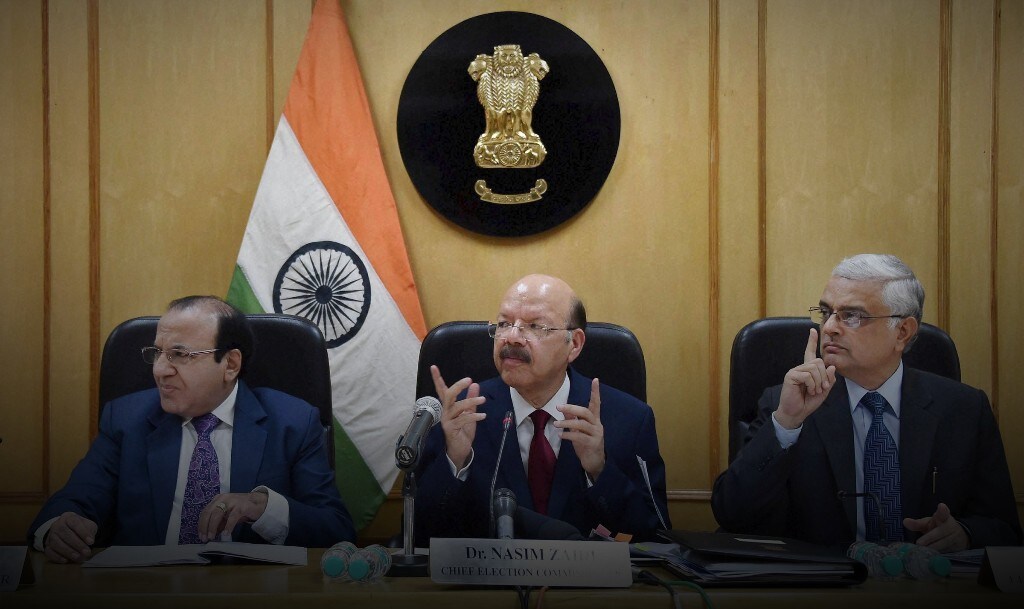
The Election Commission of India has taken a logical and commendable stand in two of its depositions before the department-related Parliamentary Standing Committee on Personnel, Public Grievances, Law and Justice. In one it has said that the “introduction of electoral bonds a retrograde step” and in the other it has said that it does “not support state funding of polls.”
Both these are in keeping with what has been recommended by several committees and commissions set up by governments, recommendations which have been ignored by successive governments for the last couple of decades. Let us first address what is called the state funding of elections.
State Funding Of Elections
The first issue with state funding of elections or of political parties is the expression itself. It arises from the general perception in the country that government money is meant to be used freely, as it does not really belong to anyone. Most people fail to notice and realise that the so-called government money is people's money. State funding will be out of the money that people pay by way of taxes, direct or indirect.
So, the first correction that is required is to refer to this as public funding of elections and of political parties, and not state funding. The second issue is with public funding of elections and of political parties being offered as a panacea for all that is wrong with the political and electoral systems. There is no better repudiation of this than the most-often-quoted report on the subject, submitted in 1998 by the Indrajit Gupta Committee, which has often been cited, instead, to justify state funding. There's a paragraph of the Indrajit Gupta Committee report that politicians love to quote.

This gives the impression of well-endowed political parties being sympathetic to their less-endowed brethren. What our politicians seem to overlook with unfailing regularity is the opening paragraph of the Conclusion of the same report, parts of which are worth highlighting.
“Before concluding, the Committee cannot help expressing its considered view that its recommendations being limited in nature and confined to only one of the aspects of the electoral reforms may bring about only some cosmetic changes in the electoral sphere. What is needed, however, is an immediate overhauling of the electoral process whereby elections are freed from the evil influence of all vitiating factors, particularly, criminalisation of politics. It goes without saying that money power and muscle power go together to vitiate the electoral process, and it is their combined effect which is sullying the purity of electoral contests and affecting free and fair elections. Meaningful electoral reforms in other spheres of electoral activity are also urgently needed,” read the report.
It is difficult to find a more succinct description of what needs to be done regarding public funding of elections, which should not be surprising since in addition to being chaired by the redoubtable former Home Minister Indrajit Gupta, the committee had members such as Somnath Chatterjee who went on to be Speaker of the Lok Sabha and Manmohan Singh, later Prime Minister of India.
The report in its entirety has not found favour with the larger political establishment, except for being quoted selectively.
Before public money can be provided to political parties or to candidates contesting elections, one presumes a provision for that amount of money would need to be made in the Budget. The question that presents itself is: How much money should be budgeted for this purpose?
Arguably, the most straightforward way would be to go by how much money was spent on this activity in the previous year.
But this means that political parties and candidates contesting elections will have to disclose how much money they actually spent in the previous year.
As is widely known, the experience on this has been far from encouraging. In election after election, an overwhelming majority of candidates keep filing sworn affidavits to the Election Commission saying they spent barely 50-60 percent of the allowable limit of the election expenditure, whereas it is widely known, and often accepted by the same candidates, that they spend several multiples of the allowable limit. There are also cases on record where elected candidates have publically stated as much. One member of Parliament said in a public meeting in Mumbai that he had spent Rs 8 crore on his election to the Lok Sabha when the limit was Rs 25 lakh.
The saga of how political parties have been blatantly defying the highest statutory authorities in the land, to avoid coming in the ambit of the Right to Information law is too well known to need recounting here. It is obvious that the main cause for this resistance is to prevent disclosure of financial information including how much money they spend and on what.
So, when the Election Commission says that it does “not support state funding of polls,” one can only agree with the Commission.
Electoral Bonds
Now to electoral bonds. Electoral bonds were introduced to the nation in Finance Minister Arun Jaitley's 2017-18 Budget speech. This was part of a section of the speech titled Transparency in Electoral Funding. Going by the title, it was obvious that everything in that section would be in the direction of increasing transparency in electoral funding.
The presentation of the Budget in Parliament was followed later in the day by the customary media interaction by the finance minister. In this interaction, Jaitley clarified on the electoral bonds issue. Note the words he used at the end of these remarks.

This clarification seemed to indicate that anonymity will contribute to transparency, which appeared counter-intuitive.
Then came the text of the Finance Bill 2017 which contained the exact amendments proposed for various laws to practically implement and operationalise the proposals announced in the Budget. A study of the amendments to Section 13A of the Income Tax Act and to Section 29 of The Representation of the People Act, proposed in the Finance Bill 2017 made it completely clear that the electoral bonds will keep the donor anonymous. A person buying an electoral bond from a bank, can hand it over to another who can give it to a political party. Even the political party receiving the bond may not know who the actual entity behind the bond is. Of course, whether a donor wants even the political party to not know that he or she has made a donation seems far fetched but the Budget announcements certainly make it possible.
What it definitely ensures is the public will never know who paid a political party and how much. It will make it impossible to assess whether a particular policy is made in public interest or the interest of such secret donors.
So, in this case too, when the Election Commission calls the introduction of electoral bonds a retrograde step, it is merely telling the truth exactly the way it is.
The electoral bonds scheme, as is publicly known till today, also makes it possible for an unsavoury donor, using money obtained through dubious sources, to make clandestine donations to political parties and thus influence their agenda and policies.
Also Read: Electoral Bonds A Disaster For Public Transparency: Milan Vaishnav
Radical Reforms
The Election Commission is also reported to have called for “radical reforms in the way funds are spent by political parties.” What could these radical reforms be?
The first clarification is that radical reforms are needed not only in the way funds are spent by political parties but also in the way funds are collected by political parties.
Both collection and spending of funds by political parties have been, and continue to be, one of the deepest mysteries. The untiring efforts political parties have been making to avoid sharing this information with anyone, by obdurately refusing to come under the purview of the Right to Information Act, has already been referred to.
Also Read: Electoral Bonds Cannot Become Parallel Currency, Arun Jaitley Says
In fact, what are actually needed are just two reforms. Whether one considers them radical or not is a matter of opinion but the fact is that they have been known for a very long time. These are:
- demonstrable internal democracy in the functioning of political parties, and
- financial transparency in political parties.
The best enunciation of these two was done by the Law Commission of India in its 170th report, submitted to the government in May 1999. The report was titled Reform of the Electoral Laws and is arguably the most comprehensive document on the subject till date. This is what the Law Commission concluded, parts of which are being highlighted.
“On the parity of the above reasoning, it must be said that if democracy and accountability constitute the core of our constitutional system, the same concepts must also apply to and bind the political parties which are integral to parliamentary democracy. It is the political parties that form the government, man the Parliament and run the governance of the country. It is therefore, necessary to introduce internal democracy, financial transparency and accountability in the working of the political parties. A political party which does not respect democratic principles in its internal working cannot be expected to respect those principles in the governance of the country. It cannot be dictatorship internally and democratic in its functioning outside.”
These two issues have been commented on, in a similar vein, in the recommendations of all committees and commissions, including the following:
- Goswami Committee, May 1990
- NN Vohra Committee, October 1993
- Indrajit Gupta Committee, December 1998
- 170th Report of the Law Commission of India, May 1999
- National Commission to Review the Working of the Constitution, March 2002
- Proposed Electoral Reforms by the Election Commission of India, July 2004
- Fourth report of the Second Administrative Reforms Commission of India, January 2007
- Justice JS Verma Committee Report, January 2013
- 255th Report of the Law Commission of India, March 2015
- Proposed Electoral Reforms by the Election Commission of India, December 2016
The Law Commission, in its 170th report, has gone to the extent of preparing the draft of a chapter to be added to the Representation of People Act, 1951, which it has titled Organisation of Political Parties and matters incidental thereto.
Despite all of these reports, none of the governments have paid any serious attention to electoral reforms though each one, actually every political party, has said that electoral reforms are extremely important and necessary, and must be done. There is also a chain of decisions by the Supreme Court that the content of our democracy is getting diluted and electoral reforms need to be done urgently. There are also many instances where the court has tried to interpret some existing laws of effect electoral reforms and the Parliament has attempted to undo the Supreme Court's judgments, accusing it of overstepping its boundary through judicial activism.
It wishes to make it even more opaque as is amply clear in the electoral bonds issue discussed above.
In this context, while the Election Commission deserves to be applauded, we must also realise the limits to what the Election Commission can do. The onus of showing the correct path to the entire political establishment, and forcing it to follow that path, rests on We, the People.
Jagdeep S Chhokar is a co-founder and trustee of the Association for Democratic Reforms.
The views expressed here are those of the author's and do not necessarily represent the views of BloombergQuint or its editorial team.

-
Getting To Work Costs Women More | The Reason Why

It is not just about women paying more than men. It is about women paying much more in cities than in villages.
-
AI Bias In Investing Cannot Be Eliminated, But It Can Be Governed
Framing is a particularly important example as identical financial information presented in terms of gains rather than losses can lead an LLM to reach a different assessment.
-
Joining The Dots | Dark Skies, Steady Diya: Why Hope Holds This Diwali
With war, a weak rupee and foreign outflows weighing on sentiment, policymakers at the NDTV World Summit and market veterans at NDTV Profit Ignite: Diwali Edition offered the same advice: stay invested and filter out the noise.
-
The Curious Case of Equitas Small Finance Bank And A CEO Who Quit For Stock
PN Vasudevan believes persistent investor concerns over a perceived conflict of interest had become a governance overhang on Equitas Small Finance Bank's stock, even as the lender improved profitability and asset quality.
-
Talking Points This Week: AI Cash Burn, A Tiger Comeback And An India That Still Finds Its Own Path
India is not immune to higher oil or tighter global liquidity, yet its earnings base is broader, its domestic policy levers are still available.
-
Foreign Investors Own Half Of HDFC Bank and ICICI Bank. An LTCG Cut Could Matter Most Here
Foreign portfolio investors have US$115 billion parked in HDFC Bank, ICICI Bank. If the government cuts long-term capital gains tax, Jefferies says returning foreign money could land here first.
-
'Never Seen This Level Of Negativity': Sandeep Tandon Says The Next Rally May Be Closer Than You Think
Veteran investor Sandeep Tandon says foreign selling is easing, large-caps are due a comeback and mid-caps are crowded, while he turns positive on gold, power and pharma this Diwali.
-
Indians Stay With Family, Not In Hotels | The Reason Why
India still lacks enough clean, reliable and affordable hotels for budget-conscious travellers.
-
The Economic Imperative: Analysing The Material Driving Force Behind India-Canada Strategic Reset
This economic complementarity is further reinforced by deep institutional investment ties and talent mobility, which form the bedrock of the bilateral framework.
-
Medicine Pricing: Where Must Profit Stop?
India must confront excessive margins, hidden incentives and regulatory gaps that threaten the integrity of medicine.










