Private Credit Isn’t As Risky As Some May Believe

(Bloomberg Opinion) -- The rapid rise of funds that make loans directly to buyout deals and other highly indebted companies — known as private credit — is among the hottest topics in finance. The sector has minted fresh billionaires, while being called a bubble by traditional financiers like UBS Group AG Chairman Colm Kelleher and attracting warnings about the dangers it could pose.
Investors need to be sharp-eyed about what private credit managers are doing with their money. This is, after all, high-yield, high-risk debt. The mad scramble for new business could easily lead to many bad lending decisions, as it always has in the history of banking. But fears that private credit could threaten the financial system should be more soberly assessed. The structure of most private credit funds answers many of the questions about panics and runs posed by the 2008 meltdown because they typically fund their lending with long-term liabilities that can't easily take flight.
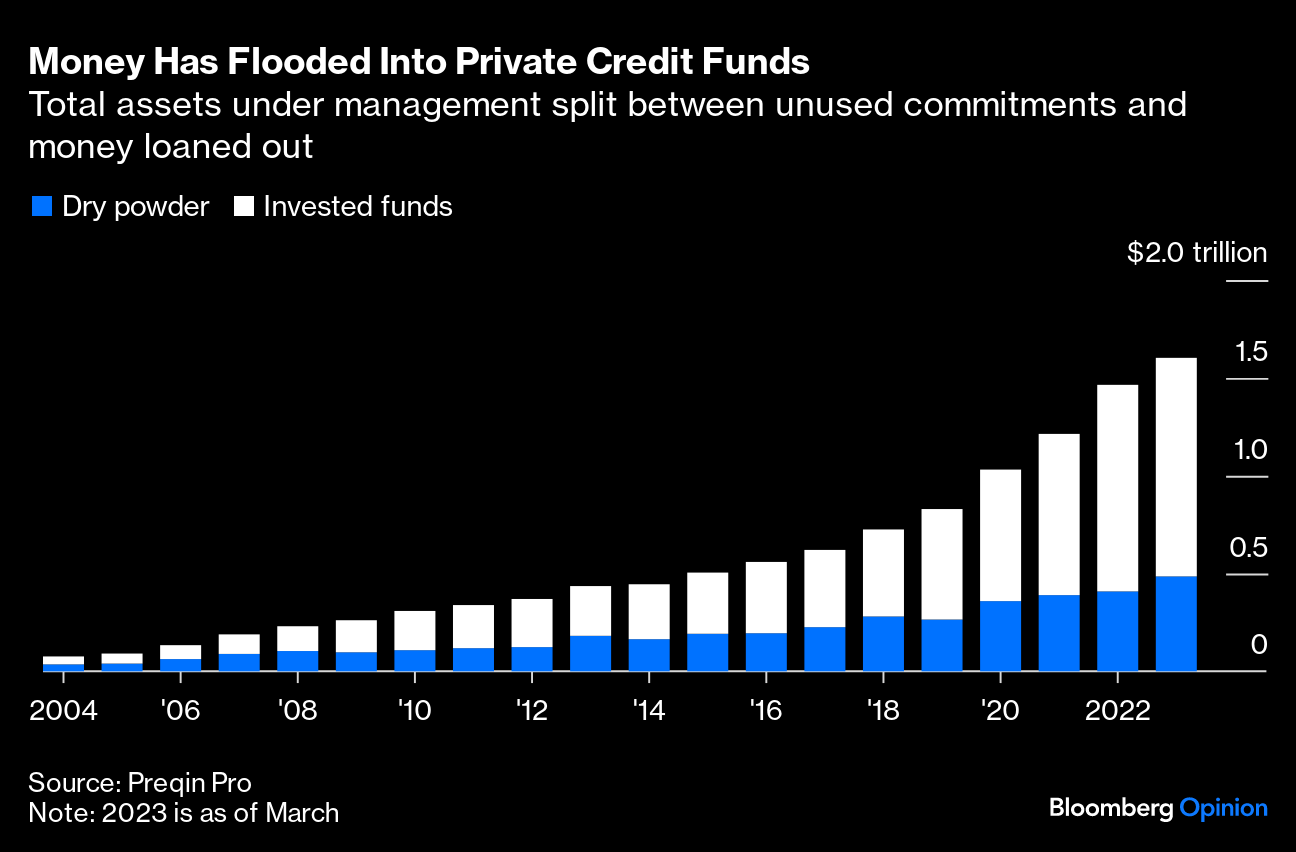
Interest in private credit managers has ballooned as the money has flooded in, while their lending approach brought advantages over traditional buyout funding, particularly this year. Total assets under management in the sector have nearly doubled since 2019 to more than $1.6 trillion, according to Preqin Pro, a data provider. Scale has led to ever-larger individual loans, like this month's record $4.9 billion for online classifieds company Adevinta ASA.
This year, private equity deal makers have struggled to raise debt through leveraged loans arranged by banks or junk bonds, opening more doors for private credit fund managers. Bond investors lost appetite for high-yield debt, while big banks have demanded extra pricing flexibility when underwriting buyout loans to protect against getting stuck with unsellable debt, like the $13 billion that helped fund Elon Musk's purchase of Twitter, now named X, last year.
By contrast, private credit managers have been able to offer more certainty to private equity firms trying to finance takeovers because they set the price themselves and keep the loans rather than trying to sell them later.
The funds can take a longer view partly because of how they raise their money. Most private credit is backed by big institutional investors, like insurers or pension providers, which agree to lock up their money for years at a time. If there is a panic, they can't just ask for their cash back like depositors in a bank. That means the fund won't need to try to pull the rug from under its borrowers or sell their loans quickly, and it won't collapse if it suddenly became unable to refund investors.
In short, private credit shouldn't ever create the kind of systemic risk unleashed in 2008 — the funds shouldn't suffer runs or fall into spirals of asset fire sales and losses, such as those that periodically engulf banks.
As ever in finance, some are exploring innovations that could undermine these good characteristics. One troubling trend is efforts to sell such funds to the ordinary investing public, who typically require some ability to pull cash early. Bad idea. Late last year, a Blackstone private credit fund for reasonably affluent individuals hit quarterly withdrawal limits as investors looked to reduce risks and book early profits. The fund restricts redemptions to a maximum of 5% of assets a quarter, so it's still vastly more stable than a deposit-funded bank. However, growing competition for retail money could be a slippery slope toward looser terms.
Some funds also borrow money to increase their lending power and juice returns, which could cause havoc if the lending banks get cold feet and demand repayment.
A greater danger could come from one of the biggest investors in such funds: insurers that sell long-term savings products known as annuities. People can cash in early in some cases. They'll pay a penalty, but the costs might seem worthwhile if they're worried about their savings' exposure to private loans or other risky, illiquid assets. The risk of a large-scale run on annuity businesses has a slim probability but could be extremely damaging to the financial system: A recent Bloomberg editorial sounded a warning about some insurers' more aggressive investment styles and closer ties with big alternative asset managers.
Regulators in the US and elsewhere need to keep a close eye on these trends. Justifiably, they are demanding more transparency from the sector. But that doesn't detract from the fundamental stability of having investors locked in for the long term in private credit funds. Even with a big wave of bankruptcies or debt defaults, this characteristic should keep the losses contained.
More From Bloomberg Opinion:
- Private Equity's Bubble Vintage May Fizzle: Chris Bryant
- What If Lending to Your Own Buyout Gets Sticky?: Chris Hughes
- The Private Equity Machine Will Be Tough to Unjam: Paul J. Davies
This column does not necessarily reflect the opinion of the editorial board or Bloomberg LP and its owners.
Paul J. Davies is a Bloomberg Opinion columnist covering banking and finance. Previously, he was a reporter for the Wall Street Journal and the Financial Times.
More stories like this are available on bloomberg.com/opinion
©2023 Bloomberg L.P.

-
Indians Stay With Family, Not In Hotels | The Reason Why

India still lacks enough clean, reliable and affordable hotels for budget-conscious travellers.
-
The Economic Imperative: Analysing The Material Driving Force Behind India-Canada Strategic Reset
This economic complementarity is further reinforced by deep institutional investment ties and talent mobility, which form the bedrock of the bilateral framework.
-
Medicine Pricing: Where Must Profit Stop?
India must confront excessive margins, hidden incentives and regulatory gaps that threaten the integrity of medicine.
-
Why Amazon And Flipkart Are Struggling To Beat Meesho In India's Smaller Cities
With 274 million users and lowest-cost logistics, Meesho is defending its value commerce crown against giants like Amazon and Flipkart.
-
High US Salaries, No Green Card Certainty: The Financial Calculation Facing Indian H-1B Families
The suspension of PERM processing at eight technology employers does not cancel existing H-1B visas. What it does is force a question many Indian families have been avoiding: is the US salary worth tying your career and family plans to one employer?
-
Swiggy vs Eternal: Food Delivery's Two Rivals Are No Longer In The Same Race
Eternal is building a private AI assistant, dark.ai. Swiggy is still working out how to make Instamart pay, with an operating loss of Rs 895 crore in the July-September quarter while Blinkit stayed profitable.
-
Where You Live Shapes How You Get To Work | The Reason Why
Two-wheelers are the most popular way to get to work in India, accounting for nearly 43% of workplace commutes.
-
Unhedged Position: Can India See An Indonesia-Style Time Correction?
The Nifty is trading below levels it first clocked in 2024. Is there, then, as I have suggested in the headline, potential that the current time correction drags on painfully for the next three-five, even ten years?
-
Navigating Friction And Energy Realities: An Analysis Of Marco Rubio's October Visit To India
Occurring at a critical juncture marked by stalled trade negotiations and escalating geopolitical pressures over global energy supplies, the visit offers a profound window into modern US-India relations.
-
India Exports Capital. Why Not Export Trusteeship?
The big question, then, is whether India can build an institution that global borrowers, investors, banks, and lawyers can trust, even without an Indian connection.










