India Will Now Become A Major Hub: PM Modi On Launch Of 22,000 Crores Plane Project
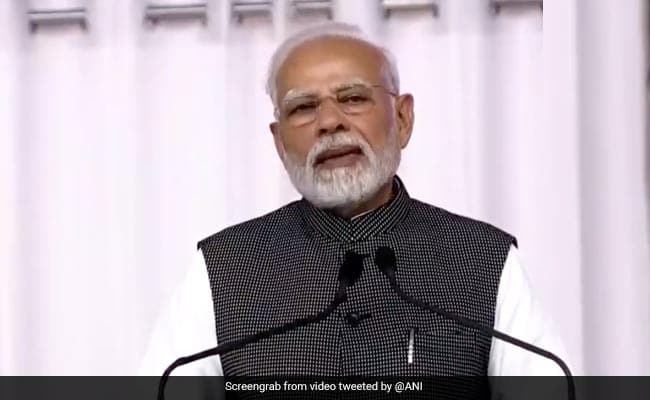
India will now become a major producer of transport aircraft, Prime Minister Narendra Modi said on Sunday after laying the foundation stone of a manufacturing facility for C-295 medium transport plane for the Indian Air Force.
PM Modi said India is witnessing rapid economic growth including in the manufacturing sector as his government's policies are "stable, predictable and futuristic".
"Today India is working with a new mindset and new work culture," he said in his address at the ceremony in this city in Gujarat.
He said India, with its 'Make-in-India' and 'Make-for-World' approach, is enhancing its strength further and that the country has emerged as a major manufacturing hub globally.
PM Modi said the manufacturing of C295 aircraft in Vadodara will not only give strength to the military but it will also create an aerospace ecosystem.
Defence Minister Rajnath Singh described the occasion as a milestone in India's quest for becoming self-reliant in defence.
The aircraft will be produced by a consortium of European aerospace major Airbus and the Tata Group.
It is the first project of its kind in which a military aircraft will be manufactured in India by a private company.
The manufacturing unit will also cater for the export of the premier transport aircraft as well as for additional orders by the Indian Air Force.
In September last year, India sealed a Rs 21,935 crore deal with Airbus Defence and Space to procure 56 C-295 aircraft to replace the IAF's ageing Avro-748 planes that entered service in the early 1960s.
Under the agreement, Airbus will deliver the first 16 aircraft in 'fly-away' condition from its final assembly line in Seville, Spain within four years and the subsequent 40 aircraft will be manufactured by Tata Advanced Systems Ltd (TASL) in India as part of an industrial partnership between the two companies.
The 16 fly-away aircraft are scheduled to be delivered to the IAF between September 2023 and August 2025.
The first Made-in-India aircraft will be rolled out of the manufacturing facility in September 2026 and the remaining 39 will have to be produced by August 2031.
The foundation laying ceremony was attended by Defence Minister Rajnath Singh, Civil Aviation Minister Jyotiraditya Scindia and Gujarat Chief Minister Bhupendrabhai Patel among others.
IAF officials said the C-295 aircraft would be able to operate from Advanced Landing Grounds (ALGs) and even unprepared runways.
It is also the first time that the C-295 aircraft will be manufactured outside of Europe.
All 56 aircraft will be fitted with an indigenous electronic warfare suite to be developed by the state-run Bharat Electronics Ltd and Bharat Dynamics Limited.
After the completion of the delivery of 56 aircraft to the IAF, Airbus Defence and Space will be allowed to sell the aircraft manufactured in India to civil operators and export to countries which are cleared by the Government of India.
Defence Secretary Ajay Kumar three days back said the indigenous content in the plane will be the highest ever in India, and that 96 per cent of the work that Airbus does in Spain to produce the plane will be done at the manufacturing unit in Vadodara.
The C-295MW is a transport aircraft of 5-10 tonne capacity with contemporary technology. The aircraft has a maximum speed of 480 kmph.
It has a rear ramp door for quick reaction and para-dropping of troops and cargo. Short take-off and landing from semi-prepared surfaces is another of its features.
The aircraft is set to strengthen the logistic capabilities of the IAF.
Officials said the project offers a unique opportunity for the Indian private sector to enter into the technology-intensive and highly competitive aviation industry.
The defence ministry said manufacturing of over 13,400 detail parts, 4,600 sub-assemblies and all the seven major component assemblies of the aircraft will be undertaken in India.
It said various systems such as engines, landing gear and avionics will be provided by Airbus Defence and Space and integrated into the aircraft by the TATA Consortium.
With a proven capability of operating from short or unprepared airstrips, the C-295 is used for tactical transport of up to 71 troops or 50 paratroopers, and for logistic operations to locations that are not accessible to current heavier aircraft.
The aircraft can airdrop paratroops and loads, and also be used for casualty or medical evacuation.
The aircraft is capable of performing special missions as well as disaster response and maritime patrol duties.
The aircraft will be tested as an integrated system by the TATA Consortium. The aircraft will be flight tested and delivered through a delivery centre at the TATA Consortium facility.
The project is expected to generate 600 highly skilled jobs directly, over 3,000 indirect jobs and an additional 3,000 medium-skill employment opportunities with more than 42.5 lakh man-hours of work within the aerospace and defence sector.
Nearly 240 engineers will be trained at the Airbus facility in Spain for the project.
(Except for the headline, this story has not been edited by NDTV staff and is published from a syndicated feed.)

-
Why Swapping Your Old Gold Can Trigger A Rs 5 Lakh Tax Bill, And How You Can Avoid It Legally

Swapping old gold for new is taxed as a sale and a fresh purchase. Getting your own gold remade can cut most of that bill, though it has its own costs.
-
The AI Trade is Done. The Real Opportunity for Investors Starts in 2027 | Unhedged Position
As pureplay AI stocks plunge and circular, capex-led financing unwinds, 2027 is set to be a year of reckoning for AI companies. Yet the bust clears the way for a better opportunity for investors in 2027 -- shifting the spotlight from AI builders to the companies using AI.
-
Leadership As Mission: Why The Age Of AI Demands More Human Leadership
Debjani Ghosh examines how AI is changing leadership, arguing that its success must be measured by its impact on people and the accountability of those guiding its use.
-
We May Need Another Tukaram Mundhe To Fight Air Pollution | The Reason Why
Developers may install basic measures such as sprinklers and green nets, resume work, and continue violating rules when this equipment stops working.
-
Extracting Value From Battery Scrap Could Be Challenging For India | The Reason Why
A discarded lithium-ion battery still contains valuable materials such as lithium, nickel and cobalt. These can be recovered and reused. When such batteries are crushed and shredded, they produce a dark powder called black mass.
-
One El Nino, India Can Handle. Two Could Break The Granary
India's grain stocks can absorb one bad year, but a second El Nino could drain the buffer in two to three years, economists say.
-
India's Troika Of Good Luck | Joining The Dots
As Jensen Huang's exit drags Nvidia down, a cooling AI trade and resilient earnings have revived investor interest in India. A likely RBI rate hike looms.
-
Talking Points This Week: Leadership Shock At Nvidia, Earnings Strength, And The Fog Over Hormuz
The Anthropic IPO pricing and first trading day, Nvidia's upcoming earnings, and any fresh signals from Iran will set the tone for the following week.
-
Signature Play: The Classic Cocktail Is Dead. Or Is It?
Classic cocktails are disappearing from India's cocktail menus. But they're still being ordered, taught to bartenders and borrowed from. So, who's really having the last drink?
-
A New Samvat Wishlist: Inclusive Prosperity And Human Development
India has strengthened its economic foundations through infrastructure, digital access and enterprise. Its next growth chapter must deepen productivity, create better livelihoods and widen participation in prosperity.









