Pound Jumps On UK Tax Cut Reversal, Oil Swings Higher
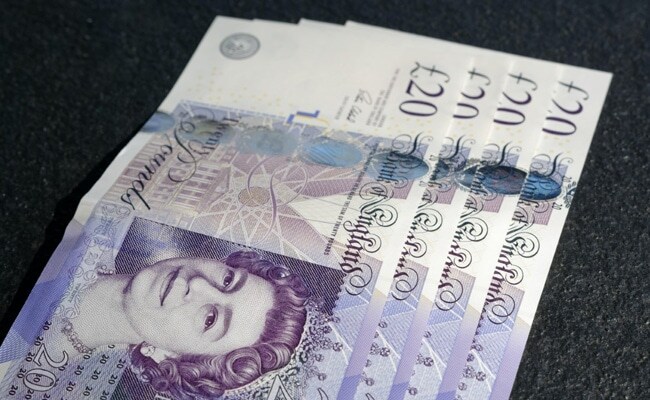
Oil jumped on Monday as OPEC+ considered reducing output at its meeting later this week while the pound swung higher after the UK government said it would reverse a controversial tax cut that had roiled British markets.
Asian stocks mostly fell in holiday-thinned trade although Japanese markets found support on strong energy and semiconductor shares.
Sterling jumped in early London trade after the British government announced plans to reverse the proposed scrapping of the higher rate of income tax that has sparked a backlash in the governing Conservative Party.
The pound rose as far as $1.128, its highest in 10 days, while FTSE futures hinted at a strong recovery in a stock market that has been battered by concerns over Prime Minister Liz Truss and her finance minister Kwasi Kwarteng's spending plans.
"From a market perspective, it is a good step in the right direction. It will take time for markets to buy the message but it should ease the pressure," said Jan Von Gerich, chief analyst at Nordea.
"Questions still remain and sterling will likely remain under pressure."
Outside Japan, stocks fell around Asia. MSCI's broadest index of Asia-Pacific shares ex-Japan was down 1.04%, on course for its fourth straight session of losses. It fell nearly 14% over the past quarter.
U.S. crude futures rose 2.70% to $81.64 a barrel after OPEC+ sources told Reuters oil production could be cut by between 500,000 and one million barrels a day. Brent crude rose 2.55% to $87.31 per barrel.
Japan's Nikkei 225 rose 0.50%, with energy stocks leading gains on the index and upbeat quarterly earnings from Mimasu Semiconductor boosting chip shares.
Minutes from the Bank of Japan's September meeting were also released on Monday, showing members debated the possibility of inflation outpacing expectations under the bank's ultra-easy monetary policy, which ultimately went unchanged.
"Some participants suggested that the BoJ should closely monitor whether the recent cost pressures will lead to a virtuous cycle of higher wages," wrote Ayako Fujita, a researcher at JPMorgan, in a note. "We think this confirmed that wage trends are the key condition for the BoJ to change its policy."
The yen briefly fell as low as 145.4 to the U.S. dollar despite remarks this morning from Japan's finance minister, Shunichi Suzuki, that the government would take "decisive steps" to prevent sharp currency moves.
It was the first time the yen has fallen through the 145 barrier since Sept. 22, when the Ministry of Finance intervened to prop up the currency, which has hit 24-year lows against the dollar this year. It later pared losses and was last at 144.86.
In Australia, where some states are observing a public holiday, the S&P/ASX 200 index fell 0.27%.
Hong Kong's Hang Seng index dropped 1.75%.
South Korea had a national holiday and China entered the Golden Week break on Monday. Hong Kong is closed for a public holiday on Tuesday.
Euro Stoxx 50 futures lost 1.63%.
Investor focus will later swing to the September U.S. ISM manufacturing index.
"ISM manufacturing is unlikely to dent the optimism around the U.S. economy that has been building up further with positive economic indicators released over the last few weeks," Saxo Bank market strategist Redmond Wong wrote in a research note.
The Reserve Bank of Australia meets on Tuesday, with markets widely expecting another 50 basis point rate hike while Japan's consumer price index is likely to show another pick up in inflation.
Spot gold was up 0.27% to $1,664.0900 an ounce.
Leading cryptocurrency Bitcoin fell 1.48% to $19,137.
(This story has not been edited by NDTV staff and is auto-generated from a syndicated feed.)

-
Extracting Value From Battery Scrap Could Be Challenging For India | The Reason Why

A discarded lithium-ion battery still contains valuable materials such as lithium, nickel and cobalt. These can be recovered and reused. When such batteries are crushed and shredded, they produce a dark powder called black mass.
-
One El Nino, India Can Handle. Two Could Break The Granary
India's grain stocks can absorb one bad year, but a second El Nino could drain the buffer in two to three years, economists say.
-
India's Troika Of Good Luck | Joining The Dots
As Jensen Huang's exit drags Nvidia down, a cooling AI trade and resilient earnings have revived investor interest in India. A likely RBI rate hike looms.
-
Talking Points This Week: Leadership Shock At Nvidia, Earnings Strength, And The Fog Over Hormuz
The Anthropic IPO pricing and first trading day, Nvidia's upcoming earnings, and any fresh signals from Iran will set the tone for the following week.
-
Signature Play: The Classic Cocktail Is Dead. Or Is It?
Classic cocktails are disappearing from India's cocktail menus. But they're still being ordered, taught to bartenders and borrowed from. So, who's really having the last drink?
-
A New Samvat Wishlist: Inclusive Prosperity And Human Development
India has strengthened its economic foundations through infrastructure, digital access and enterprise. Its next growth chapter must deepen productivity, create better livelihoods and widen participation in prosperity.
-
Love, Sex Aur Dhokha: The Audacious Plot To Spy On Jensen Huang
A Taipei dinner, a Singapore chip buyer and a suspected Chinese asset: inside the alleged spy operation that got close to NVIDIA's Jensen Huang.
-
Ten Things I Learnt This Samvat
Patience can be a trap. Cheap stocks can stay cheap. Leverage can wipe you out. What did Samvat 2082 teach us? Niraj Shah writes on 10 lessons from the year gone by.
-
Talking Points This Week: Tech Nerves, FII Buying, And A Faraway Banking Shock
The global markets are not shining this Diwali. The exception in the large markets is, India.
-
Midterm Rally Lasted A Day. The Hard Reality Of A Divided US May Last Two Years | Opinion
Between a contested AI boom, a debt ceiling that arrives in 2027 and a president with every incentive to act alone, the next two years may prove more volatile than the first day's rally suggests.









