Ready for an 800-Volt Jolt? Carmakers Are Unveiling New Fast-Charging EVs
(Bloomberg) --
Automakers are rolling out new 800-volt electric vehicle platforms, which promise to cut charging time in half, though BloombergNEF analysis finds a few of the biggest manufacturers are still hesitating to invest in the new technology, leaving them at risk of getting left behind.
Today most EVs are based on 400-volt architectures — and for a standard vehicle like the VW ID.4 it can take about 20 minutes to add 200 kilometers (124 miles) of range. An 800-volt EV can do the same job in about 10 minutes.
Seven of the 10 largest automakers by revenue globally have announced 800-volt platforms that will introduce new vehicles to the mass market over the next few years. For example, BMW will bring six models from its Neue Klasse platform starting in 2025.
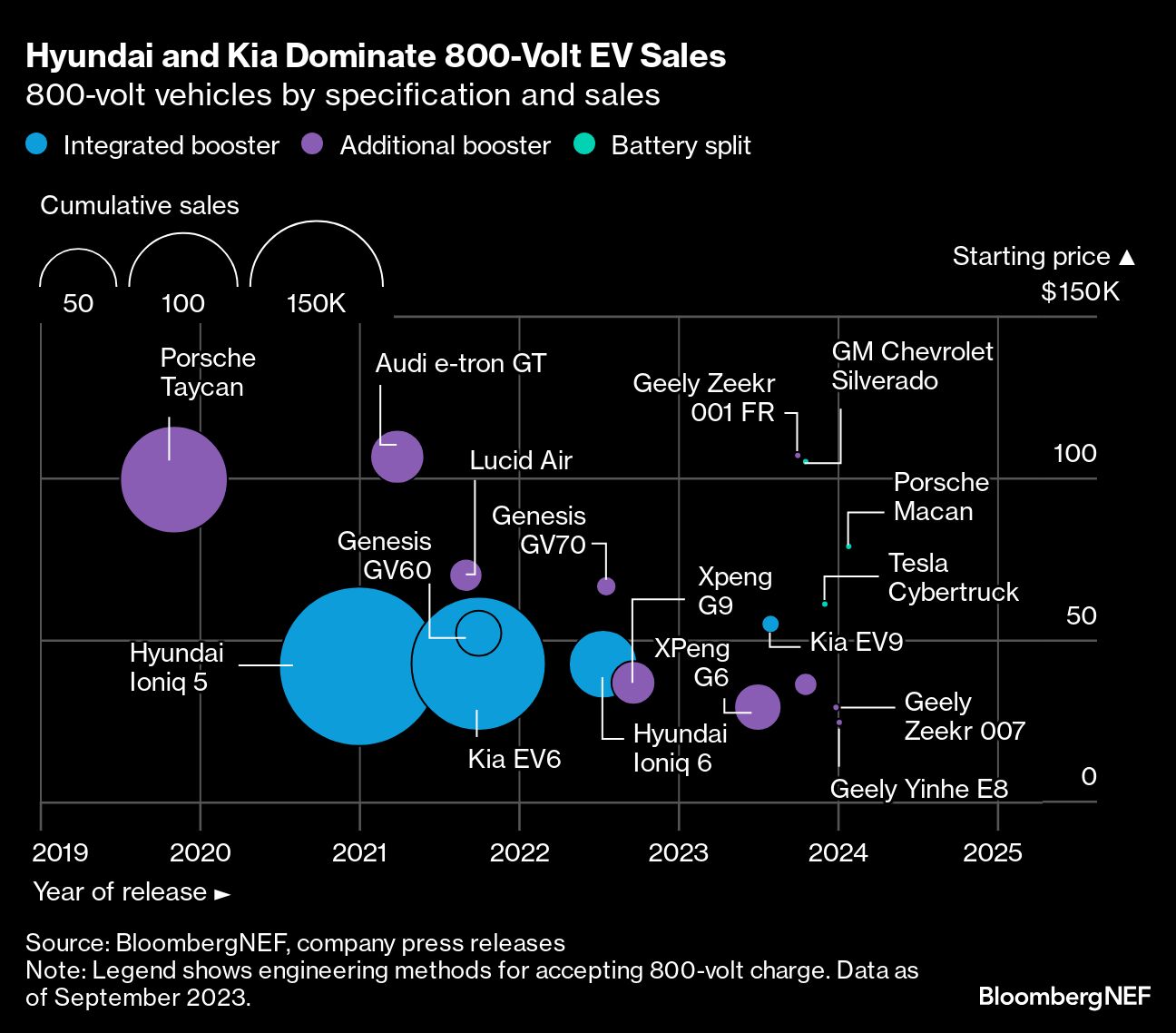
Up until now 800-volt technology has been associated with premium vehicles, with models such as the Porsche Taycan and the Audi e-tron GT.
But it's becoming less niche, according to BNEF's analysis of the market. Faster charging 800-volt models took a 4% share of all battery electric vehicle sales in the third quarter of 2023, from just 0.8% in 2020. And this may improve further as the technology trickles through to the mass market and sticker prices come down.
The most popular vehicle, with more than 218,000 units sold since launch in 2021, has been a relatively modest priced Hyundai Ioniq 5, which starts around $41,800 in the US. This model alone has accounted for 35% of all 800-volt sales.
Chinese automaker Geely is bringing out an even cheaper 800-volt EV, the Zeekr 007, at less than $30,000 domestically.

Ford, Toyota and Honda are the major manufacturers that have yet to reveal any plans for 800-volt models. There is some risk that holding back will leave them uncompetitive. However, it could pay to be a follower. It takes anywhere from four to eight years to bring a vehicle to market. They could take advantage of the new technology when others have invested in the supply chain and costs have reduced.
There is also a further issue beyond cost. Charging infrastructure has been traditionally geared to 400-volt vehicles. Currently lower voltage chargers account for 86% of the US fast chargers that can provide over 100 kilowatts of power. Even in Germany, which has done a better job at installing higher voltage chargers, 400-volt chargers account for 55% of those available.

Automakers have to design new cars to work at all these chargers, even if they can't deliver as much as the 350-kilowatt maximum charging powers advertised for the vehicles.
So far there are three different engineering approaches. The Porsche Taycan has an additional power electronic component, called a boost charger, to accept a 400-volt charge; the Hyundai Ioniq 5 has incorporated the function within the already existing vehicle motor, eliminating the need for an extra component; and the Tesla Cybertruck uses split-pack technology. This connects and disconnects smaller lower voltage battery packs from each other to achieve the required charging voltage.
While it's unlikely EV buyers will know anything about the engineering intricacies that go into these models, the different approaches highlight the complex challenges and divergence that remains in the EV market. There will be more 800-volt electric vehicles on the road in the next two years, and the strategy and designs behind them will determine which automakers come out on top.
--With assistance from Madeleine Brolly.
More stories like this are available on bloomberg.com
©2024 Bloomberg L.P.

-
Extracting Value From Battery Scrap Could Be Challenging For India | The Reason Why

A discarded lithium-ion battery still contains valuable materials such as lithium, nickel and cobalt. These can be recovered and reused. When such batteries are crushed and shredded, they produce a dark powder called black mass.
-
One El Nino, India Can Handle. Two Could Break The Granary
India's grain stocks can absorb one bad year, but a second El Nino could drain the buffer in two to three years, economists say.
-
India's Troika Of Good Luck | Joining The Dots
As Jensen Huang's exit drags Nvidia down, a cooling AI trade and resilient earnings have revived investor interest in India. A likely RBI rate hike looms.
-
Talking Points This Week: Leadership Shock At Nvidia, Earnings Strength, And The Fog Over Hormuz
The Anthropic IPO pricing and first trading day, Nvidia's upcoming earnings, and any fresh signals from Iran will set the tone for the following week.
-
Signature Play: The Classic Cocktail Is Dead. Or Is It?
Classic cocktails are disappearing from India's cocktail menus. But they're still being ordered, taught to bartenders and borrowed from. So, who's really having the last drink?
-
A New Samvat Wishlist: Inclusive Prosperity And Human Development
India has strengthened its economic foundations through infrastructure, digital access and enterprise. Its next growth chapter must deepen productivity, create better livelihoods and widen participation in prosperity.
-
Love, Sex Aur Dhokha: The Audacious Plot To Spy On Jensen Huang
A Taipei dinner, a Singapore chip buyer and a suspected Chinese asset: inside the alleged spy operation that got close to NVIDIA's Jensen Huang.
-
Ten Things I Learnt This Samvat
Patience can be a trap. Cheap stocks can stay cheap. Leverage can wipe you out. What did Samvat 2082 teach us? Niraj Shah writes on 10 lessons from the year gone by.
-
Talking Points This Week: Tech Nerves, FII Buying, And A Faraway Banking Shock
The global markets are not shining this Diwali. The exception in the large markets is, India.
-
Midterm Rally Lasted A Day. The Hard Reality Of A Divided US May Last Two Years | Opinion
Between a contested AI boom, a debt ceiling that arrives in 2027 and a president with every incentive to act alone, the next two years may prove more volatile than the first day's rally suggests.









