PMC Bank Victims: Rs 1 Lakh Insurance In 1993 Should Be Rs 1 Crore Today
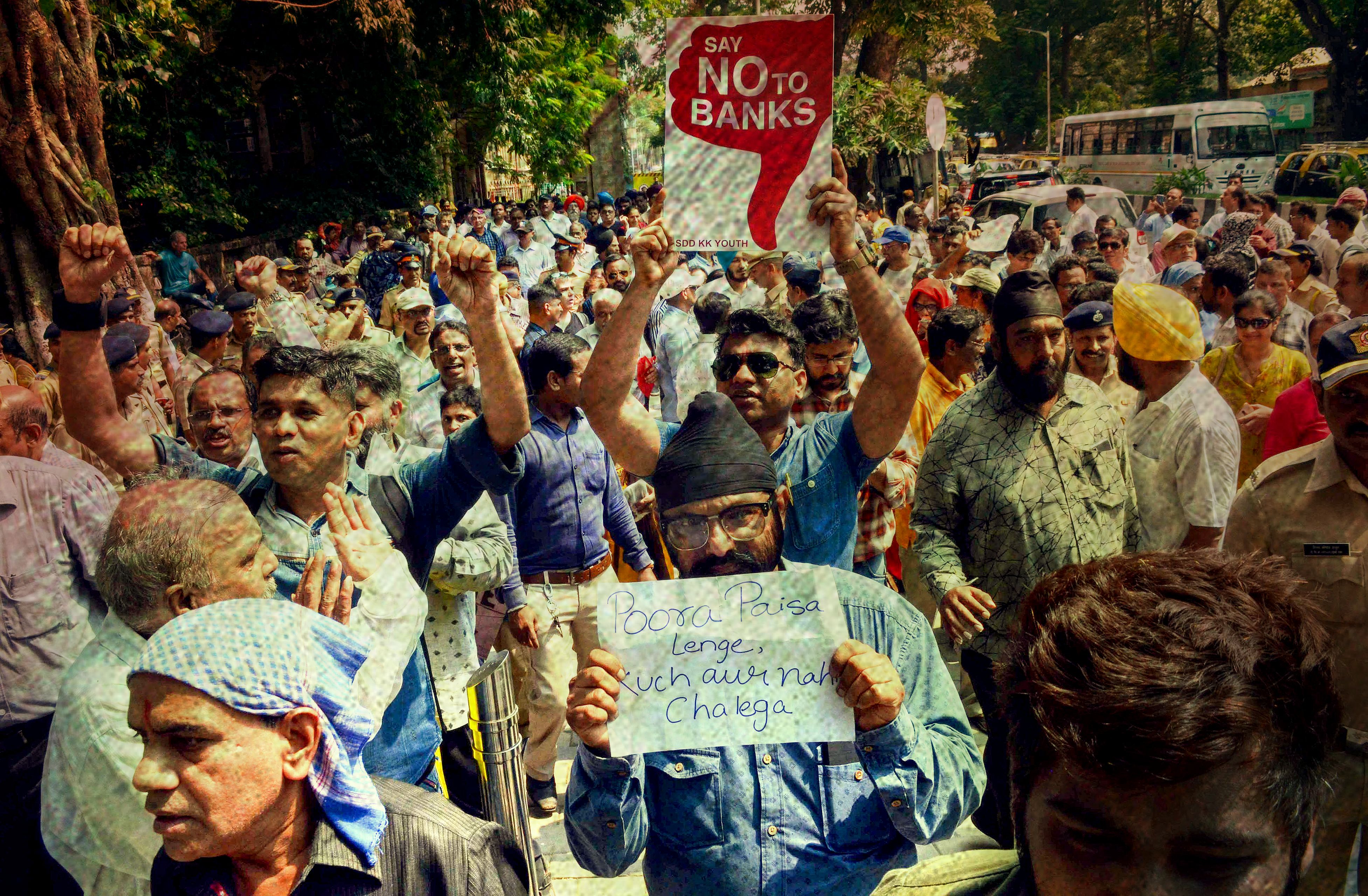
Vo kaun tha, vo kahan ka tha, kya hua tha usey
Suna hai aaj koi shakhs mar gaya yaaro
(Who was he, where did he come from, what happened to him
People shrugged; a random guy had just died)
These iconic lines penned by Shahryar for Gaman (Film; 1978) capture the pathos of three deaths in Mumbai on Tuesday, Oct. 15, so poignantly.


Now back to Shahryar's devastating lines:
Ajiib saneha mujh par guzar gaya yaaro
Main apney saaey say kal raat dar gaya yaaro
(A strange accident occurred with me
I got terrified by my own reflection)
Yes, the astonishing PMC Bank scam was the tragic saneha (accident) that terrified Sanjay, Fattomal and Yogita so much that they simply succumbed, dead.
Three weeks out, I continue to get shocked by the PMC Bank fiasco. Not so much by the audacity of the scam, but the pusillanimity of the government's response.
Let me explain.

The PMC Bank scam was more audacious than any Bonnie and Clyde heist. A high-living father-son duo, Rakesh and Sarang Wadhawan, had 44 bank accounts in a loosely regulated outfit in Mumbai called Punjab & Maharashtra Cooperative Bank. Their shenanigans had begun in the late 1990s, soon causing a cash crunch. But Rakesh Wadhawan ‘gallantly' stepped up with a deposit of Rs 100 crore to bail out PMC. Things got back to ‘normal'.

Having gotten away lightly with the first crime, the Wadhawans got bolder (aka reckless). They managed to install Waryam Singh, a former director of HDIL, their infrastructure group, as the Chairman. Another man, called Joy Thomas, with two wives, one in Mumbai and another under an alias, Junaid, in Pune, became MD. By now the Wadhawans had sucked nearly Rs 6,500 crore, a mind-boggling 73 percent of the total loan book of the ill-fated bank. This robbery took place right under the noses of RBI and the auditors. How? We do have some pieces of the jigsaw figured out now.

Now, even as the regulator was stuffing fudged reports in its information vaults, the father-son duo was gleefully buying a Dassault Falcon 200, a Bombardier Challenger, and a luxury yacht moored in Maldives. As in any ponzi operation, the party continued for as long as the cash was travelling from one blighted account to another, filling up the holes. But Waryam Singh was buying horses, Joseph/Junaid was buying apartments with his second wife, and the father-son duo was living the high life. So, once the music stopped – i.e., the ponzi chain was broken by haemorrhaging cash – poor bank depositors were left holding the ruins.

Why Bell The Cat If You Can Kill It!
But what happened next was even more tragic, and whoever conjured up this policy gem at RBI deserves to be, well … retired!
PMC's stunned depositors were told they could withdraw a maximum of Rs 1,000 over six months. That's it. One piffling thousand over six months. As a fully justified hysteria and anger got out of control, the hapless regulator increased the limit to Rs 10,000, then Rs 25,000 and now Rs 40,000.
But this is still astonishingly inexplicable. Why? Because India has a deposit guarantee scheme which assures that if a bank goes bust, each depositor is protected up to a maximum of Rs 1 lakh per aggregate account. And if you had sensibly opened two joint accounts, with the wife named first in one and the husband named first in the other, you would have been protected up to Rs 2 lakh.

Alas, the easiest thing for any government to do is ban, freeze, stop, and choke … one fatal flourish of the pen and the job is done. While the alternative is messy, rigorous, and difficult – to search for creative solutions, to do positive governance. Why bell the cat when you can simply kill it?
Rs 1 Crore Per Account If Deposit Insurance Was Indexed!
Allow me a little diversion here. India's deposit guarantee rule of Rs 1 lakh per depositor was decreed in 1993, over a quarter of a century ago. It's remained unchanged since then, even as the economy has grown in decadal multiples and inflation has denuded the real value of cash.
The above saga clearly shows the power of positive governance versus the cancer of ban-this-ban-that policies. In one, you could have given each PMC Bank depositor the ability to withdraw his or her entire cash up to Rs 50 lakh-plus, without causing a penny's loss; but in the other, you passed an unconscionable order restricting people to “Rs 1,000 in six months”.
Unfortunately, Sanjay Gulati, Fattomal Punjabi and Dr. Yogita Bijlani died.
Raghav Bahl is the co-founder and chairman of Quintillion Media, including BloombergQuint. He is the author of three books, viz ‘Superpower?: The Amazing Race Between China's Hare and India's Tortoise', ‘Super Economies: America, India, China & The Future Of The World', and ‘Super Century: What India Must Do to Rise by 2050'.

-
AI Bias In Investing Cannot Be Eliminated, But It Can Be Governed

Framing is a particularly important example as identical financial information presented in terms of gains rather than losses can lead an LLM to reach a different assessment.
-
Joining The Dots | Dark Skies, Steady Diya: Why Hope Holds This Diwali
With war, a weak rupee and foreign outflows weighing on sentiment, policymakers at the NDTV World Summit and market veterans at NDTV Profit Ignite: Diwali Edition offered the same advice: stay invested and filter out the noise.
-
The Curious Case of Equitas Small Finance Bank And A CEO Who Quit For Stock
PN Vasudevan believes persistent investor concerns over a perceived conflict of interest had become a governance overhang on Equitas Small Finance Bank's stock, even as the lender improved profitability and asset quality.
-
Talking Points This Week: AI Cash Burn, A Tiger Comeback And An India That Still Finds Its Own Path
India is not immune to higher oil or tighter global liquidity, yet its earnings base is broader, its domestic policy levers are still available.
-
Foreign Investors Own Half Of HDFC Bank and ICICI Bank. An LTCG Cut Could Matter Most Here
Foreign portfolio investors have US$115 billion parked in HDFC Bank, ICICI Bank. If the government cuts long-term capital gains tax, Jefferies says returning foreign money could land here first.
-
'Never Seen This Level Of Negativity': Sandeep Tandon Says The Next Rally May Be Closer Than You Think
Veteran investor Sandeep Tandon says foreign selling is easing, large-caps are due a comeback and mid-caps are crowded, while he turns positive on gold, power and pharma this Diwali.
-
Indians Stay With Family, Not In Hotels | The Reason Why
India still lacks enough clean, reliable and affordable hotels for budget-conscious travellers.
-
The Economic Imperative: Analysing The Material Driving Force Behind India-Canada Strategic Reset
This economic complementarity is further reinforced by deep institutional investment ties and talent mobility, which form the bedrock of the bilateral framework.
-
Medicine Pricing: Where Must Profit Stop?
India must confront excessive margins, hidden incentives and regulatory gaps that threaten the integrity of medicine.
-
Why Amazon And Flipkart Are Struggling To Beat Meesho In India's Smaller Cities
With 274 million users and lowest-cost logistics, Meesho is defending its value commerce crown against giants like Amazon and Flipkart.










