PM Modi's Cash Ban Could Boost Budget By $45 Billion: Foreign Media
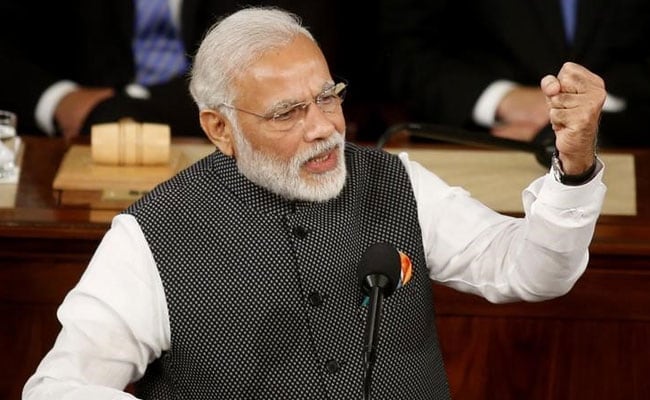
Prime Minister Narendra Modi's biggest move to fight tax evasion and graft can add $45 billion to India's budget, or about three times the size of Iceland's economy.
Mumbai-based brokerage Edelweiss Securities Ltd. predicts the government's surprise crack down on high-value currency notes will uncover 3 trillion rupees ($45 billion) in black money, which is cash that's stashed away to avoid tax. ICICI Securities Primary Dealership Ltd. is even more optimistic, pegging the figure at as much as 4.6 trillion rupees.
Economists are scrambling to calculate potential gains from Modi's late Tuesday decision to ban 500 and 1,000 rupee ($15) notes as legal tender. The move will suck out about 86 percent of the 17.8 trillion rupees of currency in circulation. The analysts say as much as a third of this will prove to be illegal and be unclaimed. Those funds can then be used by the government to narrow Asia's widest fiscal deficit.
"This money can now get utilized for various economic reforms' funding," said Edelweiss analyst Manoj Bahety. The central bank can reduce its liabilities by an equivalent amount or share the cash with the government, he said.
Here's what the funds could offer Modi:
The chance to slash by more than half his projected 5.3 trillion rupee budget deficit for the year through March 2017 The opportunity to double expenditure on defense and energy Or increase three-fold federal spending on social services such as education, health and housing.
"As investments drive up the supply capacity of the economy, overall gross domestic product growth is expected to benefit in the long term," economists including Dharmakirti Joshi at Crisil Ltd., the Indian unit of S&P Global Inc., wrote in a report on Wednesday. "In the short-term, GDP growth may get impacted negatively as the cash based economy feels a crunch and consumption and investment moderates."
Among sectors that will be squeezed are real estate, jewelry and cement, they predict. Shares of DLF Ltd., India's biggest listed developer, plunged the most in two years on Wednesday; jeweler Tribhovandas Bhimji Zaveri Ltd. tumbled the most on record; and Ambuja Cements Ltd. fell the most in a year.
However, less cash in the hands of consumers could also drive down prices of key goods, helping control one of Asia's fastest inflation rates. Citizens will have until the end of 2016 to exchange their now useless currency for newly printed 500 and 2,000 rupee notes. Each person can exchange as much as 4,000 rupees for cash while higher amounts will have to be deposited in their bank accounts.
All deposits of more than 250,000 made between Nov. 10 and Dec. 30 would be flagged to India's income tax office, which will match details with declared income. Any discrepancies would be treated as tax evasion and the tax amount plus a penalty of 200 percent of tax payable would be levied, Revenue Secretary Hasmukh Adhia told reporters on Wednesday.
Lower Borrowing Costs
"The good news here is that there could be a considerable drop in interest rates over the course of the next three to six months," S. Naren, executive director and chief investment officer at ICICI Prudential Asset Management Co., India's biggest money manager with $29 billion in assets, said in an e-mail response. "This would mean that many of the projects which were unviable could become viable as the interest rate subsides. Therefore, over the next three years, we expect a boom in the Indian economy backed by capital expenditure cycle, starting 2018."
The risk is that this "war on cash" may make households and businesses averse to spending, rendering lower interest rates ineffective, said Prasanna A. and Abhishek Upadhyay, economists at ICICI Securities.
"The move will be seen as a war on the parallel economy, corruption and money laundering," they wrote in a report on Wednesday. "Along with the introduction of the goods and services tax, this constitutes a far reaching reset of the Indian economy."
© 2016 Bloomberg L.P
(Except for the headline, this story has not been edited by NDTV staff and is published from a syndicated feed.)

-
The Curious Case of Equitas Small Finance Bank And A CEO Who Quit For Stock

PN Vasudevan believes persistent investor concerns over a perceived conflict of interest had become a governance overhang on Equitas Small Finance Bank's stock, even as the lender improved profitability and asset quality.
-
Talking Points This Week: AI Cash Burn, A Tiger Comeback And An India That Still Finds Its Own Path
India is not immune to higher oil or tighter global liquidity, yet its earnings base is broader, its domestic policy levers are still available.
-
Foreign Investors Own Half Of HDFC Bank and ICICI Bank. An LTCG Cut Could Matter Most Here
Foreign portfolio investors have US$115 billion parked in HDFC Bank, ICICI Bank. If the government cuts long-term capital gains tax, Jefferies says returning foreign money could land here first.
-
'Never Seen This Level Of Negativity': Sandeep Tandon Says The Next Rally May Be Closer Than You Think
Veteran investor Sandeep Tandon says foreign selling is easing, large-caps are due a comeback and mid-caps are crowded, while he turns positive on gold, power and pharma this Diwali.
-
Indians Stay With Family, Not In Hotels | The Reason Why
India still lacks enough clean, reliable and affordable hotels for budget-conscious travellers.
-
The Economic Imperative: Analysing The Material Driving Force Behind India-Canada Strategic Reset
This economic complementarity is further reinforced by deep institutional investment ties and talent mobility, which form the bedrock of the bilateral framework.
-
Medicine Pricing: Where Must Profit Stop?
India must confront excessive margins, hidden incentives and regulatory gaps that threaten the integrity of medicine.
-
Why Amazon And Flipkart Are Struggling To Beat Meesho In India's Smaller Cities
With 274 million users and lowest-cost logistics, Meesho is defending its value commerce crown against giants like Amazon and Flipkart.
-
High US Salaries, No Green Card Certainty: The Financial Calculation Facing Indian H-1B Families
The suspension of PERM processing at eight technology employers does not cancel existing H-1B visas. What it does is force a question many Indian families have been avoiding: is the US salary worth tying your career and family plans to one employer?
-
Swiggy vs Eternal: Food Delivery's Two Rivals Are No Longer In The Same Race
Eternal is building a private AI assistant, dark.ai. Swiggy is still working out how to make Instamart pay, with an operating loss of Rs 895 crore in the July-September quarter while Blinkit stayed profitable.










