PM Modi To Inaugurate India’s Longest Rail-Road Bridge In Bogibeel
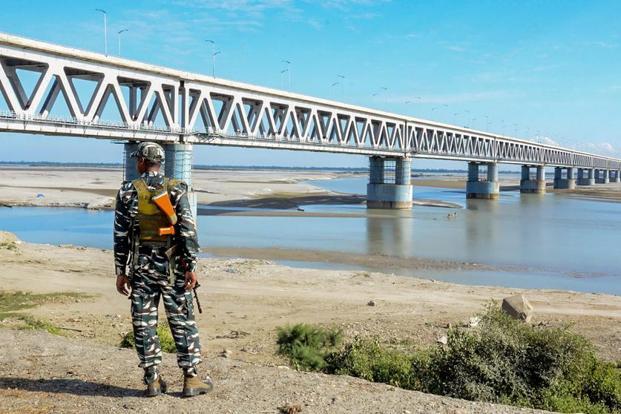
Prime Minister Narendra Modi will inaugurate the country's longest rail-cum-road bridge on Dec. 25. The Bogibeel Bridge, which is constructed over the Brahmputra river, which was a part of the Assam Accord and sanctioned in 1997-98.
The bridge is likely to play a crucial role in defence movement along the India-China border in Arunachal Pradesh and has a serviceable period of around 120 years. The bridge is also India's only fully-welded bridge for which European codes and welding standards were adhered to for the first time in the country, said Chief Engineer Mohinder Singh.
The foundation stone of the project was laid by former prime minister HD Deve Gouda on Jan. 22, 1997, while work commenced in April 2002 under the Atal Bihari Vajpayee-led government. Dec. 25 is Vajpayee's birth anniversary.
Because of the inordinate delay in implementation, the cost of the project escalated 85 percent to Rs 5,960 crore from the sanctioned estimated cost of Rs 3,230.02 crore. The total length of the bridge was also revised to 4.94 km from the earlier 4.31 km. The central government had declared the construction of the bridge as a National Project in 2007, thereby assuring availability of funds for speedy construction.
Although it will ease out inconvenience caused to people living on the northern side of Brahmaputra to a great extent, officials said the defence requirement played an important role while sanctioning the structure and its design.
"The bridge will enhance the national security of the eastern region by facilitating swift movement of defence forces and their equipment. It was constructed in such a way that even a fighter jet can land on it in case of emergency," a defence source said. This will also give the Air Force three new defence strips. in addition to shortening the travel time between India's farthest point at the border with China.
The bridge has a two-line railway track on the lower deck and a three-lane road on the top deck. For the first time in Indian Railways, the girder has steel floor system for railway tracks and concrete for road. "Early flood in the river Brahmaputra restricted the working season to a very short period of approximately five months (from November to March) and demanded huge mobilisation of construction equipment," said Singh.
Transportation of concrete across river channels of 600 metre to 900 metre width from both the north and south banks was the biggest challenge, he said. To overcome this, concrete was pumped through a pipeline laid over buoys. "Eighty-thousand tonnes of steel plates was delivered for the project via a combination of rail and road transport, while a 1,000-tonne hydraulic jack and strand jacks linked with the substructures were used for moving steel truss over the pillars," he said.
"Most 2D" automatic nesting software was used to generate efficient two-dimensional cutting plans for fabricating the steel superstructure for the bridge. After Dec. 25, people, especially patients from Assam Medical College located here, can travel straight from Dibrugarh from the other side of the river instead of using the ferries.
The road distance from Dibrugarh to Itanagar will be reduced by 150 km and the railway travel distance between these two points will shorten by 705 km, while this bridge will provide an alternate and shorter route from Dibrugarh through north bank of Brahmaputra to Delhi and Kolkata via Rangiya, an official said.
"The distance from Dibrugarh to Rangiya will be reduced by 170 km... Upper Assam and Eastern Arunachal Pradesh will see massive socio-economic development," Northeast Frontier Railway Chief Public Relations Officer Pranav Jyoti Sharma said.
Sharma said that 30 lakh bags of cement, 19,250 million tonnes of reinforcement steel and 2,800 MT structural steel were used for construction of the structure. “For the super structure of the main bridge, 77,000 MT of steel fabrication was required.”

-
Extracting Value From Battery Scrap Could Be Challenging For India | The Reason Why

A discarded lithium-ion battery still contains valuable materials such as lithium, nickel and cobalt. These can be recovered and reused. When such batteries are crushed and shredded, they produce a dark powder called black mass.
-
One El Nino, India Can Handle. Two Could Break The Granary
India's grain stocks can absorb one bad year, but a second El Nino could drain the buffer in two to three years, economists say.
-
India's Troika Of Good Luck | Joining The Dots
As Jensen Huang's exit drags Nvidia down, a cooling AI trade and resilient earnings have revived investor interest in India. A likely RBI rate hike looms.
-
Talking Points This Week: Leadership Shock At Nvidia, Earnings Strength, And The Fog Over Hormuz
The Anthropic IPO pricing and first trading day, Nvidia's upcoming earnings, and any fresh signals from Iran will set the tone for the following week.
-
Signature Play: The Classic Cocktail Is Dead. Or Is It?
Classic cocktails are disappearing from India's cocktail menus. But they're still being ordered, taught to bartenders and borrowed from. So, who's really having the last drink?
-
A New Samvat Wishlist: Inclusive Prosperity And Human Development
India has strengthened its economic foundations through infrastructure, digital access and enterprise. Its next growth chapter must deepen productivity, create better livelihoods and widen participation in prosperity.
-
Love, Sex Aur Dhokha: The Audacious Plot To Spy On Jensen Huang
A Taipei dinner, a Singapore chip buyer and a suspected Chinese asset: inside the alleged spy operation that got close to NVIDIA's Jensen Huang.
-
Ten Things I Learnt This Samvat
Patience can be a trap. Cheap stocks can stay cheap. Leverage can wipe you out. What did Samvat 2082 teach us? Niraj Shah writes on 10 lessons from the year gone by.
-
Talking Points This Week: Tech Nerves, FII Buying, And A Faraway Banking Shock
The global markets are not shining this Diwali. The exception in the large markets is, India.
-
Midterm Rally Lasted A Day. The Hard Reality Of A Divided US May Last Two Years | Opinion
Between a contested AI boom, a debt ceiling that arrives in 2027 and a president with every incentive to act alone, the next two years may prove more volatile than the first day's rally suggests.









