Bitcoin Deserves Some Space In Your Portfolio
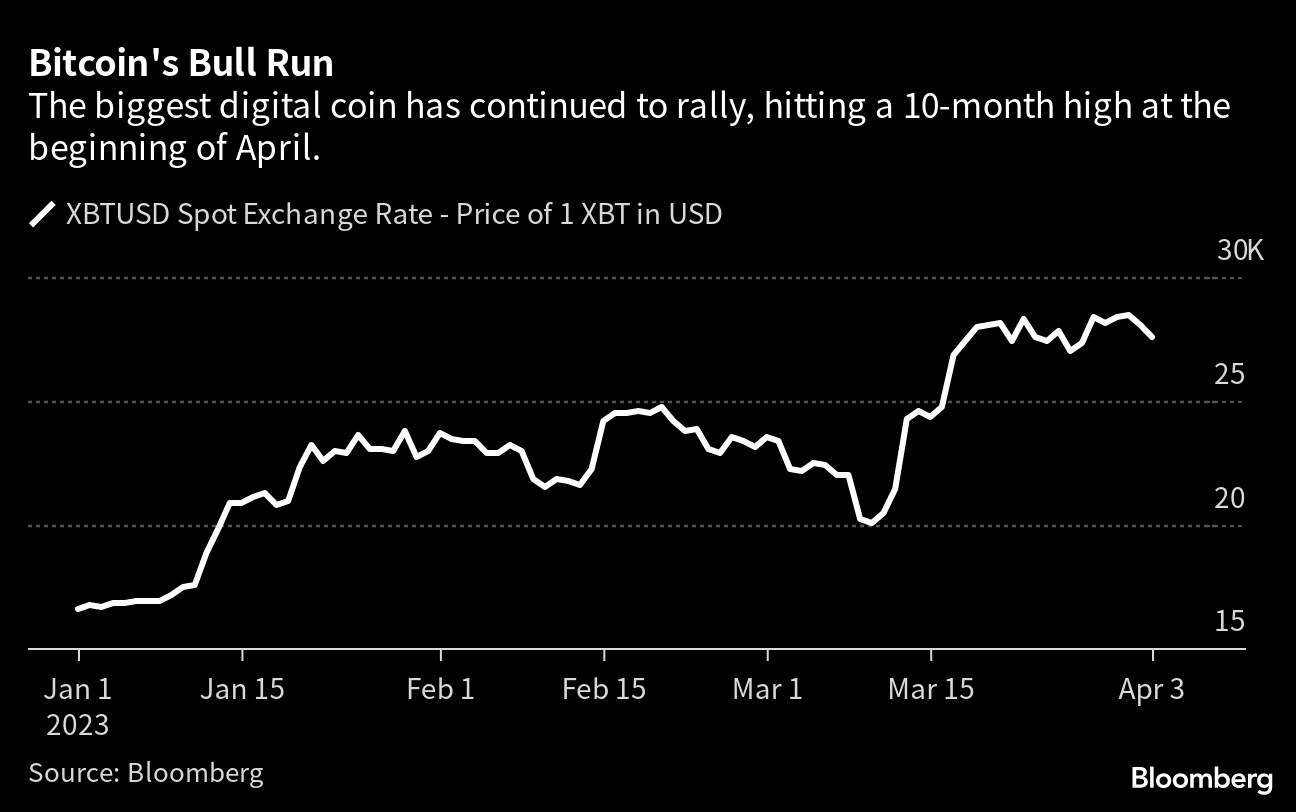
(Bloomberg Opinion) -- First, Goldman Sachs Group Inc. highlighted Bitcoin as the best-performing asset in terms of absolute and risk-adjusted returns earlier this year. Then the banking crisis happened and the largest digital coin rose to its highest price in ten months. It's enough to make even some naysayers reconsider.
But is this year's turnaround just a short-lived bubble or evidence of the what-doesn't-kill-you-makes-you-stronger thesis? Views are all over the place. The White House put out an economic report recently slamming crypto, saying the assets don't have fundamental value; while Bitcoin bulls like ARK Investment Management CEO Cathie Wood see its climb as an affirmation of decentralization.
Financial advisers' takes on whether to invest in Bitcoin yield answers ranging from “Don't mistake several months of positive performance with a long-term trend. (Remember Enron?)” to “It represents a wealth creation opportunity that we haven't seen in 35 years.”
The question takes on even more significance following the disastrous performance last year of the traditional 60/40 investing model, leading to a rethink of the six-decade-long tradition of retail investors allocating 60% of their portfolios to stocks and 40% to bonds (or some type of combination between the two).
There's no one-size-fits-all answer here. I'm neither a bull nor a bear when it comes to bitcoin, but it's hard to argue with adding a small allocation as an opportunistic growth play.
Let's take a look at the numbers. According to Morningstar Inc. calculations, an investor who had a 1% allocation to Bitcoin in a traditional 60/40 portfolio (with the Bitcoin allocation pulled from the equity bucket), would have had slightly worse returns over the past year — a decline of 8.93% versus an 8.77% drop for a traditional 60/40 portfolio. Those numbers aren't terrible considering Bitcoin tanked close to 40% during that time period.
Over longer periods, the 1% allocation to Bitcoin would have boosted returns dramatically. For the 10 years ending in March, the 1% Bitcoin portfolio handily beat the traditional 60/40 portfolio — 13.3% to 7.8% annually. A slightly larger 2% allocation delivered a slightly worse performance for the past year (a decline of about 9%), but gains of almost 18% annually over a 10-year period. Bitcoin still has a relatively low correlation with other asset classes, but that's starting to change a bit when it comes to stocks, especially large-cap ones, points out Amy Arnott, a portfolio strategist at Morningstar.
You can't bank on historical performance, of course, and it's hard to imagine Bitcoin seeing the the same tenfold price increase it experienced over the past decade. Still, it seems poised to edge higher and now may be a good time to get in relatively cheap.
Bloomberg Intelligence senior macro strategist Mike McGlone says he expects it's “only a matter of time” before Bitcoin reaches $100,000 because it has something very rare — definable diminishing supply, but it's still in the early days of adoption. “Bitcoin is well on its way to becoming global digital collateral in a world going that way,'' McGlone says. “Bumps in the road are expected but the overall trajectory seems quite enduring.''
Goldman has also said that Bitcoin could eventually hit $100,000 if investors accept its use as “digital gold.” Bloomberg Intelligence's Jamie Douglas Coutts, a senior market structure analyst, points to how Bitcoin just recorded its second-best first quarter performance in a decade — a strong first quarter has typically resulted in higher year-end prices. Notably, during previous periods of financial turmoil, when a key indicator of risk for the US banking system spiked, Bitcoin fell — this time, even as the gauge has been climbing, bitcoin has continued to rally.
All that is to say that even the optimists will struggle to pick the best time to wade in. With exposure to Bitcoin, comes volatility, underscoring how even a small allocation is really best suited for an investor with a longer horizon, who can tolerate the risk; meaning, not retirees on a fixed income. Morningstar's calculations show that a 1% allocation introduced a touch more volatility over the past year than a straight 60/40 portfolio, but over a 10-year period, the volatility is almost double.
Given Bitcoin's liquidity issues and concerns around using exchanges, retail investors who are bullish about its growth may struggle to figure out the best way to buy it. The $14 billion Grayscale Bitcoin Trust is set up so investors can effectively notch gains or losses in Bitcoin in a brokerage account rather than actually buying Bitcoin outright on an exchange with a digital wallet. While that sounds good in theory, the trust has traded at big discounts to the underlying price of Bitcoin, in part because of competition. And its 2% fees are especially high.
A better option for some investors would be if the Grayscale trust converts to an ETF, something it's been trying to do. So far its attempts have been rejected by the Securities and Exchange Commission, but if it succeeds in its appeal, an ETF structure (where shares can be created and redeemed in line with demand) would likely track Bitcoin's price better than a trust, which basically operates like a closed-end fund.
Beyond Grayscale, regulatory changes for the entire industry are ahead, making investing in Bitcoin an even bumpier ride. But they could ultimately provide more certainty and help to push the digital coin even higher. For a longer-term investor, starting to make small, regular allocations to Bitcoin seems worth it.
More From Bloomberg Opinion:
- Henry Ford and the Lesson Crypto Bulls Must Learn: Aaron Brown
- Matt Levine's Money Stuff: The CFTC Comes for Binance
- Crypto Scams and Modern Capitalism Are Siblings: David Fickling
This column does not necessarily reflect the opinion of the editorial board or Bloomberg LP and its owners.
Alexis Leondis is a Bloomberg Opinion columnist covering personal finance. Previously, she oversaw tax coverage for Bloomberg News.
More stories like this are available on bloomberg.com/opinion
©2023 Bloomberg L.P.

-
The Economic Imperative: Analysing The Material Driving Force Behind India-Canada Strategic Reset

This economic complementarity is further reinforced by deep institutional investment ties and talent mobility, which form the bedrock of the bilateral framework.
-
Medicine Pricing: Where Must Profit Stop?
India must confront excessive margins, hidden incentives and regulatory gaps that threaten the integrity of medicine.
-
Why Amazon And Flipkart Are Struggling To Beat Meesho In India's Smaller Cities
With 274 million users and lowest-cost logistics, Meesho is defending its value commerce crown against giants like Amazon and Flipkart.
-
High US Salaries, No Green Card Certainty: The Financial Calculation Facing Indian H-1B Families
The suspension of PERM processing at eight technology employers does not cancel existing H-1B visas. What it does is force a question many Indian families have been avoiding: is the US salary worth tying your career and family plans to one employer?
-
Swiggy vs Eternal: Food Delivery's Two Rivals Are No Longer In The Same Race
Eternal is building a private AI assistant, dark.ai. Swiggy is still working out how to make Instamart pay, with an operating loss of Rs 895 crore in the July-September quarter while Blinkit stayed profitable.
-
Where You Live Shapes How You Get To Work | The Reason Why
Two-wheelers are the most popular way to get to work in India, accounting for nearly 43% of workplace commutes.
-
Unhedged Position: Can India See An Indonesia-Style Time Correction?
The Nifty is trading below levels it first clocked in 2024. Is there, then, as I have suggested in the headline, potential that the current time correction drags on painfully for the next three-five, even ten years?
-
Navigating Friction And Energy Realities: An Analysis Of Marco Rubio's October Visit To India
Occurring at a critical juncture marked by stalled trade negotiations and escalating geopolitical pressures over global energy supplies, the visit offers a profound window into modern US-India relations.
-
India Exports Capital. Why Not Export Trusteeship?
The big question, then, is whether India can build an institution that global borrowers, investors, banks, and lawyers can trust, even without an Indian connection.
-
France's Economy & Politics Are In Crisis | The Reason Why
Let's look at how the French economy and politics evolved under Nicolas Sarkozy, Franois Hollande and Emmanuel Macron.










