Paytm Willing To Take The Long Road To Profitability, Says Vijay Shekhar Sharma
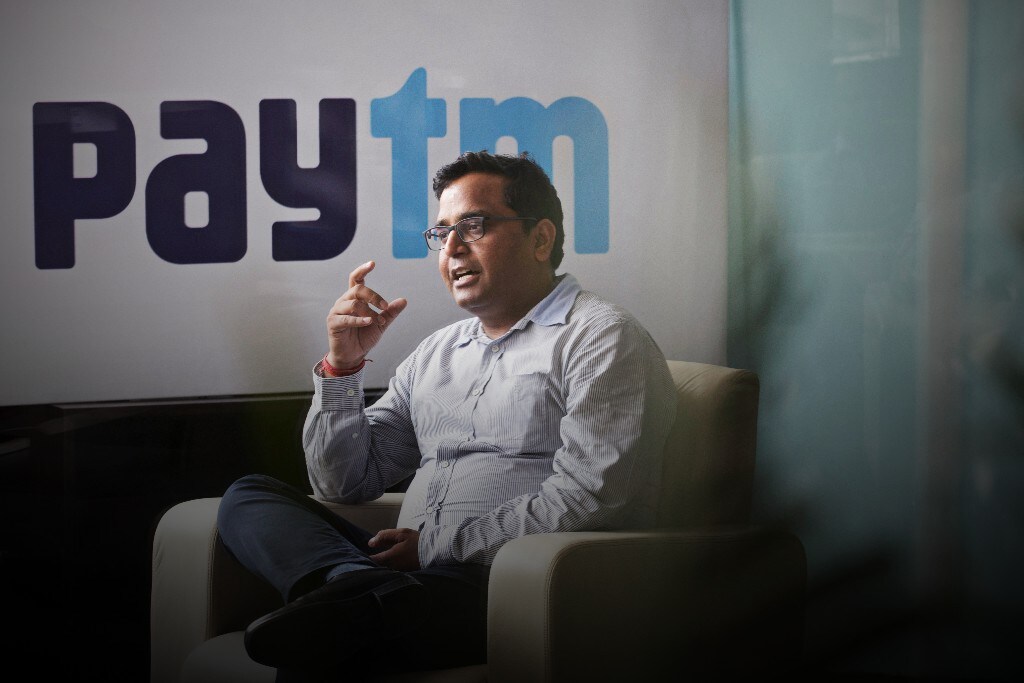
Is it a wallet? Is it a bank? Is it a gold retailer?
Vijay Shekhar Sharma says that Paytm is all that and plans to be more. 500 million customers by 2020 is the goal and, in reaching that goal, money is no object.
Armed with a $1.4 billion investment from Softbank Group Corp, raised at valuation of $7 billion, Paytm will spend the next few years investing to transform its digital payments business into a payments bank. The venture will involve an investment of Rs 10,000 crore, Sharma told BloombergQuint in an interview while dismissing all concerns about whether the payments bank model will be viable or not.
Paytm Payments Bank launched last week, offering customers a 4 percent interest rate on savings deposits. The rate offered was lower than competitors like Airtel Payments Bank, which is offering 7.25 percent, and India Post Payments Bank, which is offering 5.5 percent.
Sharma, however, says that this is just the start and the product will be built out in stages.
Let me talk technology language first. The theory of a minimal viable product in technology is that you should build small complete products first, which are addressing some subset of customers. So today's Paytm Bank product is meant for customers that have Paytm wallets. So by converting your wallet to a bank account, you can use it at places where you earlier couldn't, like Flipkart, Amazon or Ola. So we are being narrow in how we are launching. That's step 1. Step 2 is that we will offer you money transfer, step 3 will be when we add wealth management and step 4 will be when we add additional services.Vijay Shekhar Sharma, Founder, Paytm
Sharma also counters the fact that his competitors have a better distribution network on which to build a customer base for a payment bank. We are second to none, he says while explaining that Paytm has more than 5 million active merchants. A subset of those merchants will become business correspondents for the payments bank.
“We are there at the border of India from Pakistan side, we are there at the border from China side and we are there at the centre of India,” Sharma says to underline his distribution capabilities.
Those distribution capabilities, together with a campaign to convert existing wallet customers into payment bank account holders, is what Paytm is betting on to get its new venture going. A recent draft proposal to increase the know your customer (KYC) requirements for wallet customers may help Paytm speed up the process of conversion, as customers would no longer be allowed to operate wallets with minimum KYC.
Sharma, however, admits that it will be a long haul.
In fiscal 2016, Paytm reported a loss of Rs 1,549 crore, according to a December 13 report in the Economic Times. The loss was four times higher than in the previous year, the report highlighted.
Those numbers do not seem to bother Sharma.
“What I want to tell you is that in the last two years, we have spent close to $600 million on payments...and with the payments bank we are talking about Rs 10,000 crore (about $1.5 billion) in investment,” he says. “When I say spend, I mean we are willing to spend without earning,” he adds for good measure.
Sharma goes on to explain that the company will spend the next 5-6 years building the product. At present, the company is running with losses of roughly $200 million in a year at the cash flow level. We are willing to take that for the next 5-6 years, says Sharma.
The payments bank alone may break-even sooner, in less than three years.
In explaining Paytm's philosophy, Sharma borrows from Amazon's Jeff Bezos. “It's still Day 1.”
While much of the attention has been focused on Paytm's payment bank, the company has also launched a digital gold product. The product allows a customer to buy small quantities of digital gold, which can be liquidated as needed.
Sharma explains that the launch of the gold product emerges from the country's insatiable love for the yellow metal, which, he believes, will continue to be a preferred investment option for Indians.
While Sharma declined to give out exact numbers of the amount transacted using the scheme, he claims to have a larger number of gold buyers than any jewellery retailer.

-
We May Need Another Tukaram Mundhe To Fight Air Pollution | The Reason Why

Developers may install basic measures such as sprinklers and green nets, resume work, and continue violating rules when this equipment stops working.
-
Extracting Value From Battery Scrap Could Be Challenging For India | The Reason Why
A discarded lithium-ion battery still contains valuable materials such as lithium, nickel and cobalt. These can be recovered and reused. When such batteries are crushed and shredded, they produce a dark powder called black mass.
-
One El Nino, India Can Handle. Two Could Break The Granary
India's grain stocks can absorb one bad year, but a second El Nino could drain the buffer in two to three years, economists say.
-
India's Troika Of Good Luck | Joining The Dots
As Jensen Huang's exit drags Nvidia down, a cooling AI trade and resilient earnings have revived investor interest in India. A likely RBI rate hike looms.
-
Talking Points This Week: Leadership Shock At Nvidia, Earnings Strength, And The Fog Over Hormuz
The Anthropic IPO pricing and first trading day, Nvidia's upcoming earnings, and any fresh signals from Iran will set the tone for the following week.
-
Signature Play: The Classic Cocktail Is Dead. Or Is It?
Classic cocktails are disappearing from India's cocktail menus. But they're still being ordered, taught to bartenders and borrowed from. So, who's really having the last drink?
-
A New Samvat Wishlist: Inclusive Prosperity And Human Development
India has strengthened its economic foundations through infrastructure, digital access and enterprise. Its next growth chapter must deepen productivity, create better livelihoods and widen participation in prosperity.
-
Love, Sex Aur Dhokha: The Audacious Plot To Spy On Jensen Huang
A Taipei dinner, a Singapore chip buyer and a suspected Chinese asset: inside the alleged spy operation that got close to NVIDIA's Jensen Huang.
-
Ten Things I Learnt This Samvat
Patience can be a trap. Cheap stocks can stay cheap. Leverage can wipe you out. What did Samvat 2082 teach us? Niraj Shah writes on 10 lessons from the year gone by.
-
Talking Points This Week: Tech Nerves, FII Buying, And A Faraway Banking Shock
The global markets are not shining this Diwali. The exception in the large markets is, India.









