Pakistan’s Politics Seen Key To Deliver On New IMF Aid Program
(Bloomberg) -- Pakistan won vital breathing space from a potential debt default thanks to a draft agreement with the International Monetary Fund, but political stability will prove key to the South Asian economy in coming months.
The political situation has been volatile in recent weeks, adding to more than a year of upheavals since the ouster of former premier Imran Khan in April 2022. Violence erupted across the country in May after the arrest of Khan, who has been facing more than 100 cases ranging from corruption to murder in various courts.
“Everything hinges on whether political stability returns,” Uzair Aqeel, a partner at London-based Nairang Capital, said in the wake of Pakistan clinching a draft agreement with the IMF for a $3 billion loan program.
As recently as last August, Islamabad had won IMF staff approval for a $1.1 billion loan, only to have the bailout program halted over failure to meet some conditions. Prime Minister Shehbaz Sharif was able to close a new deal after multiple hour-long phone calls and several meetings with IMF Managing Director Kristalina Georgieva.
“Under duress, the government has shown reforms can be initiated — now the question is whether they will stay on track and continue to systematically work through” the issues, Aqeel said.
The nine-month, so-called standby arrangement reached on Thursday will need approval by the IMF executive board, with a vote expected in mid-July.
With some $23 billion of external debt obligations coming due in the fiscal year starting July — more than six times the nation's foreign-exchange reserves — the fresh IMF support can assuage concerns about Pakistan's ability to keep making payments.
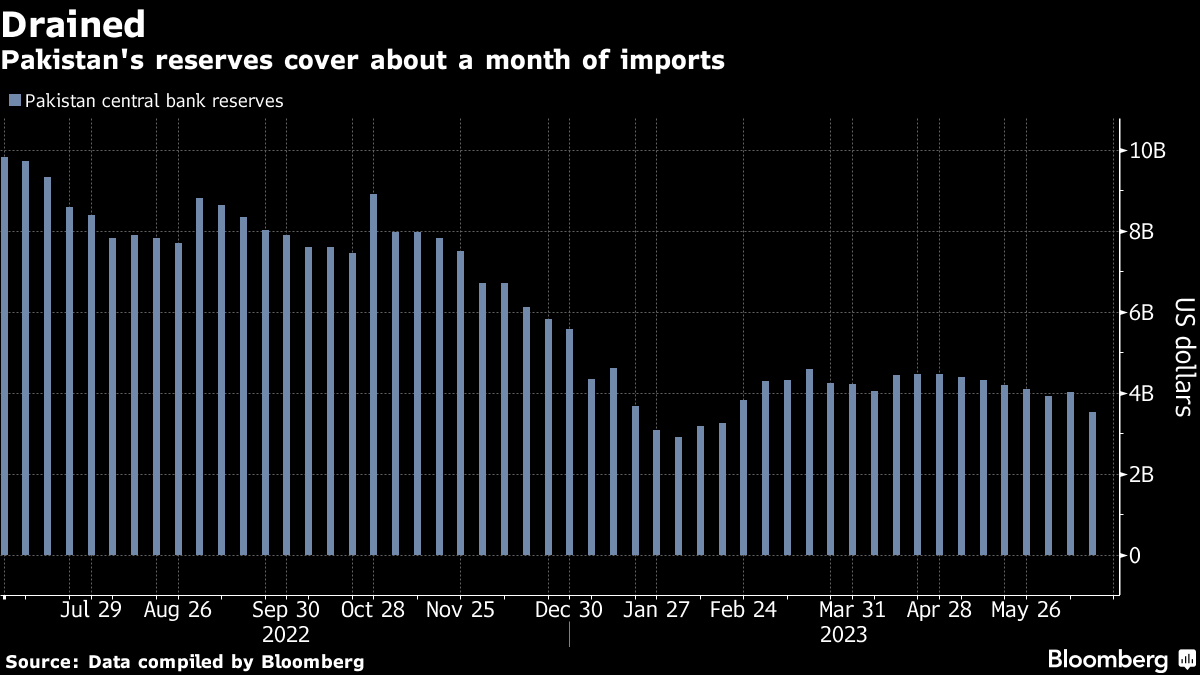
Pakistan is going through its worst economic crisis with record interest rates and inflation that's making it harder for people to buy fuel and put food on the table.
The government in June proposed a budget plan to shrink the fiscal deficit in part through tax hikes. But that will test the administration's already frayed popularity ahead of a national election due no later than October.
“I don't think the government is in a position right now to have serious reforms,” said Ruchir Desai, a co-fund manager at the AFC Asia Frontier Fund. That may indeed be why Pakistan has gone for a standby arrangement, he said. Ultimately a longer-term agreement with the IMF will be needed, he said.
For now, the deal will be “of comfort to investors,” Desai added. With Pakistani stocks so cheaply valued — the KSE-100 Index is trading at just four times earnings, by his tally — “I think the market will rally.”
But for a sustained gain beyond the next couple of months, the upcoming elections will need to go smoothly, Desai cautioned.
Markets were closed on Friday in Pakistan, and are scheduled to reopen Monday. Pakistan's dollar bonds due in 2024 surged on Friday.
The IMF deal could help to encourage other creditors to engage with Pakistan, adding to the country's breathing space, according to Mattias Martinsson, chief investment officer at Stockholm-based frontier market investors Tundra Fonder AB.
Pakistan expects Saudi Arabia and UAE to give $3 billion in fresh loans, and more in investments. It is also trying to materialize about $10 billion committed in pledges at a donor conference in Geneva after devastating floods last year.
“From our perspective, the market has already factored in a default, so a certain positive reaction is likely,” Martinsson said. “Our main apprehension, however, continues to revolve around the uncertain political situation,” looking out later this year, he said.
More stories like this are available on bloomberg.com
©2023 Bloomberg L.P.

-
The Economic Imperative: Analysing The Material Driving Force Behind India-Canada Strategic Reset

This economic complementarity is further reinforced by deep institutional investment ties and talent mobility, which form the bedrock of the bilateral framework.
-
Medicine Pricing: Where Must Profit Stop?
India must confront excessive margins, hidden incentives and regulatory gaps that threaten the integrity of medicine.
-
Why Amazon And Flipkart Are Struggling To Beat Meesho In India's Smaller Cities
With 274 million users and lowest-cost logistics, Meesho is defending its value commerce crown against giants like Amazon and Flipkart.
-
High US Salaries, No Green Card Certainty: The Financial Calculation Facing Indian H-1B Families
The suspension of PERM processing at eight technology employers does not cancel existing H-1B visas. What it does is force a question many Indian families have been avoiding: is the US salary worth tying your career and family plans to one employer?
-
Swiggy vs Eternal: Food Delivery's Two Rivals Are No Longer In The Same Race
Eternal is building a private AI assistant, dark.ai. Swiggy is still working out how to make Instamart pay, with an operating loss of Rs 895 crore in the July-September quarter while Blinkit stayed profitable.
-
Where You Live Shapes How You Get To Work | The Reason Why
Two-wheelers are the most popular way to get to work in India, accounting for nearly 43% of workplace commutes.
-
Unhedged Position: Can India See An Indonesia-Style Time Correction?
The Nifty is trading below levels it first clocked in 2024. Is there, then, as I have suggested in the headline, potential that the current time correction drags on painfully for the next three-five, even ten years?
-
Navigating Friction And Energy Realities: An Analysis Of Marco Rubio's October Visit To India
Occurring at a critical juncture marked by stalled trade negotiations and escalating geopolitical pressures over global energy supplies, the visit offers a profound window into modern US-India relations.
-
India Exports Capital. Why Not Export Trusteeship?
The big question, then, is whether India can build an institution that global borrowers, investors, banks, and lawyers can trust, even without an Indian connection.
-
France's Economy & Politics Are In Crisis | The Reason Why
Let's look at how the French economy and politics evolved under Nicolas Sarkozy, Franois Hollande and Emmanuel Macron.










