Machines Are Coming for India's Unwanted Jobs

A textile-yarn company in western Indian soon will have more machines than workers. A manufacturer in southern India sold almost double the number of its automated goods last year. India's biggest carmaker has one robot for every four plant employees.
Automation will double over the next three years in Indian factories, according to a survey by Willis Towers Watson. Companies in the Asia Pacific region reckon machines will account for 23 percent of work, on average, over the next three years, compared with 13 percent today. In India, that figure is expected to rise to almost 30 percent from 14 percent over the same period.
India Inc. is turning to machines quicker than its global peers. But unlike companies in Japan and Germany - which are automating to move up the food chain as their workers age - factories in the world's second most populous country have a surprising motivation: They're running out of willing (human) workers.
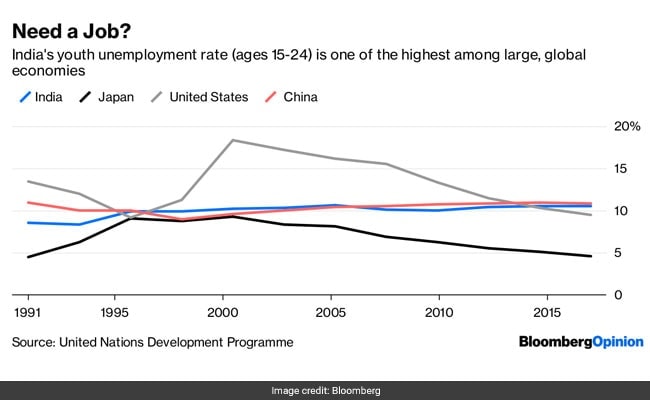
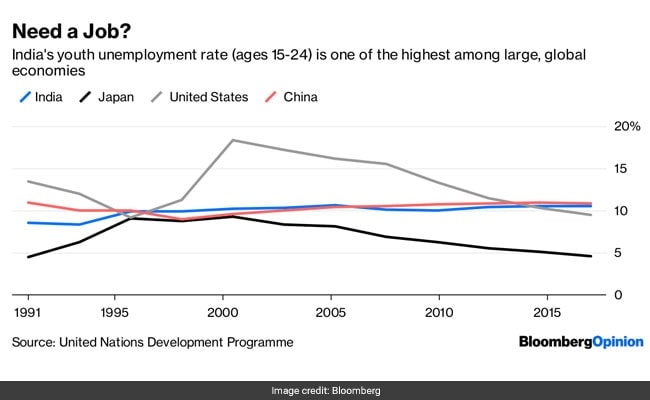
This is also happening as India's ballooning working-age population needs more jobs. Over the next decade, 138 million people will be added to the workforce, a 30 percent rise, according to the McKinsey Global Institute.
The trouble is finding jobs that Indians actually want. The country's workers would rather drive for food-delivery services on the breezy, albeit steamy, roads of Mumbai and work in hotels than in factories. Fair enough. Who would want to work in a yarn mill, which needs to maintain a temperature of 33 degrees Celsius (91 degrees Fahrenheit) and 60 percent relative humidity? Conditions on other industrial factory floors are likely worse.
That India's yarn and cloth-making industries - among the most labor-intensive in the country - have become the vanguard of automation speaks to the challenge. The textile-yarn company had to ramp up spending on hiring and venture deep into the Indian hinterland to find workers through recruitment camps, luring them with housing and attendance incentives. It even has had to pay them just to return to work after the holiday season or weddings.
The rapid pace of automation has brought its own set of problems. The cost of adding machines is high while labor costs are relatively lower. Many of these companies wouldn't break even for years by automating, and according to the Willis Towers Watson survey, few believe they are prepared to deal with the onset of machines.
The Indian government's job-guarantee program, with its skewed incentives, hasn't helped either. For every worker that signs up for the 100-day plan, fewer will fuel the manufacturing sector and the "Make in India" program. Because wages for those jobs are, in several states, set below the minimum wage, anecdotally workers have been signing up at multiple job sites just to squeak by.
Other laborers have given up altogether. Take the city of Bengaluru, whose ready-made garment industry is composed mostly of young, unskilled migrant women. Studies have found that over a fifth of workers there don't receive the minimum wage, and move from factory to factory only to end up in domestic-service work.
Who would've thought that India's low- and unskilled workers, and the welfare programs designed to help them, would drive companies toward automation? In a country where manufacturing and construction each comprise 10 percent of the labor force - compared with 25 percent in services - these sectors should be driving India's economy, not weighing it down. The sad reality is that those in the bottom tiers of the labor force will be the most severely hurt by automation.
Upgrading rusty manual machines isn't a bad thing. The transition could help overall productivity, efficiency and quality. Research also has found that automation often leads to other, better jobs. The typewriter didn't replace the stenographer completely but taught people how to type instead.
The difference is that those workers had skills that could be upgraded. Meanwhile, only 18.5 percent of India's labor force is skilled or holds an intermediate or advanced level of education, according to the United Nations Development Programme.
Manufacturing, as Professor Dani Rodrik of Harvard University, puts it, is "the quintessential escalator for developing economies." For India, which became a service-heavy economy before it fully industrialized, the consequences of automating the sector are far more dire. The self-fulfilling cycle of India's manufacturing void means workers may not be fully equipped to move up the ladder or out of the still-large informal economy.
Indian politicians have vowed to create millions of new jobs a year. That hasn't happened. Ahead of a big election, India's accidental automation may make that promise even harder to fulfill.
(Anjani Trivedi is a Bloomberg Opinion columnist covering industrial companies in Asia. She previously worked for the Wall Street Journal.)
Disclaimer: The opinions expressed within this article are the personal opinions of the author. The facts and opinions appearing in the article do not reflect the views of NDTV and NDTV does not assume any responsibility or liability for the same
(This story has not been edited by NDTV staff and is auto-generated from a syndicated feed.)

-
Getting To Work Costs Women More | The Reason Why

It is not just about women paying more than men. It is about women paying much more in cities than in villages.
-
AI Bias In Investing Cannot Be Eliminated, But It Can Be Governed
Framing is a particularly important example as identical financial information presented in terms of gains rather than losses can lead an LLM to reach a different assessment.
-
Joining The Dots | Dark Skies, Steady Diya: Why Hope Holds This Diwali
With war, a weak rupee and foreign outflows weighing on sentiment, policymakers at the NDTV World Summit and market veterans at NDTV Profit Ignite: Diwali Edition offered the same advice: stay invested and filter out the noise.
-
The Curious Case of Equitas Small Finance Bank And A CEO Who Quit For Stock
PN Vasudevan believes persistent investor concerns over a perceived conflict of interest had become a governance overhang on Equitas Small Finance Bank's stock, even as the lender improved profitability and asset quality.
-
Talking Points This Week: AI Cash Burn, A Tiger Comeback And An India That Still Finds Its Own Path
India is not immune to higher oil or tighter global liquidity, yet its earnings base is broader, its domestic policy levers are still available.
-
Foreign Investors Own Half Of HDFC Bank and ICICI Bank. An LTCG Cut Could Matter Most Here
Foreign portfolio investors have US$115 billion parked in HDFC Bank, ICICI Bank. If the government cuts long-term capital gains tax, Jefferies says returning foreign money could land here first.
-
'Never Seen This Level Of Negativity': Sandeep Tandon Says The Next Rally May Be Closer Than You Think
Veteran investor Sandeep Tandon says foreign selling is easing, large-caps are due a comeback and mid-caps are crowded, while he turns positive on gold, power and pharma this Diwali.
-
Indians Stay With Family, Not In Hotels | The Reason Why
India still lacks enough clean, reliable and affordable hotels for budget-conscious travellers.
-
The Economic Imperative: Analysing The Material Driving Force Behind India-Canada Strategic Reset
This economic complementarity is further reinforced by deep institutional investment ties and talent mobility, which form the bedrock of the bilateral framework.
-
Medicine Pricing: Where Must Profit Stop?
India must confront excessive margins, hidden incentives and regulatory gaps that threaten the integrity of medicine.










