For BJP in Poll-Bound Gujarat, ‘Urbanisation’ a Double-Edged Sword
Gujarat Elections is turning out to be a prestige battle for Prime Minister Narendra Modi and BJP President Amit Shah. A high-pitched battle is ensuing between the Congress and BJP in the state. While Rahul Gandhi is gaining traction with his ‘Navsarjan Yatra', opinion polls are predicting a BJP win. However, ‘Mission 150' looks highly improbable to achieve for BJP.
BJP has been ruling the state since March 1995, except for a brief period of 1.5 years when the Shankersinh Vaghela-led Rashtriya Janata Party was in power.
Also Read: Bigger Worries for BJP Than Defeat in Chitrakoot (Hint: Gujarat)
Increasing Urbanisation Helped BJP in Gujarat
Many reasons have contributed to the BJP's long Gujarat stint. Some of these are:
- Disintegration of KHAM (Kshatriya, Harijan, Adivasi, Muslim) alliance
- Patidars, shifting allegiance from Congress to BJP
- Consolidation of Hindu votes after Ram Janm Bhoomi
- Further polarisation after Godhra riots
- Magnetic leadership of Modi
- Gujarat model of development
All this aside, one of the less talked about factors that can be credited for BJP's success in Gujarat is increasing urbanisation. It's an established fact that BJP has traditionally performed well in urban areas compared to rural areas.
BJP's vote share in rural India was 30 percent vs 42 percent in urban India in the Lok Sabha 2014 elections. Its success rate in urban India was higher at 84 percent vs 63 percent in rural areas.
Also Read: Voices of Gujarat: ‘BJP Has Helped Farmers', ‘Gujarat is Plural'
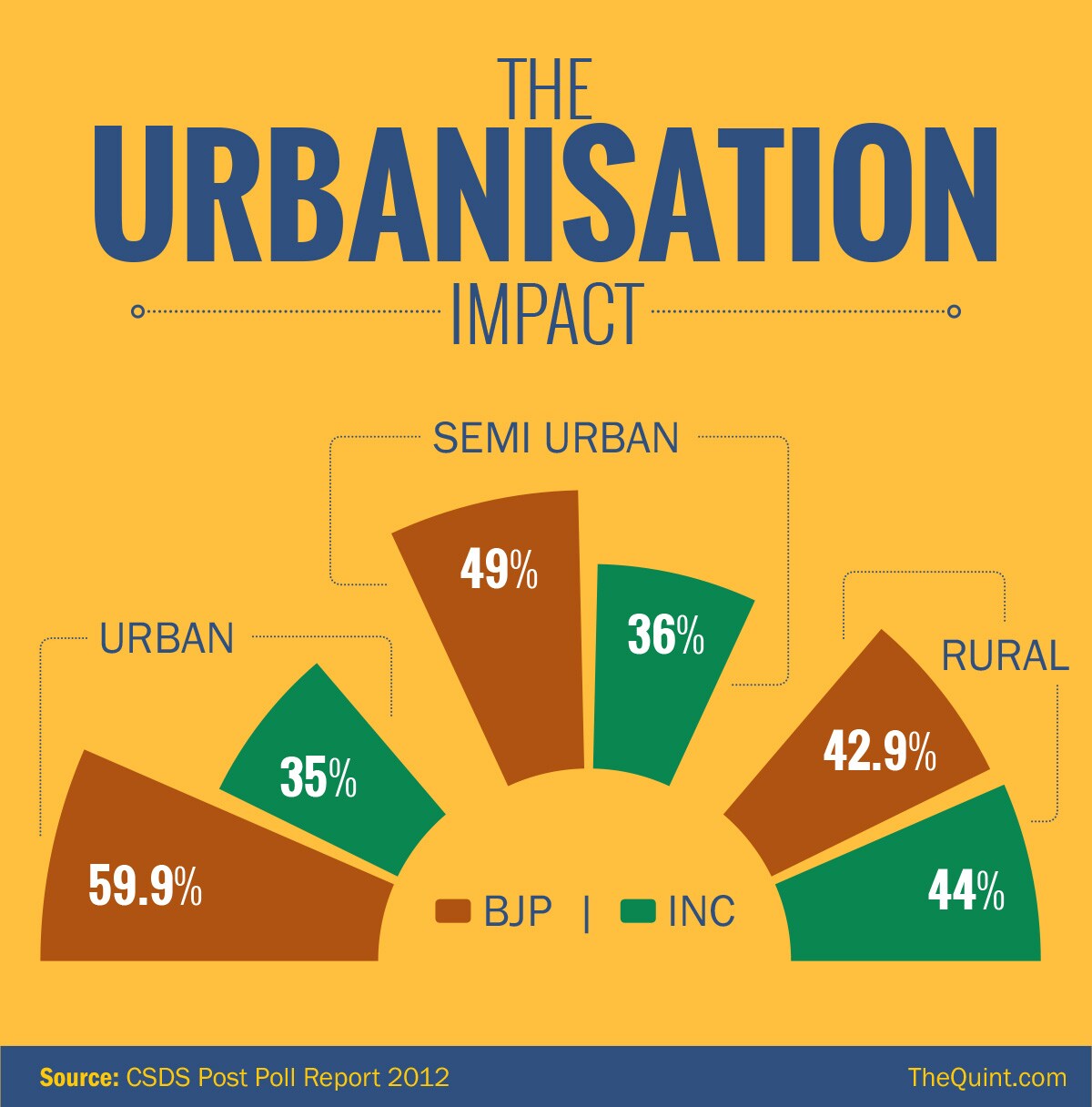
The 2012 state election results for Gujarat show that BJP swept the urban areas which propelled it to get a majority for a third time in a row in the state. It won 90 percent of the 39 urban seats and 80 percent of the 45 semi-urban seats. 62 percent out of its total tally of 115 seats were from urban areas.
.jpg "Source: CSDS Post Poll Report 2012")
Also Read: Tables Are Turning Quite Fast for the Congress in Gujarat
In rural Gujarat, BJP was actually trailing Congress by five seats. In terms of vote share too, a similar trend was noticed. BJP was leading over Congress by 24.5 percent in urban and 13 percent in semi-urban areas. In rural areas, Congress maintained a lead of just over 1 percent.
Also Read: Voices of Gujarat: ‘We Want Govt Jobs', ‘BJP Makes Empty Promises'
Urbanisation in Gujarat Higher Than National Average
Gujarat is the fourth most urbanised and third most industrialised state of India. The level of urbanisation in Gujarat has been consistently rising from 34.5 percent in 1991 to 37.4 percent in 2001 to 42.6 percent in 2011.
It has also been consistently above the level of urbanisation of pan-India level which is 31.1 percent as of 2011 census (1.33 times). While the urban population rose by 36 percent during 2001-2011, rural population witnessed a mere nine percent rate of growth, implying growth of four times in urban vs rural Gujarat.
Eight municipal corporations of Ahmedabad, Surat, Vadodara, Rajkot, Jamnagar, Junagadh, Bhavnagar and Gandhinagar, together constitute about 75 percent or 1.47 crore of the total urban population. BJP won half of its tally from these 8 corporations in 2012.
Also Read: BJP Will Win Gujarat, But Vote Share to Drop: ABP-CSDS Survey
Modi's ‘Neo Middle-Class' Constituency
Under Modi's governance, the BJP appeals to the aspirations of people in Gujarat's urban areas. He has developed a constituency of ‘neo-middle class' which has attracted voters from all caste blocks. This ‘neo middle-class' wants jobs, better infrastructure, good roads and flyovers, good lifestyle, decent salaries, among other things.
As Nirendra Dev says in his 2012 book ‘Modi to Moditva: An Uncensored Truth', for the neo middle-class, Modi is the “CEO of Gujarat”.
Even after being elected as the Prime Minister, people consider Modi to be Gujarat's ‘CEO' and Chief Minister Vijay Rupani to be a mere representative. Modi successfully managed to project himself as the messiah of this category of voters which became the anchor voting segment for the BJP.
Urban Vote-Bank – a Double-Edged Sword
This dependence on urban voters also poses a risk as is playing out in this election. Inequality is rising in Gujarat, creating a severe urban-rural divide. Only 1.2 percent of the households in rural Gujarat reported owning all the following assets – televisions, computers/laptops, telephones/mobile phones and scooters/cars vs 12.7 percent in urban Gujarat.
This is reflected in the anger of farmers against BJP rule. As per a CSDS poll, farmers ‘seem to have very strongly swung in favour of the Congress, with 50 percent of them indicating their support for the opposition party.'
Loss of jobs, slowdown in the economy post demonetisation and lack of employment opportunities has led to dissatisfaction among youth. BJP's decline among youngest voters (18-29-year-olds) is the steepest as per CSDS poll. The party had received 63% percent backing among them in August 2017 which is now down to 44 percent, signalling a rising discontent with the BJP.
The poor condition of roads after rains in Ahmedabad also exposed the Gujarat ‘model of development'. Will the BJP's strength become its Achilles heel in this year's elections? Or will the urban voter still vote for BJP for the lack of a better alternative?
We will know in a month's time.
(Amitabh Tiwari is an ex-corporate and investment banker turned political consultant and commentator. He can be reached @politicalbaaba. This is a personal blog and the views expressed above are the author's own. The Quint neither endorses nor is responsible for the same.)
(Voices of Gujarat: Tired of listening to netas make promises? As Gujarat goes to polls, The Quint wants to listen to the real voices of Gujarat – the voters. Tell us what issues matter to you this election season. Send in your videos to elections@thequint.com or WhatsApp @ +919999008335)

-
Getting To Work Costs Women More | The Reason Why

It is not just about women paying more than men. It is about women paying much more in cities than in villages.
-
AI Bias In Investing Cannot Be Eliminated, But It Can Be Governed
Framing is a particularly important example as identical financial information presented in terms of gains rather than losses can lead an LLM to reach a different assessment.
-
Joining The Dots | Dark Skies, Steady Diya: Why Hope Holds This Diwali
With war, a weak rupee and foreign outflows weighing on sentiment, policymakers at the NDTV World Summit and market veterans at NDTV Profit Ignite: Diwali Edition offered the same advice: stay invested and filter out the noise.
-
The Curious Case of Equitas Small Finance Bank And A CEO Who Quit For Stock
PN Vasudevan believes persistent investor concerns over a perceived conflict of interest had become a governance overhang on Equitas Small Finance Bank's stock, even as the lender improved profitability and asset quality.
-
Talking Points This Week: AI Cash Burn, A Tiger Comeback And An India That Still Finds Its Own Path
India is not immune to higher oil or tighter global liquidity, yet its earnings base is broader, its domestic policy levers are still available.
-
Foreign Investors Own Half Of HDFC Bank and ICICI Bank. An LTCG Cut Could Matter Most Here
Foreign portfolio investors have US$115 billion parked in HDFC Bank, ICICI Bank. If the government cuts long-term capital gains tax, Jefferies says returning foreign money could land here first.
-
'Never Seen This Level Of Negativity': Sandeep Tandon Says The Next Rally May Be Closer Than You Think
Veteran investor Sandeep Tandon says foreign selling is easing, large-caps are due a comeback and mid-caps are crowded, while he turns positive on gold, power and pharma this Diwali.
-
Indians Stay With Family, Not In Hotels | The Reason Why
India still lacks enough clean, reliable and affordable hotels for budget-conscious travellers.
-
The Economic Imperative: Analysing The Material Driving Force Behind India-Canada Strategic Reset
This economic complementarity is further reinforced by deep institutional investment ties and talent mobility, which form the bedrock of the bilateral framework.
-
Medicine Pricing: Where Must Profit Stop?
India must confront excessive margins, hidden incentives and regulatory gaps that threaten the integrity of medicine.










