There's No Half-Rescuing A Zombie. Ask Yes Bank
Whatever else you do with a bank that loses half its deposits in six months, don't leave it with half a rescue.
Yes Bank Ltd. was the poster child of India's $200 billion-plus bad-loan malaise. But the story of its dubious underwriting is now just another long-drawn criminal case. (Co-founder Rana Kapoor, who ran the bank into the ground, is facing charges of accepting bribes against loans to a fraud-ridden property financier that's since gone bankrupt. He has denied any wrongdoing.) Of late, Yes is a cautionary tale about botched bailouts and ill-conceived bail-ins.
The lessons learned might soon be put to a broader test. The shock of the coronavirus lockdown on economic activity could leave several Indian lenders short of capital - just as Yes was in March, when the authorities recapitalized it by making additional Tier 1 bondholders worthless and ordering a consortium led by the State Bank of India to buy fresh equity.
Yet the June quarter results show an institution still wandering in zombie land: Profit tumbled to $6 million, down 60 per cent from a year earlier. Despite efforts to win back savers, deposits have fallen 48 per cent, with sticky current and savings accounts making up only 26 per cent of the total, less than half the level at rival Kotak Mahindra Bank Ltd. Net interest income, which grew 16 per cent to 19 per cent at other lenders, fell at Yes.
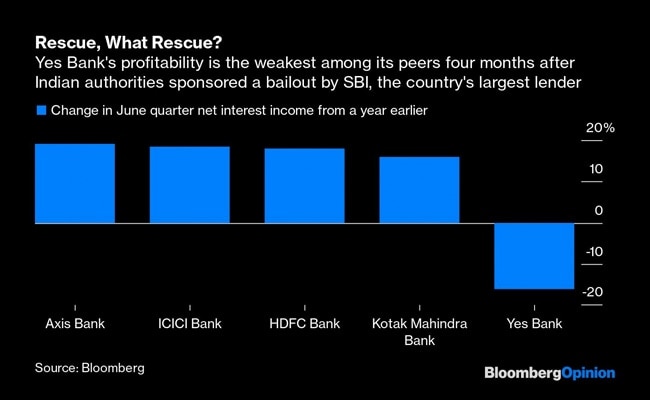
The Band-Aid of rehabilitation is coming apart, though Yes's wounds are far from healed. On a struggling loan book, the 0.4 per cent of net advances it set aside for pandemic-linked losses won't be enough. Knowing this, Yes raised another $2 billion recently in a share sale that saw lukewarm public interest. Even after it paid to make up the shortfall, SBI's 48 per cent stake got diluted to 30 per cent.
If only it was 30 per cent of something that was becoming bigger and better. Bloomberg banking analyst Diksha Gera estimates around $4 billion in new soured advances this year. Making loss provisions for those, as well as writing off existing bad loans, would leave Yes with a 20 per cent smaller book value per share by next March even after the fund-raising, she says. How's this an efficient use of the resources of taxpayer-funded SBI, the country's largest lender?
Yes Bank was privately owned, before it was quasi-nationalized by making it SBI's problem. But next year, there will be several small state-owned banks in a similar situation where capital buffers are depleted. This can't happen yet because of the central bank's Covid-19 moratorium on loan repayments. When the freeze ends next month, loans will start turning overdue. The lenders will beg delinquent borrowers to somehow pay the December installment so that the reporting of bad loans gets pushed beyond the March 2021 year-end. However, sooner or later, they'll need fresh capital - or trap AT1 bondholders, just like Yes Bank did.
That will put New Delhi in a spot. A cash-strapped government grudgingly managed $43 billion in recapitalization funds over the past five years - only to watch most of it disappear down the rabbit hole of credit losses. If the owner of 70 per cent of the country's banking system doesn't invest billions of dollars more, state-run banks will conserve capital by not writing new loans.
The 30 per cent drop in Yes Bank's advances from June last year should be a warning. If a large chunk of the financial system tries to deleverage, India's post-Covid recovery will be very sluggish. Will desperate authorities try to square the circle by bailing in depositors? The Finance Ministry has denied any plan to reintroduce a bill that had proposed forcibly converting deposits into equity. A strong public backlash killed that move. But as analysts such as Moneylife website's Sucheta Dalal have noted, a separate new law, seeking to create a resolution authority for dealing with financial failure, might give it the power to cancel or modify any liability, perhaps even large, uninsured deposits.
Any such plan would make the challenge worse. To see why, consider Yes again. The worst that happened to depositors during its recapitalization was that cash withdrawals were limited for a while. That was enough to destroy leftover confidence. Now, even a proposal for the government to cut its majority stake in public sector institutions "may dent depositor confidence and potentially lead to negative rating action as their long-term ratings are anchored to state support," Fitch Ratings notes.
A half-rescue is bad enough, as the ongoing Yes Bank misadventure has painfully underscored. Enlisting depositors to top up the capital tank would be a bigger disaster.
(Andy Mukherjee is a Bloomberg Opinion columnist covering industrial companies and financial services. He previously was a columnist for Reuters Breakingviews. He has also worked for the Straits Times, ET NOW and Bloomberg News.)
Disclaimer: The opinions expressed within this article are the personal opinions of the author. The facts and opinions appearing in the article do not reflect the views of NDTV and NDTV does not assume any responsibility or liability for the same.

-
We May Need Another Tukaram Mundhe To Fight Air Pollution | The Reason Why

Developers may install basic measures such as sprinklers and green nets, resume work, and continue violating rules when this equipment stops working.
-
Extracting Value From Battery Scrap Could Be Challenging For India | The Reason Why
A discarded lithium-ion battery still contains valuable materials such as lithium, nickel and cobalt. These can be recovered and reused. When such batteries are crushed and shredded, they produce a dark powder called black mass.
-
One El Nino, India Can Handle. Two Could Break The Granary
India's grain stocks can absorb one bad year, but a second El Nino could drain the buffer in two to three years, economists say.
-
India's Troika Of Good Luck | Joining The Dots
As Jensen Huang's exit drags Nvidia down, a cooling AI trade and resilient earnings have revived investor interest in India. A likely RBI rate hike looms.
-
Talking Points This Week: Leadership Shock At Nvidia, Earnings Strength, And The Fog Over Hormuz
The Anthropic IPO pricing and first trading day, Nvidia's upcoming earnings, and any fresh signals from Iran will set the tone for the following week.
-
Signature Play: The Classic Cocktail Is Dead. Or Is It?
Classic cocktails are disappearing from India's cocktail menus. But they're still being ordered, taught to bartenders and borrowed from. So, who's really having the last drink?
-
A New Samvat Wishlist: Inclusive Prosperity And Human Development
India has strengthened its economic foundations through infrastructure, digital access and enterprise. Its next growth chapter must deepen productivity, create better livelihoods and widen participation in prosperity.
-
Love, Sex Aur Dhokha: The Audacious Plot To Spy On Jensen Huang
A Taipei dinner, a Singapore chip buyer and a suspected Chinese asset: inside the alleged spy operation that got close to NVIDIA's Jensen Huang.
-
Ten Things I Learnt This Samvat
Patience can be a trap. Cheap stocks can stay cheap. Leverage can wipe you out. What did Samvat 2082 teach us? Niraj Shah writes on 10 lessons from the year gone by.
-
Talking Points This Week: Tech Nerves, FII Buying, And A Faraway Banking Shock
The global markets are not shining this Diwali. The exception in the large markets is, India.









