This Debt-Hit Group Is Behind India's Own Mini-Lehman Moment
India is marking the 10th anniversary of the 2008 global financial crisis with its own mini-Lehman moment.
True to script, ratings companies have belatedly realized that the IL&FS Group - Infrastructure Leasing & Financial Services Ltd. and its associates - is woefully short of liquidity, with about $500 million in repayments coming due in the second half of its fiscal year through March and only about $27 million available. The group, which missed a payment in the commercial-paper market last month, is now late in servicing an inter-corporate deposit.
Shocks are starting to reverberate amid an avalanche of ratings downgrades. That's only to be expected: On the hook for the group's $12.5 billion debt are banks and mutual funds. (IL&FS itself is a motley collection of shadow lenders that don't take deposits.)
Meanwhile, the group's assets include financial claims on everything from roads and tunnels to water treatment plants and power stations. This is the stuff that IL&FS has been financing for 30 years; none of it can be liquidated to make lenders and debt-fund investors whole.
But then, infrastructure - when taxpayers don't fund it it - is always about rolling over liquid, short-term debt to create solid long-term assets. Trouble starts when power plants get stranded for lack of fuel or purchase contracts, and roads clear environmental hurdles only to crash into low tolls, poor usage and payment disputes with the highway authority. The economics collapses backward.
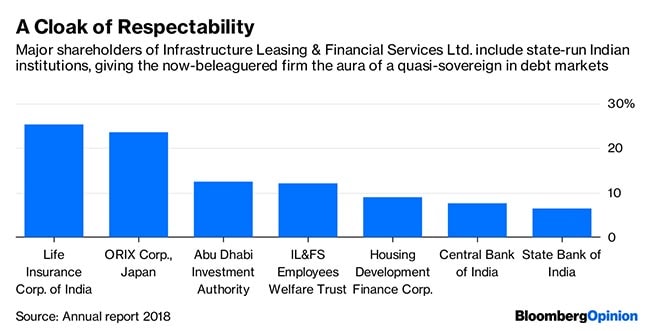
The knives are out for IL&FS, but who's going to give the pound of flesh? Ravi Parthasarathy, the all-too-powerful founder of the IL&FS empire and Indian equivalent of "Gorilla" Richard Fuld at Lehman, stepped down for health reasons in July. The rest of the board exists only for decorative purposes.
Opacity, meanwhile, has a propensity to amplify panic. As IL&FS goes radioactive, the money market doesn't know who's exposed to its toxicity, and to what extent. After mapping exposures from debt-charge documents, analysts at Nomura Research have managed to locate 64 percent of the group's liabilities to banks.
The same vulnerabilities that were exposed by the Lehman crisis are on display a decade later in India. The IL&FS Group is too big to fail; isn't regulated nearly as closely as it would have been as a deposit-taking institution; and has no "living will" - a plan to let it fail safely.
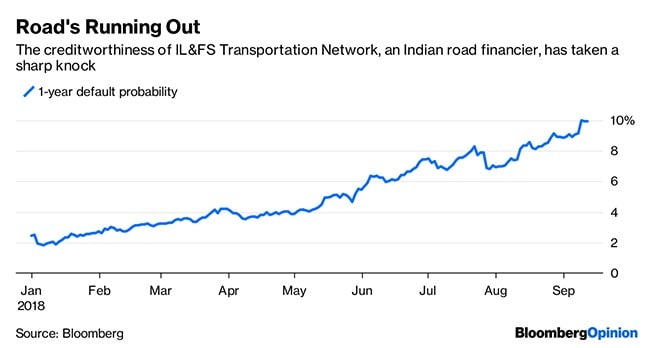
Not only do India's state-run banks have bulky exposure to IL&FS, they have also lent to some of the same projects that put it in trouble. Nomura reckons that IL&FS Transport Network's road assets are being carried as standard on the balance sheets of many banks. That's laughable, given that IL&FS Transport's own one-year default probability is approaching 10 percent, according to a proprietary Bloomberg model. Asking banks to reclassify these advances as nonperforming and make provisions at a time when they have no profits and $200 billion in stressed assets would be a stab to the heart of India's financial system.
Repugnant as the idea may be to taxpayers, socializing losses is often the only way to avoid panic from spreading. U.S. policymakers understood that only after they let Lehman go. In the case of IL&FS, New Delhi will have to mount a rescue before retail customers of money-market mutual funds turn wary. It's time perhaps to give old faithful Life Insurance Corp. of India another shot at national service. (The insurer is busy bailing out a bank, as we speak.) After all, a young population makes India's insurance customers the perfect vessels for dispensing mercy.
(Andy Mukherjee is a Bloomberg Gadfly columnist covering industrial companies and financial services. He previously was a columnist for Reuters Breakingviews. He has also worked for the Straits Times, ET NOW and Bloomberg News.)
Disclaimer: The opinions expressed within this article are the personal opinions of the author. The facts and opinions appearing in the article do not reflect the views of NDTV and NDTV does not assume any responsibility or liability for the same.

-
Getting To Work Costs Women More | The Reason Why

It is not just about women paying more than men. It is about women paying much more in cities than in villages.
-
AI Bias In Investing Cannot Be Eliminated, But It Can Be Governed
Framing is a particularly important example as identical financial information presented in terms of gains rather than losses can lead an LLM to reach a different assessment.
-
Joining The Dots | Dark Skies, Steady Diya: Why Hope Holds This Diwali
With war, a weak rupee and foreign outflows weighing on sentiment, policymakers at the NDTV World Summit and market veterans at NDTV Profit Ignite: Diwali Edition offered the same advice: stay invested and filter out the noise.
-
The Curious Case of Equitas Small Finance Bank And A CEO Who Quit For Stock
PN Vasudevan believes persistent investor concerns over a perceived conflict of interest had become a governance overhang on Equitas Small Finance Bank's stock, even as the lender improved profitability and asset quality.
-
Talking Points This Week: AI Cash Burn, A Tiger Comeback And An India That Still Finds Its Own Path
India is not immune to higher oil or tighter global liquidity, yet its earnings base is broader, its domestic policy levers are still available.
-
Foreign Investors Own Half Of HDFC Bank and ICICI Bank. An LTCG Cut Could Matter Most Here
Foreign portfolio investors have US$115 billion parked in HDFC Bank, ICICI Bank. If the government cuts long-term capital gains tax, Jefferies says returning foreign money could land here first.
-
'Never Seen This Level Of Negativity': Sandeep Tandon Says The Next Rally May Be Closer Than You Think
Veteran investor Sandeep Tandon says foreign selling is easing, large-caps are due a comeback and mid-caps are crowded, while he turns positive on gold, power and pharma this Diwali.
-
Indians Stay With Family, Not In Hotels | The Reason Why
India still lacks enough clean, reliable and affordable hotels for budget-conscious travellers.
-
The Economic Imperative: Analysing The Material Driving Force Behind India-Canada Strategic Reset
This economic complementarity is further reinforced by deep institutional investment ties and talent mobility, which form the bedrock of the bilateral framework.
-
Medicine Pricing: Where Must Profit Stop?
India must confront excessive margins, hidden incentives and regulatory gaps that threaten the integrity of medicine.










