Can Nirmala Sitharaman's Budget Deliver V-Shaped Recovery
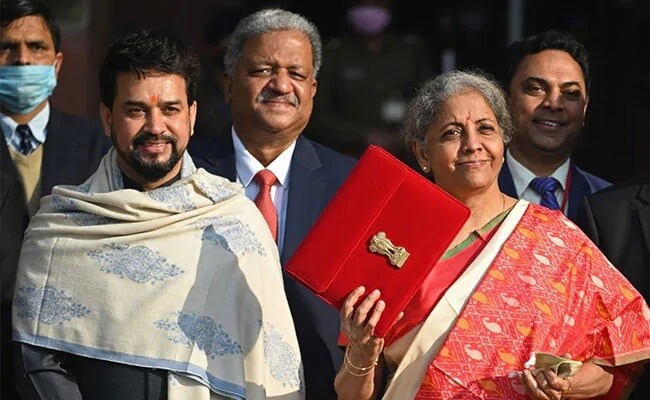
India's annual budget Monday made equity investors ecstatic and the bond market morose. Could both of them be right?
In her speech, Finance Minister Nirmala Sitharaman pegged total government expenditure for the current fiscal year at 34.5 trillion rupees ($472 billion). That's $57 billion more than what analysts had forecast based on a muted April-to-November trend, extrapolated for a bump in December through March, the final four months of the accounting period. But not only is Sitharaman spending much more liberally than expected, she wants to loosen her purse strings by another $5 billion in the next fiscal year.
The equity market is happy for four main reasons. One, there was no major new tax - or an increase in tax rates - to meet the spending goal. Two, even as total outlay goes up by $5 billion, the capital expenditure part, which could create new orders and profit for India Inc., is projected to rise by $15 billion. Third, the finance minister's promise of a bad bank to take away commercial lenders' soured assets is giving the market hope that clogged-up credit will start to flow more freely. The government is also setting up a new "development" financial institution to meet the needs of the infrastructure sector. Finally, the decision to allow foreign insurers to boost their stakes in local joint ventures to 74% from 49% is a welcome reform.
The bond investor, meanwhile, is nursing a rude sticker-price shock. The finance minister said the current fiscal year's budget deficit would be as wide as 9.5% of gross domestic product, about 2 percentage points more than the consensus estimate. In the coming year, she wants to trim the shortfall, but not too drastically. A targeted deficit of 6.8% of GDP will require New Delhi to borrow aggressively once again, both from the bond market and from citizens' small savings pool. All eyes are on the central bank. Given that the Reserve Bank also intends to buy the dollars flooding into India's stock market to keep the rupee from rising too much, there's a limit on how many government bonds it may purchase from banks.
India wants to spend its way to a V-shaped recovery and hoping that getting there would also ease the resource crunch. For instance, next year's budget assumes a 17% jump in tax revenue and a more than five-fold jump in state asset sales. With the spread of the virus contained - and inoculation expected to gather pace - these targets may not be as daunting as they appear.
Even then, a lot has to go right for financing issues to not raise their head during the year, especially if the U.S. Federal Reserve decides to start tapering its asset purchases, raising borrowing costs for emerging markets. This leaves India with very little time to steady an economy that was slowing precipitously even before Covid-19. Disturbingly, India's protectionist turn - under the garb of self-reliance - continued in the budget, with import tariffs going up on auto components and mobile-phone parts. This doesn't augur well for manufacturing, especially for smaller firms whose revival holds the key to employment.
After they fled locked-down urban centers, 60 million migrant workers - equivalent to Italy's population - found a halfway house in India's rural job guarantee last June. While demand for publicly funded low-wage jobs has since ebbed to 34 million, a fifth of Indians who lost their services, manufacturing and construction jobs are still working as farmhands or are unemployed.
Still, the pandemic has finally alerted India to some long-neglected priorities: Even after taking away the cost of vaccination, the $30 billion earmarked for health and wellbeing is a doubling of the pre-Covid-19 spending level. What remains to be seen is whether this money can actually be spent. Overall, too, execution will determine the outcome of India's high-risk spending plan. It'll decide whether the bond investor turns more sanguine about financing, or the equity market turns more skeptical of V-shaped growth. Perhaps the initial reaction of both will be proved a little right, and wrong.
(Andy Mukherjee is a Bloomberg Opinion columnist covering industrial companies and financial services. He previously was a columnist for Reuters Breakingviews. He has also worked for the Straits Times, ET NOW and Bloomberg News.)
Disclaimer: The opinions expressed within this article are the personal opinions of the author. The facts and opinions appearing in the article do not reflect the views of NDTV and NDTV does not assume any responsibility or liability for the same.

-
Talking Points This Week: Leadership Shock At Nvidia, Earnings Strength, And The Fog Over Hormuz

The Anthropic IPO pricing and first trading day, Nvidia's upcoming earnings, and any fresh signals from Iran will set the tone for the following week.
-
Signature Play: The Classic Cocktail Is Dead. Or Is It?
Classic cocktails are disappearing from India's cocktail menus. But they're still being ordered, taught to bartenders and borrowed from. So, who's really having the last drink?
-
A New Samvat Wishlist: Inclusive Prosperity And Human Development
India has strengthened its economic foundations through infrastructure, digital access and enterprise. Its next growth chapter must deepen productivity, create better livelihoods and widen participation in prosperity.
-
Love, Sex Aur Dhokha: The Audacious Plot To Spy On Jensen Huang
A Taipei dinner, a Singapore chip buyer and a suspected Chinese asset: inside the alleged spy operation that got close to NVIDIA's Jensen Huang.
-
Ten Things I Learnt This Samvat
Patience can be a trap. Cheap stocks can stay cheap. Leverage can wipe you out. What did Samvat 2082 teach us? Niraj Shah writes on 10 lessons from the year gone by.
-
Talking Points This Week: Tech Nerves, FII Buying, And A Faraway Banking Shock
The global markets are not shining this Diwali. The exception in the large markets is, India.
-
Midterm Rally Lasted A Day. The Hard Reality Of A Divided US May Last Two Years | Opinion
Between a contested AI boom, a debt ceiling that arrives in 2027 and a president with every incentive to act alone, the next two years may prove more volatile than the first day's rally suggests.
-
Blue Wave Will Derail the AI Trade but Won't Dismantle the AI Era | Unhedged Position
The Democrats' sweep of the US Congress will see politics collide with economic forces both over the long and short term.
-
It's Time To Take The GST Council's Bet On Trust Global
Payment records can prove India's services exports, and clear, proportionate rules can bring foreign digital sellers into the tax net.
-
Opinion | India at 38: From Innovation Overperformer to Innovation Powerhouse
India now has 453 VC-backed deep science startups, 18 of them late-stage, after 117 percent growth since 2020. Laurus Labs, at USD 9.3 billion, is the most valuable deep science company in any middle-income economy outside China.









