Banks Play Risky Game As Covid Loan Truce Ends
India's lenders and their shareholders are playing a dangerous game of hide and seek.
Financial firms need to raise a record amount of capital, something they would like to do before the central bank's Covid-19 moratorium on repayment ends next month and they have to disclose a big jump in bad loans. So they have an incentive to pretend that their borrowers have become miraculously stress-free. Investors know this and are trying to ferret out bad news. Valuations are sliding, and if policy makers have a plan for rescuing this vital industry, they're keeping it close to their chests.
In March, the central bank told lenders they could stop collecting from borrowers for three months after Prime Minister Narendra Modi put a stop to most economic activity to contain the virus. Since then, the regulator has extended the timeout by another three months. But as they announce their June quarter figures, lenders are under pressure from the stock market to show how most of their customer accounts have become regular again after the lockdown was relaxed May 10.
Axis Bank Ltd. shares jumped more than 7 per cent in Mumbai on Wednesday after it said loans under moratorium were down to 9.7 per cent by value from 28 per cent in May. It wants to raise $2 billion to boost its capital buffers after S&P Global Ratings cut its debt rating to junk. Non-bank financier Bajaj Finance Ltd. disclosed that a little under 16 per cent of advances are frozen, a drop from 27 per cent at the end of April. This improvement, however, failed to cheer investors because at least some of it came from tweaking term loans to “flexi” arrangements where borrowers only need to pay interest for one or two years.
More broadly, analysts are finding it hard to swallow the sudden unfreezing, given that an average of 38 per cent of the book for mortgage financiers and 64 per cent for auto lenders was at a standstill in May. Customers paying just the June installment would get off the list of accounts under moratorium, “even if they have not cleared the past dues,” says Elara Securities India Pvt.
Sanford C. Bernstein & Co. analyst Gautam Chhugani has identified two other strategies. The first is to simply deny deferment requests and keep auto-debiting customer accounts. The other method is to help wobbly borrowers with fresh funds, so “the underlying health of the loan won't be known for a long time until 2021,” he says.
The pandemic has given banks tools to do this. Lenders have approved $17 billion out of a $40 billion state-guaranteed small-business credit program. Media reports suggest part of the money has gone to borrowers on the condition that they repay old loans. Shadow banks, especially ones exposed to troubled property developers, are hawking new bonds. Banks can use the monetary authority's funding-for-lending program to buy the notes. Here again, they want financiers to keep servicing existing bank debt.
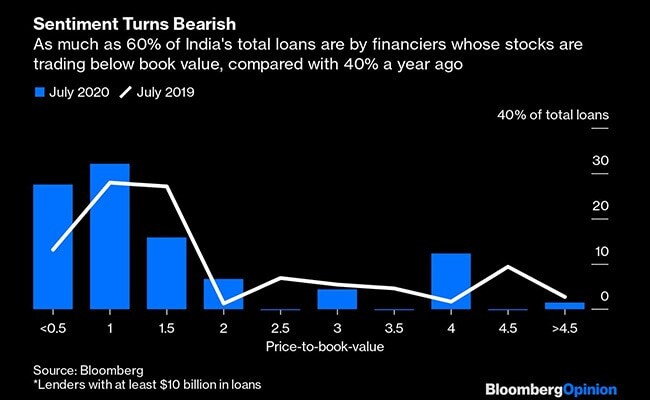
At $1.4 trillion, advances by India's top banks and other lenders are broadly unchanged from a year earlier. While stagnation in loan growth is only to be expected in a shrinking economy, what's also worrying is that financiers accounting for three-fifths of the credit are being judged by investors to be worth less than their assets. It's a sharp deterioration from a year ago, when 40 per cent of institutions by total loans were trading below book value.
Dismal valuations will stop many state-run banks from joining the fund-raising party, which may top $10 billion this year, almost double the record $5.2 billion in 2017. The government must come to the rescue. Economists at State Bank of India suggest lowering the minimum capital norm to 8 per cent from 9 per cent of risk-weighted assets, and deferring the rainy-day capital conservation buffer.
Those two measures will save almost $40 billion. That's not enough capital. Delinquent corporate debt, which was weighing India down even before the coronavirus, is getting heavier. India Ratings and Research Pvt., a Fitch Ratings affiliate, has pegged additional loan-loss costs from 500 heavily indebted firms at $30 billion, a conservative estimate because bankruptcy courts aren't taking new cases and asset buyers are looking to wriggle out of commitments. To this, add the post-Covid slide in small firms' fortunes, as well as losses on micro credit and other individual loans.
Even if a bad bank is set up to take problem loans out of the financial system, the discounted price at which it will buy them means that private capital will have to absorb chunky losses. No amount of gloss by bankers can hide the stress for too long. The market will eventually find it.
(Andy Mukherjee is a Bloomberg Opinion columnist covering industrial companies and financial services. He previously was a columnist for Reuters Breakingviews. He has also worked for the Straits Times, ET NOW and Bloomberg News.)
Disclaimer: The opinions expressed within this article are the personal opinions of the author. The facts and opinions appearing in the article do not reflect the views of NDTV and NDTV does not assume any responsibility or liability for the same.

-
Extracting Value From Battery Scrap Could Be Challenging For India | The Reason Why

A discarded lithium-ion battery still contains valuable materials such as lithium, nickel and cobalt. These can be recovered and reused. When such batteries are crushed and shredded, they produce a dark powder called black mass.
-
One El Nino, India Can Handle. Two Could Break The Granary
India's grain stocks can absorb one bad year, but a second El Nino could drain the buffer in two to three years, economists say.
-
India's Troika Of Good Luck | Joining The Dots
As Jensen Huang's exit drags Nvidia down, a cooling AI trade and resilient earnings have revived investor interest in India. A likely RBI rate hike looms.
-
Talking Points This Week: Leadership Shock At Nvidia, Earnings Strength, And The Fog Over Hormuz
The Anthropic IPO pricing and first trading day, Nvidia's upcoming earnings, and any fresh signals from Iran will set the tone for the following week.
-
Signature Play: The Classic Cocktail Is Dead. Or Is It?
Classic cocktails are disappearing from India's cocktail menus. But they're still being ordered, taught to bartenders and borrowed from. So, who's really having the last drink?
-
A New Samvat Wishlist: Inclusive Prosperity And Human Development
India has strengthened its economic foundations through infrastructure, digital access and enterprise. Its next growth chapter must deepen productivity, create better livelihoods and widen participation in prosperity.
-
Love, Sex Aur Dhokha: The Audacious Plot To Spy On Jensen Huang
A Taipei dinner, a Singapore chip buyer and a suspected Chinese asset: inside the alleged spy operation that got close to NVIDIA's Jensen Huang.
-
Ten Things I Learnt This Samvat
Patience can be a trap. Cheap stocks can stay cheap. Leverage can wipe you out. What did Samvat 2082 teach us? Niraj Shah writes on 10 lessons from the year gone by.
-
Talking Points This Week: Tech Nerves, FII Buying, And A Faraway Banking Shock
The global markets are not shining this Diwali. The exception in the large markets is, India.
-
Midterm Rally Lasted A Day. The Hard Reality Of A Divided US May Last Two Years | Opinion
Between a contested AI boom, a debt ceiling that arrives in 2027 and a president with every incentive to act alone, the next two years may prove more volatile than the first day's rally suggests.