On Government's Corporate Tax Cut Move, Abhijit Banerjee's Caution

How do you spur demand in an economy? By raising taxes, not cutting them, says this year's winner of the Nobel prize for economics.
Reducing taxes to boost investment is a myth spread by businesses, says Abhijit Banerjee, who won the prize along with Esther Duflo of the Massachusetts Institute of Technology and Michael Kremer of Harvard University for their approach to alleviating global poverty. "You are giving incentives to the rich who are already sitting on tons of cash."
A better approach would be to raise some taxes and distribute the money to people to spend, Mr Banerjee said in an interview Monday in New Delhi, where he was promoting his book 'Good Economics for Hard Times.'
"You don't boost growth by cutting taxes, you do that by giving money to people," he said. "Investment will respond to demand."
Countries from China to India to Indonesia are slashing taxes for businesses to spur growth amid a gloomy global outlook. The International Monetary Fund this month made a fifth-straight cut to its 2019 world growth forecast, pegging it at 3 per cent.
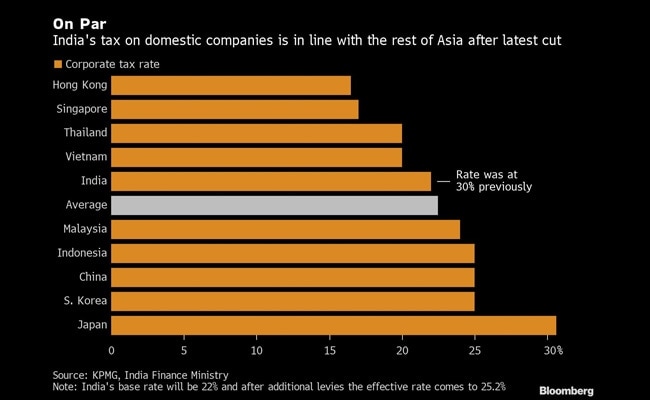
China earlier this year rolled out tax cuts worth $280 billion on personal income and corporate profits, while India surprised with corporate tax cuts worth $20 billion. Indonesia also plans to lower tax on companies to 20 per cent from 25 per cent.
Taxing the wealthy has emerged as a key political issue among potential Democratic Party challengers to US President Donald Trump, who has promised more "substantial" tax cuts next year.
The widening inequality gap in developed countries such as the US has angered people and contributed to the global trade tensions we are seeing today, Mr Banerjee said. "It is unbelievable that in the name of growth you have allowed inequality to explode to this point," he said.
India Slowdown
In India, where growth has slowed to a six-year low, the government should be more expansionary, the Nobel economist said.
Aside from corporate tax cuts, the government has taken a number of steps to reverse the slowdown -- including scrapping a tax on foreign funds and allowing concessions on vehicle purchases. The fiscal stimulus has raised worries about a widening budget deficit.
"Given the demand slump it's not a bad thing for the government to be expansionary," Mr Banerjee said. "If we want to stimulate demand and corporate tax cut doesn't do that, which is my prediction, then what do we do."

-
Signature Play: The Classic Cocktail Is Dead. Or Is It?

Classic cocktails are disappearing from India's cocktail menus. But they're still being ordered, taught to bartenders and borrowed from. So, who's really having the last drink?
-
A New Samvat Wishlist: Inclusive Prosperity And Human Development
India has strengthened its economic foundations through infrastructure, digital access and enterprise. Its next growth chapter must deepen productivity, create better livelihoods and widen participation in prosperity.
-
Love, Sex Aur Dhokha: The Audacious Plot To Spy On Jensen Huang
A Taipei dinner, a Singapore chip buyer and a suspected Chinese asset: inside the alleged spy operation that got close to NVIDIA's Jensen Huang.
-
Ten Things I Learnt This Samvat
Patience can be a trap. Cheap stocks can stay cheap. Leverage can wipe you out. What did Samvat 2082 teach us? Niraj Shah writes on 10 lessons from the year gone by.
-
Talking Points This Week: Tech Nerves, FII Buying, And A Faraway Banking Shock
The global markets are not shining this Diwali. The exception in the large markets is, India.
-
Midterm Rally Lasted A Day. The Hard Reality Of A Divided US May Last Two Years | Opinion
Between a contested AI boom, a debt ceiling that arrives in 2027 and a president with every incentive to act alone, the next two years may prove more volatile than the first day's rally suggests.
-
Blue Wave Will Derail the AI Trade but Won't Dismantle the AI Era | Unhedged Position
The Democrats' sweep of the US Congress will see politics collide with economic forces both over the long and short term.
-
It's Time To Take The GST Council's Bet On Trust Global
Payment records can prove India's services exports, and clear, proportionate rules can bring foreign digital sellers into the tax net.
-
Opinion | India at 38: From Innovation Overperformer to Innovation Powerhouse
India now has 453 VC-backed deep science startups, 18 of them late-stage, after 117 percent growth since 2020. Laurus Labs, at USD 9.3 billion, is the most valuable deep science company in any middle-income economy outside China.









