Oil’s New Map: How India Turns Russia Crude Into the West’s Fuel
(Bloomberg) -- India is playing an increasingly important role in global oil markets, buying more and more cheap Russian oil and refining it into fuel for Europe and the US.
Yet New Delhi has faced little public blowback because it's meeting the West's twin goals of crimping Moscow's energy revenue while preventing an oil supply shock. And as Europe ramps us sanctions, India is only going to become more central to a global oil map that's been redrawn by Vladimir Putin's year-long war in Ukraine.
“US treasury officials have two main goals: keep the market well supplied, and deprive Russia of oil revenue,” said Ben Cahill, a senior fellow with the Center for Strategic and International Studies, a Washington think tank. “They are aware that Indian and Chinese refiners can earn bigger margins by buying discounted Russian crude and exporting products at market prices. They're fine with that.”
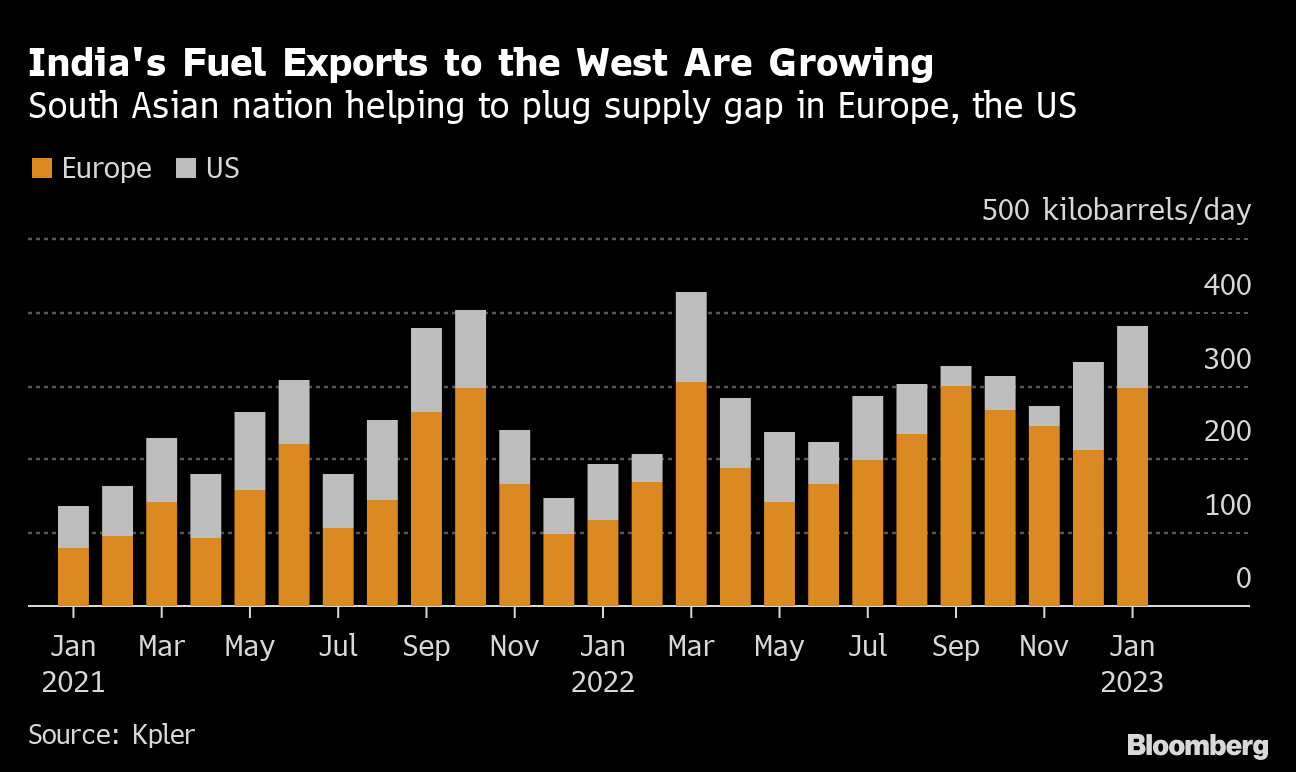
India shipped about 89,000 barrels a day of gasoline and diesel to New York last month, the most in nearly four years, according to data intelligence firm Kpler. Daily low-sulfur diesel flows to Europe were at 172,000 barrels in January, the most since October 2021.
The Asian nation's importance is expected to expand after fresh European Union sanctions on Russian petroleum exports take effect Sunday. The ban will remove a huge volume of diesel from the market and see more consumers, especially in Europe, tap Asia to fill the supply gap.
That will make cheap Russian oil even more attractive to India, which relies on imports to meet around 85% of its crude needs. The nation's refiners, including state-run processors that are responsible for meeting domestic demand, ramped up exports last year in order to profit from higher international prices.
Fueling the West
“India is a net exporter of refined product and much of this will be going to the West to help ease current tightness,” said Warren Patterson, Singapore-based head of commodities strategy at ING Groep NV. “It's pretty clear that a growing share of the feedstock used for this product originates from Russia.”
Under EU guidelines, India is likely operating within the rules. When Russian crude is processed into fuels in a country outside of the bloc such as India, the refined products can be delivered into the EU because they're not deemed to be of Russian origin.
The Group of Seven nations are keen to cut Moscow's revenue as much as possible, but they also have an interest in ensuring that Russia's oil and refined products continue to flow to avoid a global supply crunch, said Serena Huang, lead Asia analyst at Vortexa Ltd.
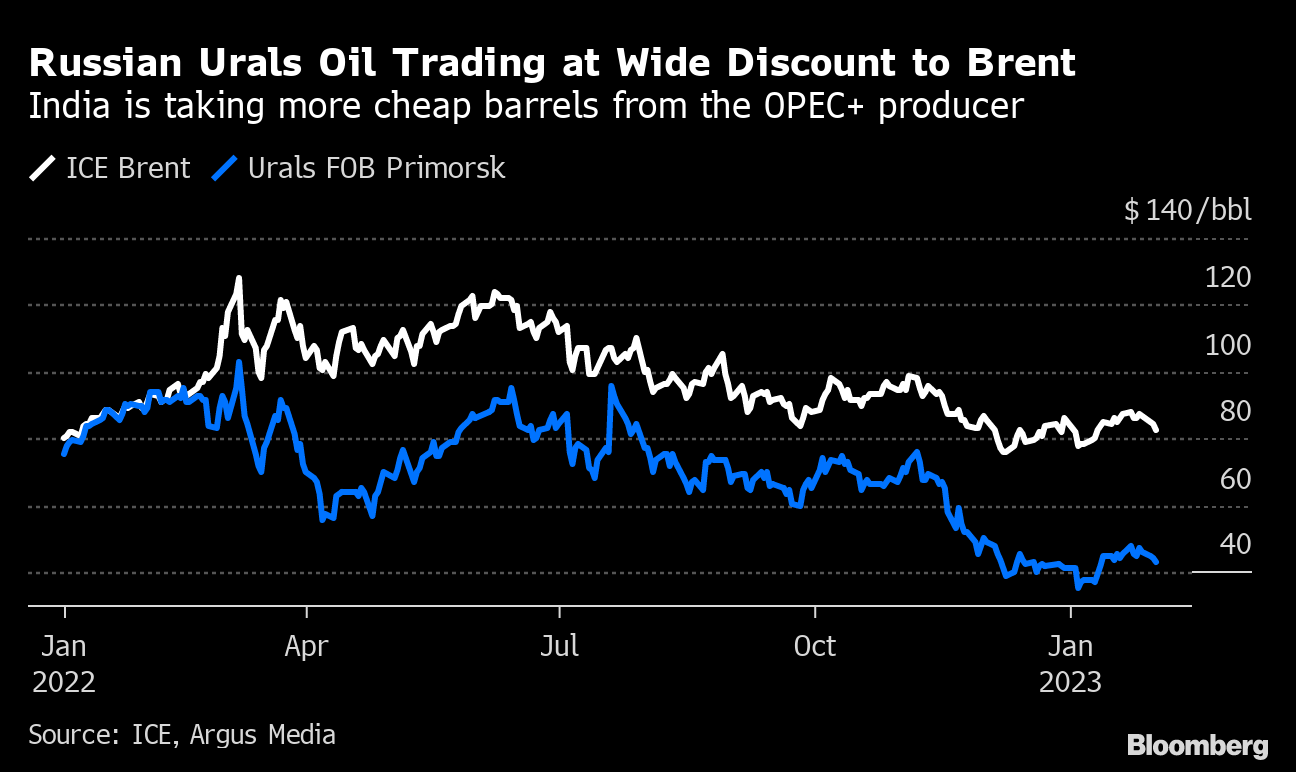
A key facet of the mechanism to crimp revenues to the Kremlin and keep some oil on the market has been a price cap on Russian crude, a measure that was spearheaded by the US. India hasn't publicly said if the nation does or doesn't adhere to the limit, but sanctions have driven oil from the OPEC+ producer below the $60 a barrel cap.
A US National Security Council spokesperson said a price cap had been put in place that countries including India could leverage to keep energy markets stable, while limiting the Kremlin's revenue.
“India's willingness to buy more Russian crude at a steeper discount is a feature, not a bug, in the plan of Western nations to impose economic pain on Putin without imposing it on themselves,” said Jason Bordoff, founding director of the Center on Global Energy Policy at Columbia University and a former adviser in the Obama administration.
Executives and officials from nations and companies including Saudi Arabia, United Arab Emirates, the US, and Abu Dhabi National Oil Co. are gathering in Bangalore Monday for a three-day energy forum organized with India's petroleum and natural gas ministry.
--With assistance from , , and .
More stories like this are available on bloomberg.com
©2023 Bloomberg L.P.

-
One Battle After Another: India's Corporate Dynasties Battle For Control

2026 could go down as Corporate India's year of succession wars, governance battles and family fault lines.
-
Rs 50-Lakh Gold In Bank Locker, Rs 3 Lakh Of Protection: The Gap Most Families Don't Know About
The RBI ties a bank's liability to the annual locker rent and families who want to insure their jewellery face a separate question about how to prove what was inside.
-
The More Food Turns Into Fuel, The Harder It Is To Read Agricultural Markets | The Reason Why
A policy designed to reduce dependence on imported fuel can create new pressures elsewhere in the food economy.
-
Your iPhone Costs 12 Grams Of Gold, A Car About 100. What Does Your Life Weigh?
Measured in rupees, almost everything looks more expensive than it did a generation ago. Measured in grams of gold, a lot of it has become cheaper.
-
Gold Is Rs 22,000 Cheaper Than A Month Ago. Should You Buy Amid The Wedding Season?
Gold's potential slide to $3,500 could save around Rs 4,700 per 10 grams, but a soft inflation print could just as easily push prices back up. One way to split the risk is to buy in parts, some now and the rest after the Fed's Dec. 9 decision.
-
AI Agents Are Gaining Power. Who Governs Them?
Artificial intelligence agents promise to transform productivity by moving machines from assisting decisions to executing them. But as organisations delegate greater authority to these AI-agents, they must first establish who controls that authority and who remains accountable when things go wrong.
-
Why Swapping Your Old Gold Can Trigger A Rs 5 Lakh Tax Bill, And How You Can Avoid It Legally
Swapping old gold for new is taxed as a sale and a fresh purchase. Getting your own gold remade can cut most of that bill, though it has its own costs.
-
The AI Trade is Done. The Real Opportunity for Investors Starts in 2027 | Unhedged Position
As pureplay AI stocks plunge and circular, capex-led financing unwinds, 2027 is set to be a year of reckoning for AI companies. Yet the bust clears the way for a better opportunity for investors in 2027 -- shifting the spotlight from AI builders to the companies using AI.
-
Leadership As Mission: Why The Age Of AI Demands More Human Leadership
Debjani Ghosh examines how AI is changing leadership, arguing that its success must be measured by its impact on people and the accountability of those guiding its use.
-
We May Need Another Tukaram Mundhe To Fight Air Pollution | The Reason Why
Developers may install basic measures such as sprinklers and green nets, resume work, and continue violating rules when this equipment stops working.









