Oil Rebounds, Trades Above $100 After Tumbling On Recession Worries
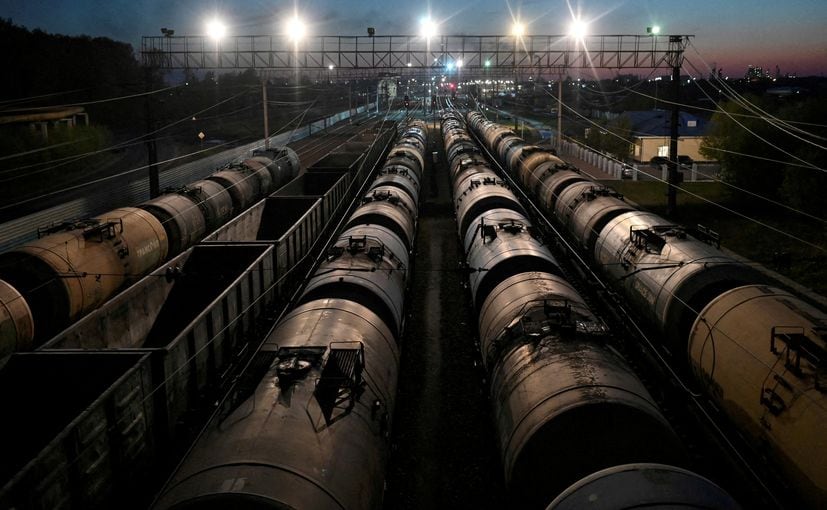
Oil prices rose as much as nearly 3% on Wednesday before paring some gains as investors piled back into the market after a heavy rout in the previous session, with supply concerns returning to the fore even as worries about a global recession linger.
Brent crude futures rose as much as $3.08, or 2.9%, to $105.85 a barrel in early trade after plunging 9.5% on Tuesday, the biggest daily drop since March. It was last up 92 cents, or 0.9%, at $103.69 a barrel at 8:13 am.
U.S. West Texas Intermediate crude climbed to a session high of $102.14 a barrel, up $2.64, or 2.7%, after closing below $100 for the first time since late April. It was last up 46 cents, or 0.5%, at $99.96 a barrel.
"Today is sort of a reset. No doubt there is short covering and bargain hunters are coming in," said John Kilduff, partner at Again Capital LLC.
"The fundamental story regarding global tightness is still there ... The sell-off was definitely overdone," he added.
OPEC Secretary General Mohammad Barkindo said on Tuesday that the industry was "under siege" due to years of under-investment, adding shortages could be eased if extra supplies from Iran and Venezuela were allowed.
Russia's former president Dmitry Medvedev also warned that a reported proposal from Japan to cap the price of Russian oil at around half its current level would lead to significantly less oil in the market and push prices above $300-$400 a barrel.
On the other hand, the Norwegian government on Tuesday intervened to end a strike in the petroleum sector that had cut oil and gas output, a union leader and the labour ministry said, ending a stalemate that could have worsened Europe's energy crunch.
By Saturday, the strike would have cut daily gas exports by 1,117,000 barrels of oil equivalent (boe), or 56% of daily gas exports, while 341,000 of barrels of oil would have been lost, the Norwegian Oil and Gas (NOG) employers' lobby said.
Worries about a recession, however, have continued to weigh on markets. By some early estimates, the world's largest economy may have shrunk in the three months from April through June. That would be the second straight quarter of contraction, considered the definition of a technical recession.
More G10 central banks raised interest rates in June than in any month for at least two decades, Reuters calculations showed. With inflation at multi-decade highs, the pace of policy-tightening is not expected to let up in the second half of 2022.
"Although crude oil still faces the problem of a supply shortage, key factors that led to the sharp selloff in oil yesterday remain," said Leon Li, a Shanghai-based analyst at CMC Markets. He cited policy tightening by global central banks and a likely interest rate hike by the U.S. Federal Reserve as pressuring commodities prices.
"Thus, today's rebound could be a short-term correction for bears and oil prices are likely to remain under pressure in the near future."
(This story has not been edited by NDTV staff and is auto-generated from a syndicated feed.)

-
Getting To Work Costs Women More | The Reason Why

It is not just about women paying more than men. It is about women paying much more in cities than in villages.
-
AI Bias In Investing Cannot Be Eliminated, But It Can Be Governed
Framing is a particularly important example as identical financial information presented in terms of gains rather than losses can lead an LLM to reach a different assessment.
-
Joining The Dots | Dark Skies, Steady Diya: Why Hope Holds This Diwali
With war, a weak rupee and foreign outflows weighing on sentiment, policymakers at the NDTV World Summit and market veterans at NDTV Profit Ignite: Diwali Edition offered the same advice: stay invested and filter out the noise.
-
The Curious Case of Equitas Small Finance Bank And A CEO Who Quit For Stock
PN Vasudevan believes persistent investor concerns over a perceived conflict of interest had become a governance overhang on Equitas Small Finance Bank's stock, even as the lender improved profitability and asset quality.
-
Talking Points This Week: AI Cash Burn, A Tiger Comeback And An India That Still Finds Its Own Path
India is not immune to higher oil or tighter global liquidity, yet its earnings base is broader, its domestic policy levers are still available.
-
Foreign Investors Own Half Of HDFC Bank and ICICI Bank. An LTCG Cut Could Matter Most Here
Foreign portfolio investors have US$115 billion parked in HDFC Bank, ICICI Bank. If the government cuts long-term capital gains tax, Jefferies says returning foreign money could land here first.
-
'Never Seen This Level Of Negativity': Sandeep Tandon Says The Next Rally May Be Closer Than You Think
Veteran investor Sandeep Tandon says foreign selling is easing, large-caps are due a comeback and mid-caps are crowded, while he turns positive on gold, power and pharma this Diwali.
-
Indians Stay With Family, Not In Hotels | The Reason Why
India still lacks enough clean, reliable and affordable hotels for budget-conscious travellers.
-
The Economic Imperative: Analysing The Material Driving Force Behind India-Canada Strategic Reset
This economic complementarity is further reinforced by deep institutional investment ties and talent mobility, which form the bedrock of the bilateral framework.
-
Medicine Pricing: Where Must Profit Stop?
India must confront excessive margins, hidden incentives and regulatory gaps that threaten the integrity of medicine.










