Oil-Merger Mania Threatens Crude’s Liquidity As Hedgers Vanish
(Bloomberg) -- The recent wave of dealmaking by US oil producers — which may not be finished just yet — is hastening a decline in liquidity from the oil market.
Hess Corp. and Pioneer Natural Resources Co. have in recent years bought large derivatives positions to lock in prices for their future production. Those holdings are set to dry up after the drillers' takeovers by Chevron Corp. and Exxon Mobil Corp. because supermajors tend not to hedge, instead using their refining and retail operations as natural buffers against price moves. Two other top hedgers — Devon Energy Corp. and Marathon Oil Corp. — are also said to have held merger talks.
The consolidation threatens to accelerate a decline in listed producers' activity in the oil derivatives market, potentially increasing volatility and exposing drillers to steeper earnings drops in the event of a price crash. US oil producers had about 750,000 barrels a day of supplies locked in using derivatives contracts in the first quarter, down more than two thirds since before the pandemic, according to data from BloombergNEF. Those are near the lowest levels in data dating back to 2017.
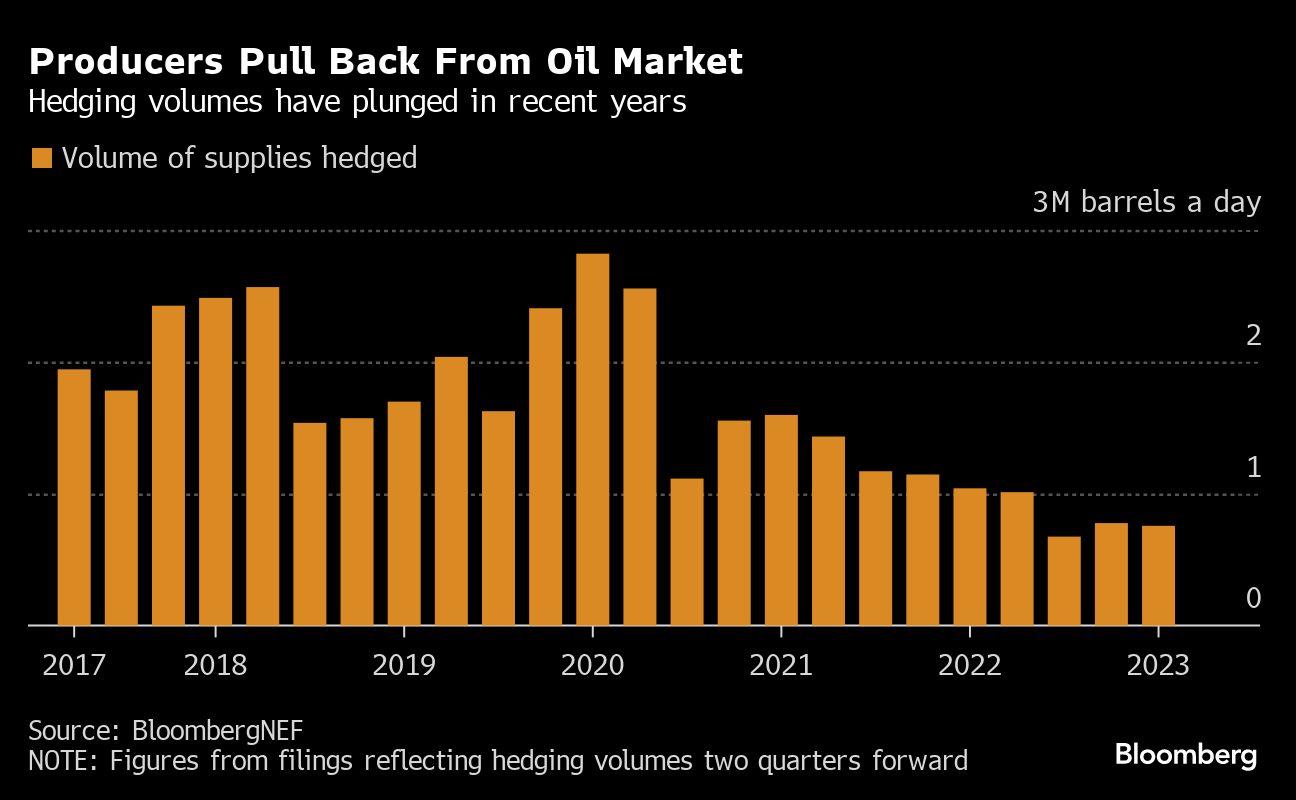
Oil producers typically use derivative contracts such as swaps and options to cover production about 24 months or more into the future, guaranteeing their revenues even if prices slump. The practice provides crucial liquidity for the more distant oil futures contracts and spurs active trading in the instruments, where participation is otherwise thin.
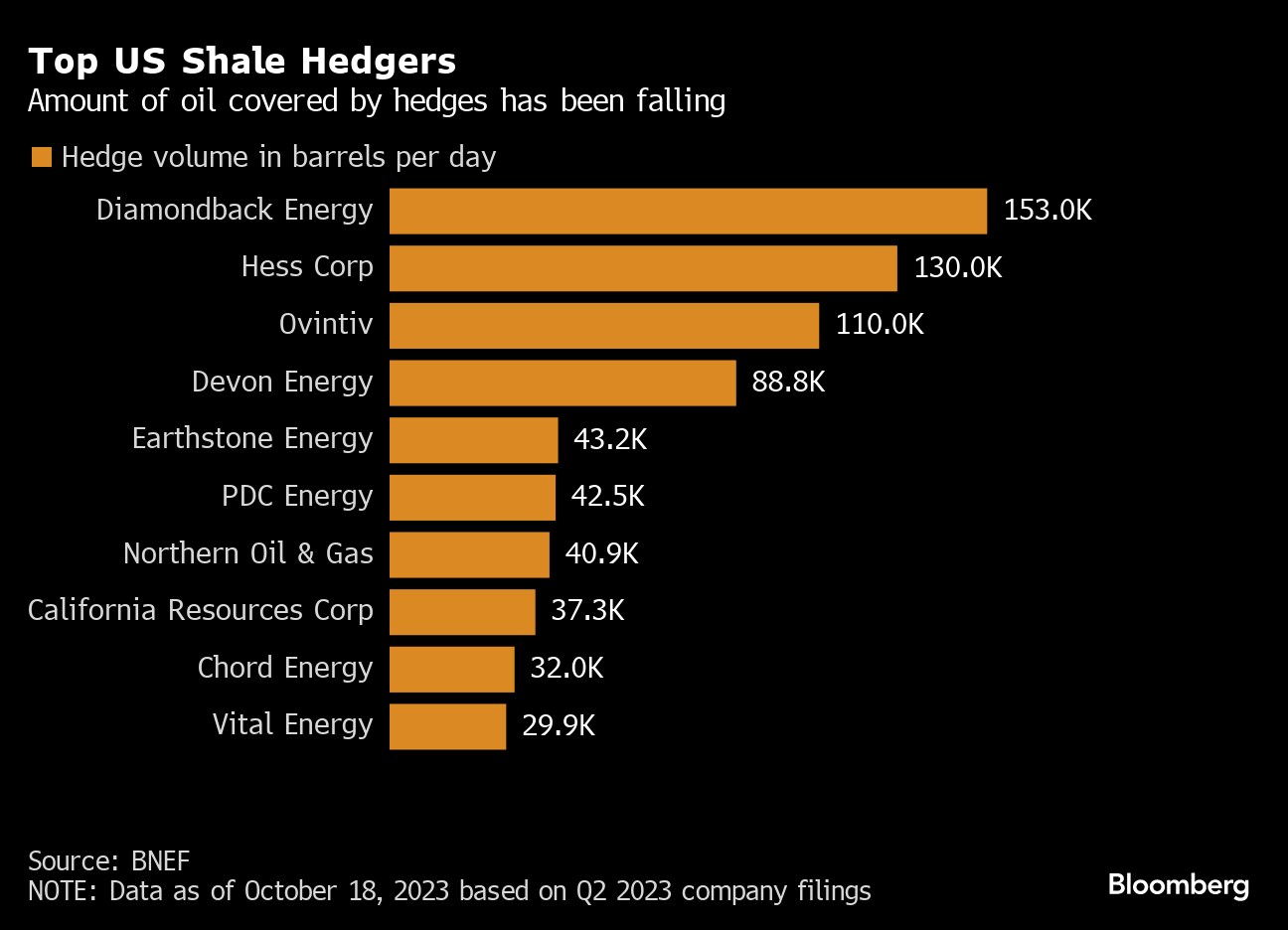
Hess had locked in prices for about 130,000 barrels a day of production for the rest of 2023, according to its most recent press release. That is the second-largest volume of producer hedges in the US, according to BloombergNEF data. While Pioneer had only 3,000 barrels a day of production hedged as of the end of June this year, it had locked in about 175,000 barrels a day for 2021 by the end of 2020.
An additional 100,000 barrels a day would be lost if Devon and Marathon merged and choose not to hedge, based on the companies' previous activity.
Diamondback Energy was the largest hedger at 153,000 barrels a day, accounting for about one of every five barrels that has been hedged.
As hedgers become more rare, the futures curve can become increasingly flattened during a rally because of the absence of natural sellers in the back end. In an unlikely event where oil prices crash suddenly into the $50s or even lower, the move to leave production uninsured could prove costly and eat into earnings.
“In principle, the reduction in hedging from the public companies should make prices higher than they otherwise would be as there are fewer sellers or at least less depth in the market,” said Jay Stevens, director of market analytics at Aegis Hedging, which helps producers and consumer companies with their strategies.
The trend may also mean less business for banks and brokers that execute the hedges for producers.
Hedging volumes across US producers have declined by about 1 million barrels a day since 2019, equating to roughly 365,000 contracts over a year. That's more than 20% of the current open interest on West Texas Intermediate futures, which is already down by about 1 million contracts from a record set in 2018.
To be sure, the volume of hedging is largely dropping from the public companies. Private companies are still actively hedging, market participants and consultants said.
“The small privates that borrow proportionately more and depend on private equity have less autonomy, so if they are forced to hedge by their sponsor, they will,” said Steve Sinos, managing partner at Blue Lacy Advisors.
Hedging hasn't always been a profitable operation for producers. High prices left many drillers not needing their contracts last year, according to BNEF, which estimates that $47 billion has been spent on WTI, Brent and Henry Hub contracts in the last two years.
Read More: Oil Hedges Out of Style as FOMO Grips Drillers Amid $100 Crude
Even before the flurry of deal activity, shale producers had focused less on expanding production, reducing their need to lock in future prices as banks had often required them to do when lending for new projects. They've instead plowed cash into reducing debt and boosting payouts to shareholders — a discipline they've pledged to continue.
“As we continue to drive debt down, we'll drive that hedging level down from that sort of 50% and 40% down back toward a quarter to a third of production,” Ovintiv Inc. Chief Executive Officer Brendan McCracken said on an earnings call earlier this year.
More stories like this are available on bloomberg.com
©2023 Bloomberg L.P.

-
Talking Points This Week: Leadership Shock At Nvidia, Earnings Strength, And The Fog Over Hormuz

The Anthropic IPO pricing and first trading day, Nvidia's upcoming earnings, and any fresh signals from Iran will set the tone for the following week.
-
Signature Play: The Classic Cocktail Is Dead. Or Is It?
Classic cocktails are disappearing from India's cocktail menus. But they're still being ordered, taught to bartenders and borrowed from. So, who's really having the last drink?
-
A New Samvat Wishlist: Inclusive Prosperity And Human Development
India has strengthened its economic foundations through infrastructure, digital access and enterprise. Its next growth chapter must deepen productivity, create better livelihoods and widen participation in prosperity.
-
Love, Sex Aur Dhokha: The Audacious Plot To Spy On Jensen Huang
A Taipei dinner, a Singapore chip buyer and a suspected Chinese asset: inside the alleged spy operation that got close to NVIDIA's Jensen Huang.
-
Ten Things I Learnt This Samvat
Patience can be a trap. Cheap stocks can stay cheap. Leverage can wipe you out. What did Samvat 2082 teach us? Niraj Shah writes on 10 lessons from the year gone by.
-
Talking Points This Week: Tech Nerves, FII Buying, And A Faraway Banking Shock
The global markets are not shining this Diwali. The exception in the large markets is, India.
-
Midterm Rally Lasted A Day. The Hard Reality Of A Divided US May Last Two Years | Opinion
Between a contested AI boom, a debt ceiling that arrives in 2027 and a president with every incentive to act alone, the next two years may prove more volatile than the first day's rally suggests.
-
Blue Wave Will Derail the AI Trade but Won't Dismantle the AI Era | Unhedged Position
The Democrats' sweep of the US Congress will see politics collide with economic forces both over the long and short term.
-
It's Time To Take The GST Council's Bet On Trust Global
Payment records can prove India's services exports, and clear, proportionate rules can bring foreign digital sellers into the tax net.
-
Opinion | India at 38: From Innovation Overperformer to Innovation Powerhouse
India now has 453 VC-backed deep science startups, 18 of them late-stage, after 117 percent growth since 2020. Laurus Labs, at USD 9.3 billion, is the most valuable deep science company in any middle-income economy outside China.









