Now, A Socially-Aware Robotic Assistant That Gets Your Mood!
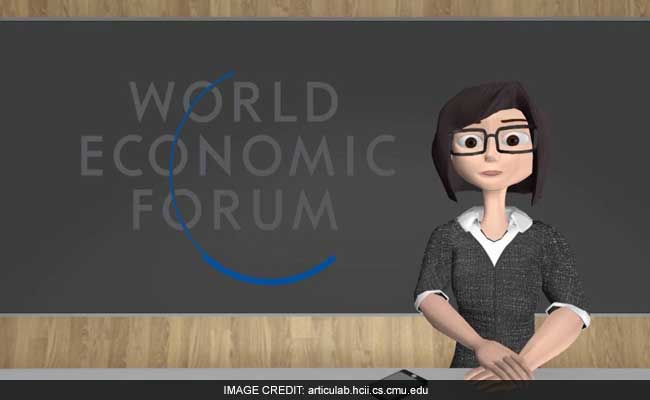
Davos: Taking artificial intelligence a step further, a new Socially-Aware Robot Assistant (SARA) took the participants of the World Economic Forum (WEF) here by surprise by understanding their spoken words and non-verbal behaviour to build a relationship.
Developed by students and professors of prestigious Carnegie Mellon University (CMU) as a research project, SARA became a key exhibit at the WEF annual meeting held in this ski resort town last week.
CMU President Subra Suresh, who was here for the WEF, said the university would also take SARA to other parts of the world, which may include India, for exhibition and eventually, it may be licensed to some company or organisation for commercial use, but any decision on that will be taken by the persons concerned and professors at the university.
"With technology advancing so fast, one of the opportunities for us is whether we can combine robotics, artificial intelligence, machine learning etc to create tools that will have positive impact on society. This is how SARA has come out," Suresh told PTI in an interview here on the sidelines of the WEF meet.
"It is Socially Aware Robot Assistant. It is not even a robot, but a computer screen that interacts with you with a camera in front and asks you questions and it essentially through machine learning engaged hundreds and thousands of humans. It can look at your face, your eyebrows and from your smile, it detects your mood and it can have a conversation with you," he said.
Giving an example, Suresh said that if you say you want to find President of Carnegie Mellon, SARA will ask do you want to meet him or talk to him.
"It will say do you want me to call him for you or can I send an e-mail to him for you. It does that kind of thing. So, essentially it is assisting you," he said while adding that SARA can be of great use to the elderly who may be lonely and need assistance, as also for the children who want to learn.
"Our students have also tried a version of SARA on children with autism and they performed better. So, those are the things SARA can do for teaching, assisting and customisin for you," Suresh said.
"Essentially, we though rather than humans interacting with robots, can robots interact with the humans to enable them to feel better?"
Talking about various innovations at CMU, the president said it has pioneered a lot of technologies that are now part of the fourth industrial revolution, be it artificial intelligence or machine learning and it also has top-ranked computer science programme in the world.
"For example, when you go to a website, there is a programme called 'captcha'. When you go to Amazon and want to buy something online, they ask you to repeat some letters to prove that you are not a robot and a human being. That was done at Carnegie Mellon. We have done a lot of cyber security tools," he explained.
Suresh said CMU has a long history of creating technologies that have made Web and e-commerce and cyber activities possible and it was also very strong in a field called science of learning.
On whether the university would seek to commercialise it, Suresh said, "Essentially, this is a research project done by the students and professors over a period of time. We also have other programmes where we have robots."
On security concern about the new technologies, he said, "For any technology, you will have people trying to beat that.
It doesn't matter if you have got a state-of-the-art lock, or a combination lock, or physical lock or a camera system in the house, somebody will try to beat it.
"Another example I can give is that there is this kitchen knife which is a wonderful tool for cutting things for cooking and it can also be used to kill somebody very quickly. So, I think that with every positive aspect of the technology, there would be a negative aspect too.
"But historically, the humanity has advanced very fast and the technologies have not been held back. People have created new technologies and they will keep doing that. It is up to governments and societies to make sure the good aspects of the technology are maximised and the bad aspects are minimised or eliminated.
"I think it is always going to see that tension and the place where we are right now, the pace of technology is so fast and the society's ability to adapt that is also so fast. And it diffuses also so quickly."
Suresh said when he left India in 1977, it used to take eight years to get a landline phone.
"We had to pay deposit and then wait for eight years. Many people didn't have a phone. But now, people have access to technology, the mobile devices are there even with the fisher women.
"Technology is moving so fast and how do you maximise the positive aspects is going to be the key challenge. That's how we will find out in the next 20 years, whether we move forward or backward as a global society."
On whether he would take SARA to other places, including India, he said, "We are having demonstration in different parts of the world."
On commercialising it, Suresh said, "It is in constant learning process and everything it talks to someone, it learns something and eventually, it will have to be licensed to some company or something, but that decision would need to be taken by the persons concerned in the university."
(This story has not been edited by NDTV staff and is auto-generated from a syndicated feed.)

-
Indians Are Travelling, But Not Every Journey Is A Holiday | The Week In Whys

Pilgrims, patients and working women are the real travellers, and the system hasn't quite caught up with them.
-
Getting To Work Costs Women More | The Reason Why
It is not just about women paying more than men. It is about women paying much more in cities than in villages.
-
AI Bias In Investing Cannot Be Eliminated, But It Can Be Governed
Framing is a particularly important example as identical financial information presented in terms of gains rather than losses can lead an LLM to reach a different assessment.
-
Joining The Dots | Dark Skies, Steady Diya: Why Hope Holds This Diwali
With war, a weak rupee and foreign outflows weighing on sentiment, policymakers at the NDTV World Summit and market veterans at NDTV Profit Ignite: Diwali Edition offered the same advice: stay invested and filter out the noise.
-
The Curious Case of Equitas Small Finance Bank And A CEO Who Quit For Stock
PN Vasudevan believes persistent investor concerns over a perceived conflict of interest had become a governance overhang on Equitas Small Finance Bank's stock, even as the lender improved profitability and asset quality.
-
Talking Points This Week: AI Cash Burn, A Tiger Comeback And An India That Still Finds Its Own Path
India is not immune to higher oil or tighter global liquidity, yet its earnings base is broader, its domestic policy levers are still available.
-
Foreign Investors Own Half Of HDFC Bank and ICICI Bank. An LTCG Cut Could Matter Most Here
Foreign portfolio investors have US$115 billion parked in HDFC Bank, ICICI Bank. If the government cuts long-term capital gains tax, Jefferies says returning foreign money could land here first.
-
'Never Seen This Level Of Negativity': Sandeep Tandon Says The Next Rally May Be Closer Than You Think
Veteran investor Sandeep Tandon says foreign selling is easing, large-caps are due a comeback and mid-caps are crowded, while he turns positive on gold, power and pharma this Diwali.
-
Indians Stay With Family, Not In Hotels | The Reason Why
India still lacks enough clean, reliable and affordable hotels for budget-conscious travellers.
-
The Economic Imperative: Analysing The Material Driving Force Behind India-Canada Strategic Reset
This economic complementarity is further reinforced by deep institutional investment ties and talent mobility, which form the bedrock of the bilateral framework.










