There's No Magic $45 Billion Behind India's Dry ATMs: Foreign Media
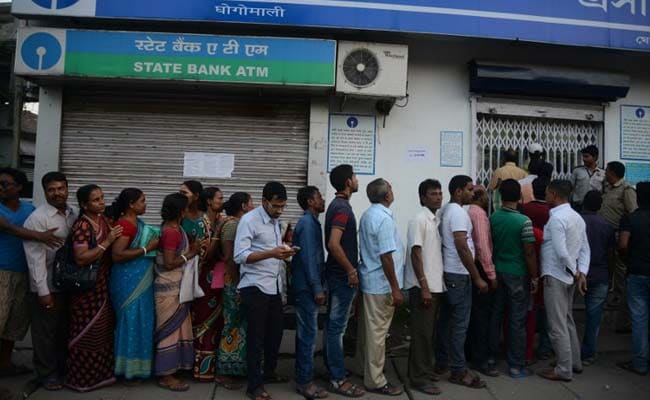
India's radical move to outlaw 86 percent of its currency in circulation is one of those bold economic experiments that thankfully don't occur too often. But because they're rare, the chaos that follows such events becomes a breeding ground for urban legends.
The demonetization of India's existing stock of 500 and 1,000 rupee notes has spawned a number of such apocryphal tales, one of which is a $45 billion bonanza for the government that can be used to recapitalize the country's broken banking system, which needs roughly $90 billion to become whole again.
It goes a little something like this. Not everybody will be able to surrender their banknotes before they become useless so the Reserve Bank of India, which counts currency in circulation as its obligation, will strike off a part of its liability. With no change in the central bank's assets, its net worth would increase. The Indian government, as the ultimate owner, could demand a special dividend.
The myth is backed up by math. Start with a simple representation of the RBI's balance sheet on June 30:
Since then, notes in circulation have expanded to $264 billion, and deposits at the RBI by commercial banks and the government have increased to $85 billion. The monetary authority's assets have grown in tandem.
Let's assume a fifth of the current stock of 500 and 1,000 rupee notes is "lost," in the sense that their owners, who have either avoided taxes or earned the money illegally, fail to return them to the banking system after exhausting all laundering options. That's 17.2 percent of $264 billion the RBI can presumably forget about.
If nothing else changes by the time the central bank draws up its balance sheet for next year, here's what it might look like:
So much for accounting.
But there are at least three reasons why there won't be any such $45 billion kitty and the central bank will continue to count those outstanding notes as a liability.
For one, while it's unusual but legitimate for a sovereign to declare what is (and isn't) legal tender, investors would perceive a central bank repudiating a liability under state pressure as an assault on its independence, and credibility.
Two, given that India aspires to emulate China and promote greater international use of its currency, it would be suicidal to generate resources for a bank recap by such a desperate measure.
For now, the world's attention is focused on the hardships of a billion people, and whether the move will make a dent in endemic corruption. But if it becomes a profitable experiment, demonetization will lose its justification as a graft-buster. Foreigners will fear expropriation, and that could ruin the prospects of rupee-denominated bank deposits and masala bonds in London or Singapore.
Finally, this isn't the time for silliness. With the dollar surging, and Donald Trump's presidential win adding ballast to expectations of higher U.S. bond yields, emerging markets need to give a compelling reason for foreigners to stay invested.
In India, the $44 billion of low-cost deposits financial institutions have won in four days provides just that. The greater the rush among people to get their money to safety, the more leeway lenders will have to buy risk-free government notes, keeping a lid on yields, even as global bond markets tumble.
With property transactions coming to a halt, and big-ticket purchases getting postponed, credit growth is unlikely to revive soon. If it looks like a cash shortage is stalling the economy, however, there could be a rate cut or two. Mark-to-market profit on banks' portfolios would go some way to mending their balance sheets, so long as there isn't a fresh wave of nonperforming loans.
For the bad debt-laden state-run banks, a gradual repair may not have the same appeal as a big one-time recapitalization. But the latter is just a fantasy. Behind those ATMs that have run dry, there's hope that corruption will ebb, and anger about the inconvenience it's caused ordinary people.
One thing not lurking there is a $45 billion check.
This column does not necessarily reflect the opinion of Bloomberg LP and its owners.
(Except for the headline, this story has not been edited by NDTV staff and is published from a syndicated feed.)

-
Indians Are Travelling, But Not Every Journey Is A Holiday | The Week In Whys

Pilgrims, patients and working women are the real travellers, and the system hasn't quite caught up with them.
-
Getting To Work Costs Women More | The Reason Why
It is not just about women paying more than men. It is about women paying much more in cities than in villages.
-
AI Bias In Investing Cannot Be Eliminated, But It Can Be Governed
Framing is a particularly important example as identical financial information presented in terms of gains rather than losses can lead an LLM to reach a different assessment.
-
Joining The Dots | Dark Skies, Steady Diya: Why Hope Holds This Diwali
With war, a weak rupee and foreign outflows weighing on sentiment, policymakers at the NDTV World Summit and market veterans at NDTV Profit Ignite: Diwali Edition offered the same advice: stay invested and filter out the noise.
-
The Curious Case of Equitas Small Finance Bank And A CEO Who Quit For Stock
PN Vasudevan believes persistent investor concerns over a perceived conflict of interest had become a governance overhang on Equitas Small Finance Bank's stock, even as the lender improved profitability and asset quality.
-
Talking Points This Week: AI Cash Burn, A Tiger Comeback And An India That Still Finds Its Own Path
India is not immune to higher oil or tighter global liquidity, yet its earnings base is broader, its domestic policy levers are still available.
-
Foreign Investors Own Half Of HDFC Bank and ICICI Bank. An LTCG Cut Could Matter Most Here
Foreign portfolio investors have US$115 billion parked in HDFC Bank, ICICI Bank. If the government cuts long-term capital gains tax, Jefferies says returning foreign money could land here first.
-
'Never Seen This Level Of Negativity': Sandeep Tandon Says The Next Rally May Be Closer Than You Think
Veteran investor Sandeep Tandon says foreign selling is easing, large-caps are due a comeback and mid-caps are crowded, while he turns positive on gold, power and pharma this Diwali.
-
Indians Stay With Family, Not In Hotels | The Reason Why
India still lacks enough clean, reliable and affordable hotels for budget-conscious travellers.
-
The Economic Imperative: Analysing The Material Driving Force Behind India-Canada Strategic Reset
This economic complementarity is further reinforced by deep institutional investment ties and talent mobility, which form the bedrock of the bilateral framework.










