Notes Ban Led To Formalisation Of Economy, Expanded Tax Base: Arun Jaitley
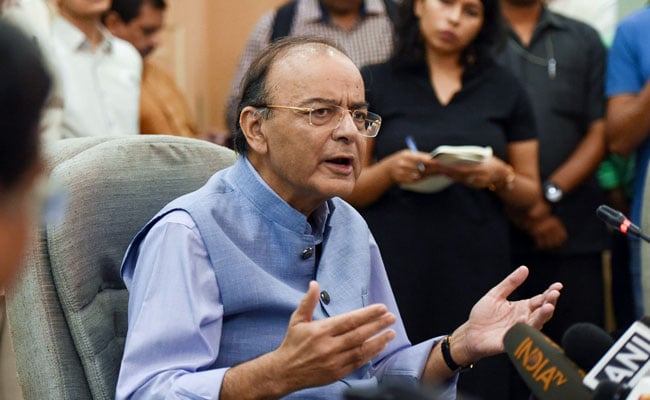
Finance Minister Arun Jaitley on Thursday said demonetisation resulted in formalisation of economy and increased tax base, prompting the government to earmark more resources for the poor and infrastructure development. In a Facebook post on the second anniversary of demonetisation, Jaitley said in first four years of the National Democratic Alliance (NDA) government, the number of income tax returns filers has gone up to 6.86 crore from 3.8 crore in May 2014. "By the time the first five years of this government are over, we will be close to doubling the assessee base," he said in the post titled "Impact Of Demonetisation".
The demonetisation of Rs 500 and Rs 1,000 currency notes in November 2016, the minister said, had resulted in "more formalisation (of economy), more revenue, more resources for the poor, better infrastructure, and a better quality of life for our citizens."
He further said with the implementation of the goods and services tax (GST), it is now becoming increasingly difficult to evade the tax system and the indirect tax to gross domestic product (GDP) ratio has gone up to 5.4 per cent post GST, from 4.4 per cent in 2014-15.
Terming the criticism, that almost the entire cash money got deposited in the banks post demonetisation, as "ill-informed", Jaitley said confiscation of currency was not an objective of demonetisation.
"Getting it into the formal economy and making the holders pay tax was the broader objective. The system required to be shaken in order to make India move from cash to digital transactions. This would obviously have an impact on higher tax revenue and a higher tax base," Jaitley said.
The government had on November 8, 2016, announced ban on old 500 and 1000 rupee notes, to curb black money in the system.
Of the Rs 15.41 lakh crore worth Rs 500 and Rs 1,000 notes in circulation on November 8, 2016, 99.3 per cent or notes worth Rs 15.31 lakh crore have returned to the banking system.
This means, just Rs 10,720 crore of the junked currency did not return to the banking system. After the note ban, old junked notes, called specified bank notes (SBNs), were allowed to be deposited in banks with unusual deposits coming under income tax scrutiny.
Jaitley said demonetisation compelled holders of cash to deposit the same in the banks.
"The enormity of cash deposited and identified with the owner resulted in suspected 17.42 lakh account holders from whom the response has been received online through non-invasive method," he said. The violators faced punitive actions. Larger deposits in banks improved lending capacity for the banks. A lot of this money was diverted to mutual funds for further investments. It became a part of the formal system, Jaitley added.
He said the share of indigenously developed payment system of unified payments interface (UPI) and RuPay card have reached 65 per cent of the payments done through debit and credit cards.
Jaitley said in 2017-18, the tax returns filed reached 6.86 crore, an increase of 25 per cent over the previous year.
This year, as on October 31, 2018, already 5.99 crore returns have been filed - which is an increase of 54.33 per cent compared to the previous year till this date. As many as 86.35 lakh new filers were added this year.
Economic Affairs Secretary Subhash Chandra Garg said demonetisation and GST reflect long-term vision of the government and its ability to undertake massive structural reforms. "Tax filers under both direct and indirect taxes are close to getting doubled. Digital payments have risen sharply and become common place. Fake notes are out," Garg tweeted.

-
Getting To Work Costs Women More | The Reason Why

It is not just about women paying more than men. It is about women paying much more in cities than in villages.
-
AI Bias In Investing Cannot Be Eliminated, But It Can Be Governed
Framing is a particularly important example as identical financial information presented in terms of gains rather than losses can lead an LLM to reach a different assessment.
-
Joining The Dots | Dark Skies, Steady Diya: Why Hope Holds This Diwali
With war, a weak rupee and foreign outflows weighing on sentiment, policymakers at the NDTV World Summit and market veterans at NDTV Profit Ignite: Diwali Edition offered the same advice: stay invested and filter out the noise.
-
The Curious Case of Equitas Small Finance Bank And A CEO Who Quit For Stock
PN Vasudevan believes persistent investor concerns over a perceived conflict of interest had become a governance overhang on Equitas Small Finance Bank's stock, even as the lender improved profitability and asset quality.
-
Talking Points This Week: AI Cash Burn, A Tiger Comeback And An India That Still Finds Its Own Path
India is not immune to higher oil or tighter global liquidity, yet its earnings base is broader, its domestic policy levers are still available.
-
Foreign Investors Own Half Of HDFC Bank and ICICI Bank. An LTCG Cut Could Matter Most Here
Foreign portfolio investors have US$115 billion parked in HDFC Bank, ICICI Bank. If the government cuts long-term capital gains tax, Jefferies says returning foreign money could land here first.
-
'Never Seen This Level Of Negativity': Sandeep Tandon Says The Next Rally May Be Closer Than You Think
Veteran investor Sandeep Tandon says foreign selling is easing, large-caps are due a comeback and mid-caps are crowded, while he turns positive on gold, power and pharma this Diwali.
-
Indians Stay With Family, Not In Hotels | The Reason Why
India still lacks enough clean, reliable and affordable hotels for budget-conscious travellers.
-
The Economic Imperative: Analysing The Material Driving Force Behind India-Canada Strategic Reset
This economic complementarity is further reinforced by deep institutional investment ties and talent mobility, which form the bedrock of the bilateral framework.
-
Medicine Pricing: Where Must Profit Stop?
India must confront excessive margins, hidden incentives and regulatory gaps that threaten the integrity of medicine.










