N. Korea Fires 8 Missiles, Testing Biden With Launch Record
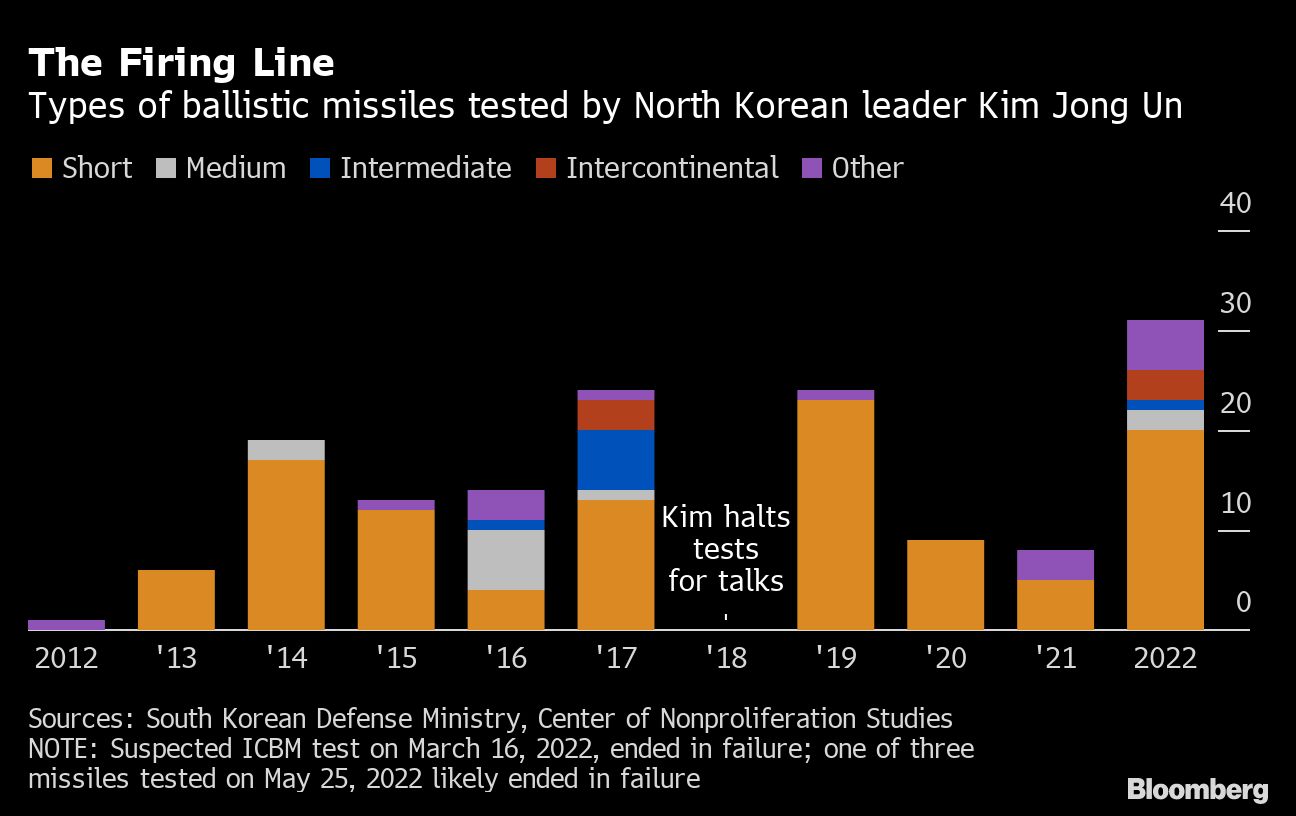
(Bloomberg) -- North Korea fired eight short-range ballistic missiles Sunday, pushing it to a record number of launches in a single year under Kim Jong Un, who appears ready to further ratchet up tensions with his first test of a nuclear device since 2017.
South Korea's military said it detected the missiles being fired between 9:08 a.m. and 9:43 a.m. from four different sites, including an area around Pyongyang's main airport toward waters off its east coast. The single-day ballistic barrage is likely the biggest since Kim took power a decade ago, with launches for this year beating the previous record of 24. North Korea has so far fired off 31 ballistic missiles in 2022, which include at least two failed attempts.
“While our military has reinforced surveillance and vigilance to prepare for any additional launches, we are maintaining a full readiness posture in close cooperation with the US,” South Korea's Joint Chiefs of Staff said in a statement.
Japanese Prime Minister Fumio Kishida said he was informed the missiles landed outside of his country's exclusive economic zone, calling the launches a threat to peace. South Korea's National Security Council convened to discuss the North Korean activities.

The missiles reached a maximum altitude of between 25 and 90 kilometers (16-56 miles) at speeds approaching Mach 3 to 6, and traveled for roughly 110 to 670 kilometers, South Korea said. Japan's Ministry of Defense said at least one missile had an irregular trajectory.
US envoy for North Korea policy Sung Kim, along with his South Korean and Japanese counterparts, strongly denounced the latest launches as an outright violation of the United Nations Security Council resolutions and serious provocation that raises tension on the Korean peninsula and the neighboring region, South Korea's foreign ministry said in a statement.
The latest test comes after South Korea and the US staged a joint naval drill in international waters off of Japan's island prefecture of Okinawa. New South Korean President Yoon Suk Yeol has pledged closer security cooperation with Biden and a stepping up joint military exercises -- which have been decried by Pyongyang for years as a prelude to an invasion.
“For Kim to have kept silent after this would have been a tacit sign of resignation,” said Soo Kim, a policy analyst with the Rand Corp. who previously worked at the Central Intelligence Agency.
“Yet Kim Jong Un has not conducted a nuclear test. We know it's coming, so it's a matter of when, not if,” she said, adding Pyongyang will be watching how Biden and Yoon respond to this latest spate of missile tests “as a barometer of their actions to an even more intense provocation.”
The U.S. Indo-Pacific Command said it's aware of the latest launches, saying in a statement they “highlight the destabilizing impact of the DPRK's illicit weapons program,” referring to North Korea by its official name.
The purpose of latest launch carries a tactical meaning since eight missiles were fired from four different locations, said Park Won-gon, a North Korea studies professor at Ewha Womans University in Seoul.
“It becomes difficult to detect and defend against multiple missiles when they are fired simultaneously from different locations,” he said. “Pyongyang is trying to portray a message saying that the bolstered deterrence Biden and Yoon agreed to and the latest military drills will not help fight their provocation.”
North Korea last fired off missiles on May 25, just hours after Joe Biden finished his first trip as president to South Korea and Japan. It was one of the biggest provocations that coincided with a US president's visit to the region and tested Biden's efforts to strengthen defense ties with the two American allies.
Biden and US allies might not have much leverage in trying to slow down the tests or ratchet up global sanctions to punish Pyongyang for its provocations. The US push to isolate Russia over Vladimir Putin's war in Ukraine, coupled with increasing animosity toward China, has allowed Kim to strengthen his nuclear deterrent without fear of facing more sanctions at the UN Security Council.
There's almost no chance Russia or China, which have veto power at the council, would support any measures against North Korea, as they did in 2017 following a series of weapons tests that prompted then-President Donald Trump to warn of “fire and fury.” The two countries in late May vetoed a council resolution drafted by the US to ratchet up sanctions on North Korea for its ballistic missile tests this year.
North Korea may also soon conduct a nuclear test, according to US, South Korean and Japanese government officials in a meeting last week. North Korea is barred from testing ballistic missiles and nuclear devices by United Nations Security Council resolutions.
Kim has also found ways to evade sanctions through cybercrimes and crypto-currency theft. Investigators from the U.S. and United Nations have said his regime has already taken in nearly $3 billion -- or about 10% of its annual economy -- through cybercrimes, and is poised to rake in even more.
South Korea said the May 25 test included a suspected intercontinental ballistic missile that reached an altitude of about 540 kilometers and traveled a distance of about 360 kilometers. Weapons experts said North Korea also appeared to have launched a short-range ballistic missile with a maneuverable warhead as well as another rocket that failed soon after lift-off. The ICBM is designed to carry a nuclear warhead capable of reaching the US mainland.
(Updates with details on launch from paragraph two)
More stories like this are available on bloomberg.com
©2022 Bloomberg L.P.

-
Talking Points This Week: Leadership Shock At Nvidia, Earnings Strength, And The Fog Over Hormuz

The Anthropic IPO pricing and first trading day, Nvidia's upcoming earnings, and any fresh signals from Iran will set the tone for the following week.
-
Signature Play: The Classic Cocktail Is Dead. Or Is It?
Classic cocktails are disappearing from India's cocktail menus. But they're still being ordered, taught to bartenders and borrowed from. So, who's really having the last drink?
-
A New Samvat Wishlist: Inclusive Prosperity And Human Development
India has strengthened its economic foundations through infrastructure, digital access and enterprise. Its next growth chapter must deepen productivity, create better livelihoods and widen participation in prosperity.
-
Love, Sex Aur Dhokha: The Audacious Plot To Spy On Jensen Huang
A Taipei dinner, a Singapore chip buyer and a suspected Chinese asset: inside the alleged spy operation that got close to NVIDIA's Jensen Huang.
-
Ten Things I Learnt This Samvat
Patience can be a trap. Cheap stocks can stay cheap. Leverage can wipe you out. What did Samvat 2082 teach us? Niraj Shah writes on 10 lessons from the year gone by.
-
Talking Points This Week: Tech Nerves, FII Buying, And A Faraway Banking Shock
The global markets are not shining this Diwali. The exception in the large markets is, India.
-
Midterm Rally Lasted A Day. The Hard Reality Of A Divided US May Last Two Years | Opinion
Between a contested AI boom, a debt ceiling that arrives in 2027 and a president with every incentive to act alone, the next two years may prove more volatile than the first day's rally suggests.
-
Blue Wave Will Derail the AI Trade but Won't Dismantle the AI Era | Unhedged Position
The Democrats' sweep of the US Congress will see politics collide with economic forces both over the long and short term.
-
It's Time To Take The GST Council's Bet On Trust Global
Payment records can prove India's services exports, and clear, proportionate rules can bring foreign digital sellers into the tax net.
-
Opinion | India at 38: From Innovation Overperformer to Innovation Powerhouse
India now has 453 VC-backed deep science startups, 18 of them late-stage, after 117 percent growth since 2020. Laurus Labs, at USD 9.3 billion, is the most valuable deep science company in any middle-income economy outside China.









