Nobel Economics Prize To 3 US Economists For Global Banking Crisis Management
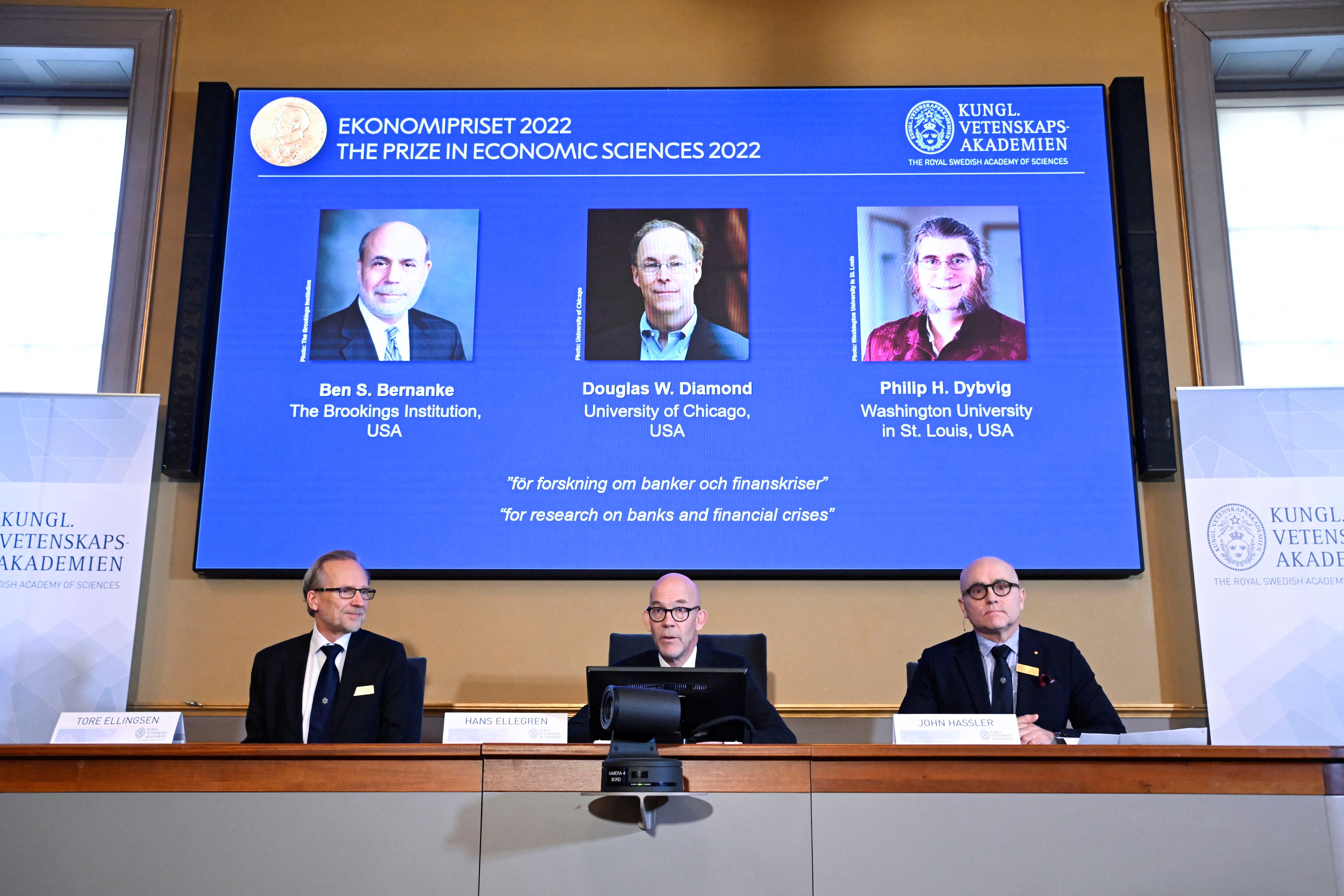
A trio of US economists including Former Federal Reserve chief Ben Bernanke won this year's Nobel Economics Prize on Monday for laying the foundation of how the world now manages global crises like the recent pandemic or the Great Recession of 2008.
The trio, who also include Douglas Diamond and Philip Dybvig, won for their research on how regulating the financial sector and propping up failing banks can stave off an even deeper economic crisis, such as the Great Depression of the 1930s.
"The actions taken by central banks and financial regulators around the world in confronting two recent major crises – the Great Recession and the economic downturn that was generated by the COVID-19 pandemic – were in large part motivated by the laureates' research," the Swedish Academy said in announcing this year's prize winners.
Governments around the world bailed out banks in 2008 and 2009, generating a torrent of criticism as ordinary consumers suffered with many losing their homes even as banks, a key culprit of the crisis, were saved.
But society on the whole benefited, the laureates' research suggests.
"Even though these bailouts have problems, ... they could actually be good for society," Diamond told a news conference with the Swedish Academy, arguing that preventing the collapse of a financial firm like Lehman Brothers would have made the crisis less severe.
Ironically Bernanke was the chair of the US Federal Reserve at the time of Lehman's collapse in 2008, which became one of the main catalysts of the world's biggest financial turmoil since the 1930s.
He argued at the time that there was no legal way to save Lehman so the next best thing was to let the bank fail and use the government's financial resources to prevent wider systemic failures.
BANK RUNS
The trio's main work focused on understanding the role of banks in the economy, particularly during financial crises and how banking failures can amplify and self-perpetuate a crisis.
"An important finding in their research is why avoiding bank collapses is vital," the academy added. "Their analyses have been of great practical importance in regulating financial markets and dealing with financial crises."
The Academy said that Bernanke showed with statistical analysis that bank runs led to bank failures and this was the mechanism that turned a relatively ordinary recession into the depression in the 30s, the world's most dramatic, and, severe crisis.
Bank runs can easily become self-fulfilling leading to the collapse of an institution and putting the entire financial sector at risk.
"These dangerous dynamics can be prevented through the government providing deposit insurance and acting as a lender of last resort to banks," the Academy said.
The trio join such luminaries as Paul Krugman and Milton Friedman, previous winners of the prize.
The majority of previous laureates have been from the United States.
The economics prize is not one of the original five awards created in the 1895 will of industrialist and dynamite inventor Alfred Nobel.
It was established by Sweden's central bank and first awarded in 1969, its full and formal name being the Sveriges Riksbank Prize in Economic Sciences in Memory of Alfred Nobel.
(Except for the headline, this story has not been edited by NDTV staff and is published from a syndicated feed.)

-
Gold Is Rs 22,000 Cheaper Than A Month Ago. Should You Buy Amid The Wedding Season?

Gold's potential slide to $3,500 could save around Rs 4,700 per 10 grams, but a soft inflation print could just as easily push prices back up. One way to split the risk is to buy in parts, some now and the rest after the Fed's Dec. 9 decision.
-
AI Agents Are Gaining Power. Who Governs Them?
Artificial intelligence agents promise to transform productivity by moving machines from assisting decisions to executing them. But as organisations delegate greater authority to these AI-agents, they must first establish who controls that authority and who remains accountable when things go wrong.
-
Why Swapping Your Old Gold Can Trigger A Rs 5 Lakh Tax Bill, And How You Can Avoid It Legally
Swapping old gold for new is taxed as a sale and a fresh purchase. Getting your own gold remade can cut most of that bill, though it has its own costs.
-
The AI Trade is Done. The Real Opportunity for Investors Starts in 2027 | Unhedged Position
As pureplay AI stocks plunge and circular, capex-led financing unwinds, 2027 is set to be a year of reckoning for AI companies. Yet the bust clears the way for a better opportunity for investors in 2027 -- shifting the spotlight from AI builders to the companies using AI.
-
Leadership As Mission: Why The Age Of AI Demands More Human Leadership
Debjani Ghosh examines how AI is changing leadership, arguing that its success must be measured by its impact on people and the accountability of those guiding its use.
-
We May Need Another Tukaram Mundhe To Fight Air Pollution | The Reason Why
Developers may install basic measures such as sprinklers and green nets, resume work, and continue violating rules when this equipment stops working.
-
Extracting Value From Battery Scrap Could Be Challenging For India | The Reason Why
A discarded lithium-ion battery still contains valuable materials such as lithium, nickel and cobalt. These can be recovered and reused. When such batteries are crushed and shredded, they produce a dark powder called black mass.
-
One El Nino, India Can Handle. Two Could Break The Granary
India's grain stocks can absorb one bad year, but a second El Nino could drain the buffer in two to three years, economists say.
-
India's Troika Of Good Luck | Joining The Dots
As Jensen Huang's exit drags Nvidia down, a cooling AI trade and resilient earnings have revived investor interest in India. A likely RBI rate hike looms.
-
Talking Points This Week: Leadership Shock At Nvidia, Earnings Strength, And The Fog Over Hormuz
The Anthropic IPO pricing and first trading day, Nvidia's upcoming earnings, and any fresh signals from Iran will set the tone for the following week.









